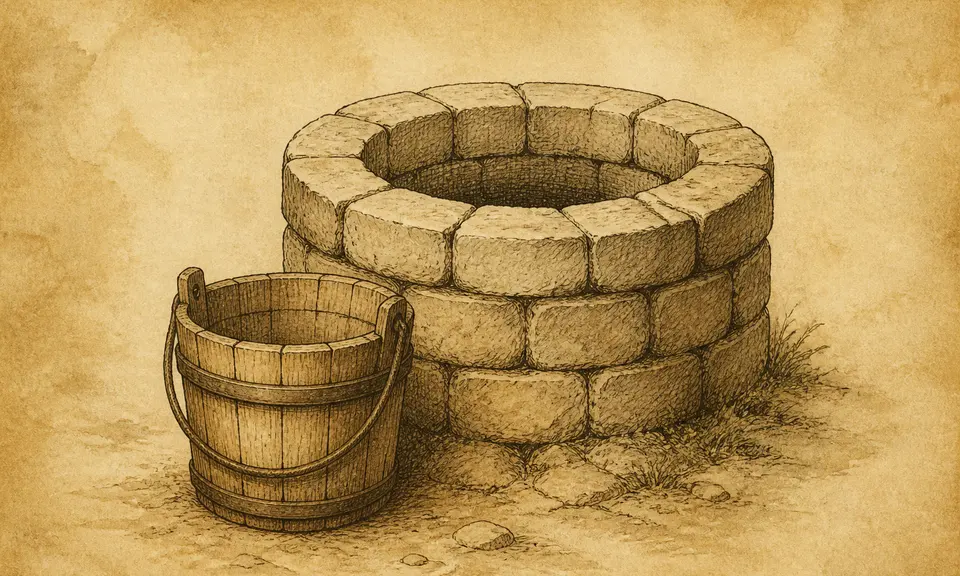
Pail

2 readings from 2 sources.

The image was generated by a model. It is not a period engraving and comes from none of the sources.

Miller reads the pail by what is in it: full of milk it means fair prospects and pleasant company, empty it means famine or bad crops, and a young woman carrying one means housework. an-Nabulsi reads the bucket as a man who draws money out by cunning, and then reads every use of it. Water gathered into a vessel is money got by cunning; water emptied anywhere else is money that will not stay. Water poured on a garden is a woman, and fruit on that garden is a child by her. An old well watered for camels, beasts or people is the noblest kind of kindness, and the dreamer stands where the shepherd stands. Letting the bucket down for himself alone is work for his own world only. And if water comes up in it, every waiting thing comes in with it: the child is a boy, the goods arrive, the sick man recovers, the prisoner goes free.

This paragraph was generated by a model. It sums up the sources above, comes from none of them and is attributed to no one.

Arabic dream book

In a dream it is a man who draws money out by cunning. Whoever sees that he draws water with a bucket from a well and gathers the water into his vessel gathers money he came by through cunning. If he sees that he empties it anywhere but into a vessel, that money will not stay with him, or its uses will go from him. If he watered a garden with it, he gets a woman by it, or gets something from her; and if the garden bore fruit, he gets a child by her, after the manner of the fruit he sees in that garden. If he saw an old well and watered camels or beasts or people from it, he does the best and noblest of kindly deeds, in the measure of his strength and of his earnestness in it, and he stands in the place of the shepherd who pours out water on his flock of camels and sheep. Whoever sees that he lets a bucket down into an old well and waters the animals is making a show in his work, whether for religion or for the world, in the measure of his strength and his effort. Whoever sees that he lets a bucket down for himself alone reaches in his work what serves his own world, in the measure of his strength, because he drew the bucket for his own world only. Whoever sees that he pulls the bucket out of the well and washes himself with it — if he was a prisoner, he is delivered, and he gets money and good fortune. Whoever lets a bucket down into a well and has a wife with child is granted a boy; and if he has no wife with child, he is a seeker of provision: if water came up in the bucket, he gets that provision; and if he has goods on a journey, they come in and reach him; and if he has a sick man, he recovers and is saved; and if he was a prisoner, he is delivered; and otherwise he gets through to a ruler, or to a man of power, in some need of his. Whoever sees that he stood at a well with a bucket in his hand, meaning to draw with it — that is good, and he gets money. And the well may be a woman, for the well is of the feminine; and if the man drawing with the bucket was a seeker of knowledge, the well is his teacher, from whom he gets his learning, and what he gathered of the water is his portion and his share.

Section letter dal

The Perfuming of Mankind in the Interpretation of Dreams

Abd al-Ghani al-Nabulsi

before 1731; first printed Cairo 1858 · Arab-Islamic

carries the ancient tradition after Artemidorus

About this source

An Arabic dream book by the Damascene scholar al-Nabulsi, an alphabetical dictionary of two and a half thousand headwords. It draws on the ancient tradition directly: Artemidorus was translated into Arabic by Hunayn ibn Ishaq in the ninth century. The readings here almost always address the dreamer’s standing, property and faith rather than their feelings.

Rights: public domain

Where the text is from: https://shamela.ws/book/1217

Miller

To dream of full pails of milk, is a sign of fair prospects and pleasant associations. An empty pail is a sign of famine, or bad crops. For a young woman to be carrying a pail, denotes household employment.

Ten Thousand Dreams Interpreted; Or, What's in a Dream

Gustavus Hindman Miller

1901 · American Victorian

carries fragments of the ancient tradition without its system

About this source

An American dream book, the only one here that knows the telephone, the railroad or the elevator. Doctrinally it is the most degraded: it keeps fragments of the ancient tradition without the system that once held them together.

Rights: public domain

Where the text is from: https://www.gutenberg.org/ebooks/926