Ox

2 readings from 2 sources.

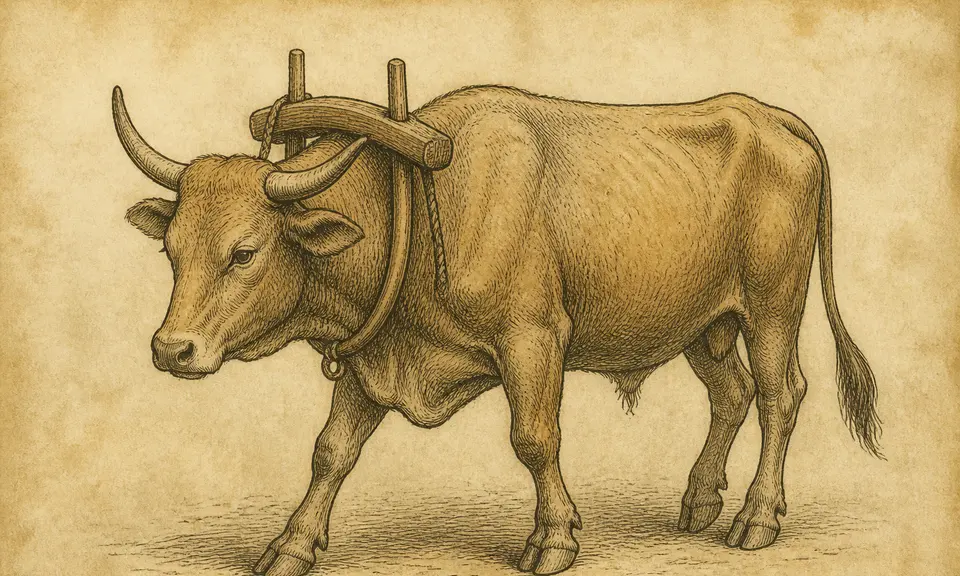
The image was generated by a model. It is not a period engraving and comes from none of the sources.

Artemidorus has one case of the ox and its point is not about the animal. A man dreamed he was riding on a black ox, and the ox was carrying him unwillingly, or doing him some other harm. He happened to be at sea; that very day he came into great danger, and not many days later he met with a shipwreck and was barely saved. The reason he puts elsewhere — how a ship and an ox are alike, he says, he has said in the second book — so the reader gets the outcome and not the reading. Miller reads the animal's condition instead and gets a whole string of signs out of it: a well-fed ox signifies that you will become a leading person in your community and receive much adulation from women; fat oxen in green pastures signify fortune and a rise beyond your expectations, lean ones a dwindling fortune and friends who fall away; oxen well-matched and yoked betoken a happy and wealthy marriage; a dead ox is a sign of bereavement; and oxen drinking from a clear pond or stream mean a long-desired estate, which may come in the form of a lovely and devoted woman. The Greek ox is a ship, and one dream of it is a shipwreck; the American one is livestock, and prosperity is read off its condition.

This paragraph was generated by a model. It sums up the sources above, comes from none of them and is attributed to no one.

Greek dream book

He was riding on a black ox, and the ox was carrying him unwillingly, or doing him some other harm. He happened to be at sea, and on that very day he came into great danger, and not many days later he met with a shipwreck and, when the ship was lost, was barely saved. How a ship and an ox are alike I have said in the second book.

Passage Book V

Ὀνειροκριτικά (Oneirokritika)

Artemidorus of Daldis; edited by Rudolf Hercher

second century; Hercher’s edition 1864 · Greco-Roman

the source of the ancient tradition itself, which the others draw on

About this source

Five books of second-century Greek prose, not an alphabetical dictionary: the readings sit inside argued chapters and the author says of each one why it reads as it does. It is the source the other European and Arabic dream books draw on, including where they do not name it.

Rights: public domain

Where the text is from: https://archive.org/details/bub_gb_CRwTAAAAQAAJ

Miller

To see a well-fed ox, signifies that you will become a leading person in your community, and receive much adulation from women. To see fat oxen in green pastures, signifies fortune, and your rise to positions beyond your expectations. If they are lean, your fortune will dwindle, and your friends will fall away from you. If you see oxen well-matched and yoked, it betokens a happy and wealthy marriage, or that you are already joined to your true mate. To see a dead ox, is a sign of bereavement. If they are drinking from a clear pond, or stream, you will possess some long-desired estate, perhaps it will be in the form of a lovely and devoted woman. If a woman she will win the embraces of her lover. See Cattle.
Ten Thousand Dreams Interpreted; Or, What's in a Dream

Gustavus Hindman Miller

1901 · American Victorian

carries fragments of the ancient tradition without its system

About this source

An American dream book, the only one here that knows the telephone, the railroad or the elevator. Doctrinally it is the most degraded: it keeps fragments of the ancient tradition without the system that once held them together.

Rights: public domain

Where the text is from: https://www.gutenberg.org/ebooks/926