To eat onions and garlic is bad, but to have them is good; and for the sick alone onions turn out otherwise.
Passage Book I, 67
8 readings from 3 sources.
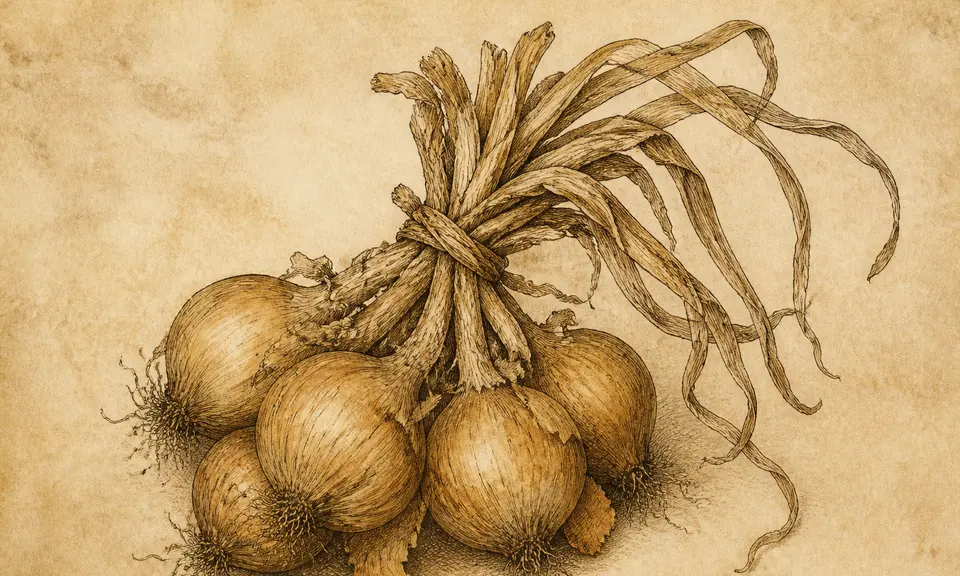
Both books count the onions, and the count runs the opposite way in each. For Miller the quantity is other people: seeing quantities of them represents the amount of spite and envy you will meet by being successful, and cutting them until the juice escapes into your eyes means your rivals defeat you. Eating them is the one act that turns it around, since then you overcome all opposition. an-Nabulsi opens with the flat verdict that it is an indication of evil for whoever ate it, and then reads the onion as illness and as what cannot be kept hidden, for eating the herbs that have a smell points to the appearing of a hidden thing, and a hatred from the people of his own house comes upon him. His quantity runs backwards from Miller's, since much onion is the health of the body, though with grief and separation — and at the end, where the sick man eats, a little points to his death and much to his cure. Miller's dreamer is counting enemies; an-Nabulsi's is counting a dose. Artemidorus counts them too, and his count agrees with the Arabic one down to the sick man's dose: if a sick man dreams that he is eating many of them he will rise from his bed but will mourn somebody else, and if he eats few he will die. And the reason is tears, for those who eat onions weep, and the dying weep too, but the dying weep little while mourners weep much, because they go on weeping a long while.
This paragraph was generated by a model. It sums up the sources above, comes from none of them and is attributed to no one.
To eat onions and garlic is bad, but to have them is good; and for the sick alone onions turn out otherwise.
Passage Book I, 67
But I say this: if a man dreams that he is eating many onions and happens to be sick, he will rise from his bed, but he will mourn someone else; if he eats few, he will die. For the dying weep little, but those who mourn weep much, since they go on weeping a long while.
Passage Book I, 67
These are good when they are seen, but bad when they are eaten.
Passage Book IV
Here is another thing. Many outcomes turn on number, and again on size.
Passage Book IV
On number, as with onions: if a sick man dreams that he is eating them, then if they are many he will get up again, but will mourn somebody else; if they are few, he will die. For those who eat onions weep, and the dying weep too: no one has ever died without tears.
Passage Book IV
But these weep little, so that sometimes it even escapes those nearby, only the eyelids being moistened; while mourners weep much, for they weep for a long time.
Passage Book IV
In a dream it is an indication of evil for whoever ate it. So whoever saw as though he ate onion and he was ill, he dies. And the green of it points to profit with toil. And much of it points to the health of the body together with grief and separation. And when a man sees in his dream as though he eats of the herbs that have a smell, that points to the appearing of a hidden thing, and a hatred from the people of his house comes upon him. And as for what is peeled of them and stripped away, it points to harms, and that is because of what is thrown away of them of the superfluities. And if the sick man eats in his dream a little onion, it points to his death; and if it was much, he is cured of his illness.
Section letter ba
Seeing quantities of onions in your dreams, represents the amount of spite and envy that you will meet, by being successful. If you eat them, you will overcome all opposition. If you see them growing, there will be just enough of rivalry in your affairs, to make things interesting. Cooked onions, denote placidity and small gains in business. To dream that you are cutting onions and feel the escaping juice in your eyes, denotes that you will be defeated by your rivals.