Myrtle

3 readings from 3 sources.

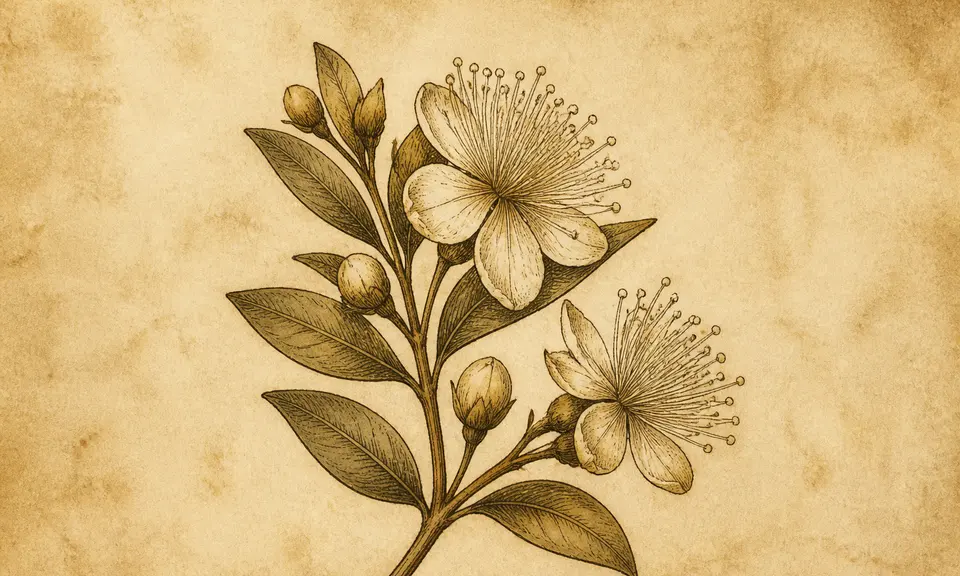
The image was generated by a model. It is not a period engraving and comes from none of the sources.

Miller reads the myrtle as a wedding plant: myrtle in foliage and bloom means desires gratified, a young woman wearing a sprig of it an early marriage with a well-to-do and intelligent man, and withered myrtle happiness missed through careless conduct. Artemidorus reads the myrtle together with the box tree and the oleander, and makes of it a woman of quite another kind: they mean women of the courtesan sort, not at all well behaved; to those setting out on some business they mean deceptions, to the sick recovery and health, and for everyone else they stand as symbols of labour spent in vain. an-Nabulsi reads it as what lasts, and the marriage is in his reading too — a wreath of myrtle on the head means a husband whose staying lasts, or a wife who remains. For a sick man it means health and an even frame; planting it means doing things with management; and it is a lasting building, an office, a relief that lasts, and it may mean money.

This paragraph was generated by a model. It sums up the sources above, comes from none of them and is attributed to no one.

Greek dream book

Box trees and myrtles and oleanders mean women of the courtesan sort, not at all well behaved; and to those who are setting out on some business they mean deceptions, and to the sick recovery and health; for everyone else they stand as symbols of labour spent in vain.

Passage Book II, 25

Ὀνειροκριτικά (Oneirokritika)

Artemidorus of Daldis; edited by Rudolf Hercher

second century; Hercher’s edition 1864 · Greco-Roman

the source of the ancient tradition itself, which the others draw on

About this source

Five books of second-century Greek prose, not an alphabetical dictionary: the readings sit inside argued chapters and the author says of each one why it reads as it does. It is the source the other European and Arabic dream books draw on, including where they do not name it.

Rights: public domain

Where the text is from: https://archive.org/details/bub_gb_CRwTAAAAQAAJ

Arabic dream book

Seeing it in a dream points, for the sick man, to health and an even frame, and to the face covered with hair or the body with clothing; and it may point to the cutting off of despair of what he hopes to get, and it is the myrtle. It is said it is a man who keeps his promises: whoever saw on his head a wreath of myrtle, man or woman, that is a husband whose staying lasts, or a wife who remains — and so with smelling it. Whoever saw it, it is a good that lasts; and if he saw that he was planting myrtle, he does things with management. The myrtle is a lasting building, an office and a relief that lasts; and the myrtle may point to money.

Section letter alif
The Perfuming of Mankind in the Interpretation of Dreams

Abd al-Ghani al-Nabulsi

before 1731; first printed Cairo 1858 · Arab-Islamic

carries the ancient tradition after Artemidorus

About this source

An Arabic dream book by the Damascene scholar al-Nabulsi, an alphabetical dictionary of two and a half thousand headwords. It draws on the ancient tradition directly: Artemidorus was translated into Arabic by Hunayn ibn Ishaq in the ninth century. The readings here almost always address the dreamer’s standing, property and faith rather than their feelings.

Rights: public domain

Where the text is from: https://shamela.ws/book/1217

Miller

To see myrtle in foliage and bloom in your dream, denotes that your desires will be gratified, and pleasures will possess you. For a young woman to dream of wearing a sprig of myrtle, foretells to her an early marriage with a well-to do and intelligent man. To see it withered, denotes that she will miss happiness through careless conduct.

Ten Thousand Dreams Interpreted; Or, What's in a Dream

Gustavus Hindman Miller

1901 · American Victorian

carries fragments of the ancient tradition without its system

About this source

An American dream book, the only one here that knows the telephone, the railroad or the elevator. Doctrinally it is the most degraded: it keeps fragments of the ancient tradition without the system that once held them together.

Rights: public domain

Where the text is from: https://www.gutenberg.org/ebooks/926