Mouth

2 readings from 2 sources.

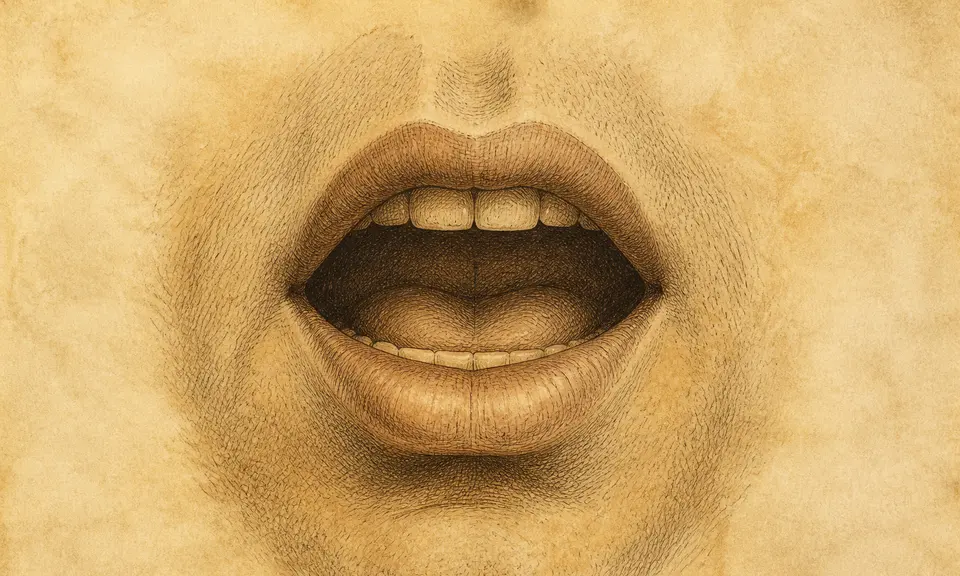
The image was generated by a model. It is not a period engraving and comes from none of the sources.

Both books read the mouth by what passes through it, and they arrive there from opposite directions. Artemidorus's item is not a rule but a case, and the mouth in it is in the wrong place: a man dreamt that he had a mouth in his fundament, with teeth large and fine, that he broke into speech through it and ate through it, and that everything done with the mouth he had there just the same. Through rashness of speech he was driven from his own country — and Artemidorus says outright that he leaves the reasons unsaid, because what happened was fitting and reasonable. an-Nabulsi has no case but a definition: the mouth is the key of its owner's affair and its seal, the vessel of his soundness and of his corruption, the course of his provision and the mainstay of his affair. He then splits that definition by direction: what comes out of the mouth is of the substance of speech, in good and in evil, and what entered it is of the substance of provision. That division is exactly what the Greek case acts out — he spoke and ate through the same mouth, and it was the speech that drove him out, not the food.

This paragraph was generated by a model. It sums up the sources above, comes from none of them and is attributed to no one.

Greek dream book

A man dreamt that he had a mouth in his fundament, and teeth large and fine, and that he broke into speech through it and ate through it, and that everything done with the mouth he had there just the same. Through rashness of speech he was driven from his own country. I leave the reasons unsaid: what happened was fitting and reasonable.

Passage Book V

Ὀνειροκριτικά (Oneirokritika)

Artemidorus of Daldis; edited by Rudolf Hercher

second century; Hercher’s edition 1864 · Greco-Roman

the source of the ancient tradition itself, which the others draw on

About this source

Five books of second-century Greek prose, not an alphabetical dictionary: the readings sit inside argued chapters and the author says of each one why it reads as it does. It is the source the other European and Arabic dream books draw on, including where they do not name it.

Rights: public domain

Where the text is from: https://archive.org/details/bub_gb_CRwTAAAAQAAJ

Arabic dream book

It in a dream is the key of its owner's affair and its seal, and the vessel of his soundness and of his corruption, and the course of his provision and the mainstay of his affair. And what comes out of the mouth is, in the interpretation, of the substance of speech, in good and in evil; and what entered into it is of the substance of provision.

Section letter fa

The Perfuming of Mankind in the Interpretation of Dreams

Abd al-Ghani al-Nabulsi

before 1731; first printed Cairo 1858 · Arab-Islamic

carries the ancient tradition after Artemidorus

About this source

An Arabic dream book by the Damascene scholar al-Nabulsi, an alphabetical dictionary of two and a half thousand headwords. It draws on the ancient tradition directly: Artemidorus was translated into Arabic by Hunayn ibn Ishaq in the ninth century. The readings here almost always address the dreamer’s standing, property and faith rather than their feelings.

Rights: public domain

Where the text is from: https://shamela.ws/book/1217