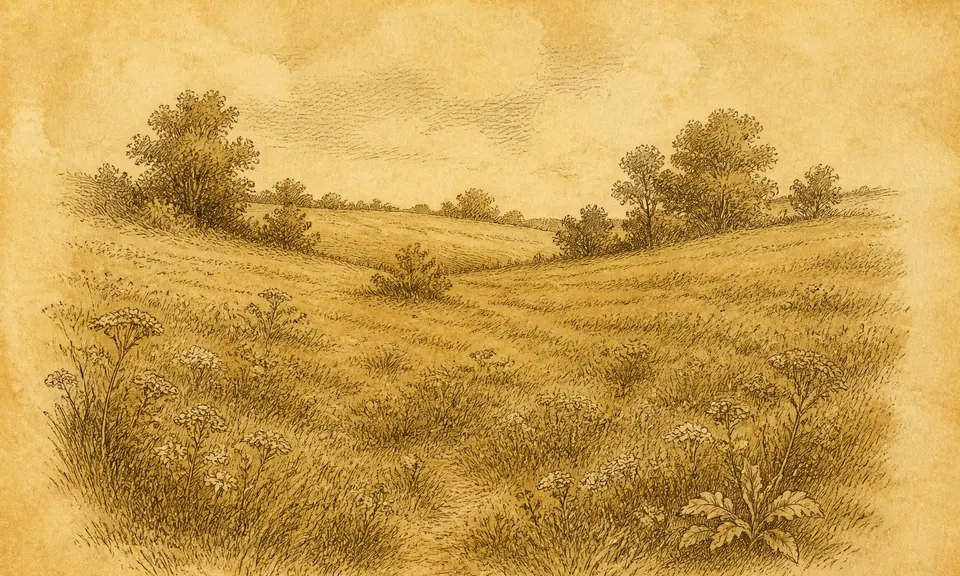
Meadow

3 readings from 2 sources.

The image was generated by a model. It is not a period engraving and comes from none of the sources.

Miller reads the meadow as company: happy reunions under bright promises of future prosperity. an-Nabulsi reads the colour and nothing else — green meadows whose substance the dreamer does not know are Islam and religion, and so is every green thing in the earth. It is the widest reading either book gives a landscape: one makes the field a place where people meet again, the other makes green itself a creed, and both leave the grass out of it. Another Arabic reading opens the meadow out past the colour: a provision without weariness, a wife of little upkeep, a knowledge given from God, an alms that keeps on giving — and then the meadow full of herbage and flowers as the world itself, its ornament and its gilding, and so a place where the world is earned, the treasury and the market. Walking in it is measured against the dreamer: the poor man grows rich, the rich man richer, and the man who had turned from the world returns to it and is taken by it.

This paragraph was generated by a model. It sums up the sources above, comes from none of them and is attributed to no one.

Arabic dream book

Whoever sees green meadows in a dream whose substance he does not know, they are Islam and religion, and so is every green thing in the earth. And whoever saw a meadow is harmed suddenly. And if he saw the dead man in a fair meadow, then he is in the garden. And the meadow points to the world and its adornment, and to the wife of much money and much trousseau. And the unknown meadow, whose adornment is known only by his being present at it, points to Islam. And it may point to every place of excellence and every spot in which God most high is obeyed, such as the grave of the Prophet, God bless him and give him peace, and the circles of remembrance, and the gatherings of good, and the graves of the people of righteousness. And the meadow may point to the Book and to the book of the people of knowledge and wisdom. And perhaps it points to the garden, so whoever went out of it onto salt barren ground and the like went out of the custom into a new-fangled thing, or did a disobedience. And whoever saw himself in a meadow and he eats from it, and it was in the season of the pilgrimage, or he was calling the prayer in it, he goes on pilgrimage. And if the unbeliever saw that, he submits; or the sinner, he repents; and if not, then it is a good deed he does, such as attending a Friday prayer or a funeral over which he prays.

Section letter ra

It is in a dream a provision without weariness, or a wife of little upkeep, or a knowledge given from God, or an alms that keeps on giving. And the meadow known for its kinds of herbage and flowers is the world and its ornament and its moneys and its gilding. And perhaps the meadow points to a place where the world is earned and taken from, such as the treasury and the market. And the meadow points to Islam. Whoever sees that he is in a meadow, or in grass that he gathers or eats — his state is looked at: if he was poor he grows rich, and if he was rich his riches increase; and if he was one who turned from the world and wanted none of it, he returns to it and is taken by it. And if he moved from one meadow to another, he travelled in search of the world, and moved from one market to another and from one trade to another.

Section letter mim

The Perfuming of Mankind in the Interpretation of Dreams

Abd al-Ghani al-Nabulsi

before 1731; first printed Cairo 1858 · Arab-Islamic

carries the ancient tradition after Artemidorus

About this source

An Arabic dream book by the Damascene scholar al-Nabulsi, an alphabetical dictionary of two and a half thousand headwords. It draws on the ancient tradition directly: Artemidorus was translated into Arabic by Hunayn ibn Ishaq in the ninth century. The readings here almost always address the dreamer’s standing, property and faith rather than their feelings.

Rights: public domain

Where the text is from: https://shamela.ws/book/1217

Miller

To dream of meadows, predicts happy reunions under bright promises of future prosperity.

Ten Thousand Dreams Interpreted; Or, What's in a Dream

Gustavus Hindman Miller

1901 · American Victorian

carries fragments of the ancient tradition without its system

About this source

An American dream book, the only one here that knows the telephone, the railroad or the elevator. Doctrinally it is the most degraded: it keeps fragments of the ancient tradition without the system that once held them together.

Rights: public domain

Where the text is from: https://www.gutenberg.org/ebooks/926