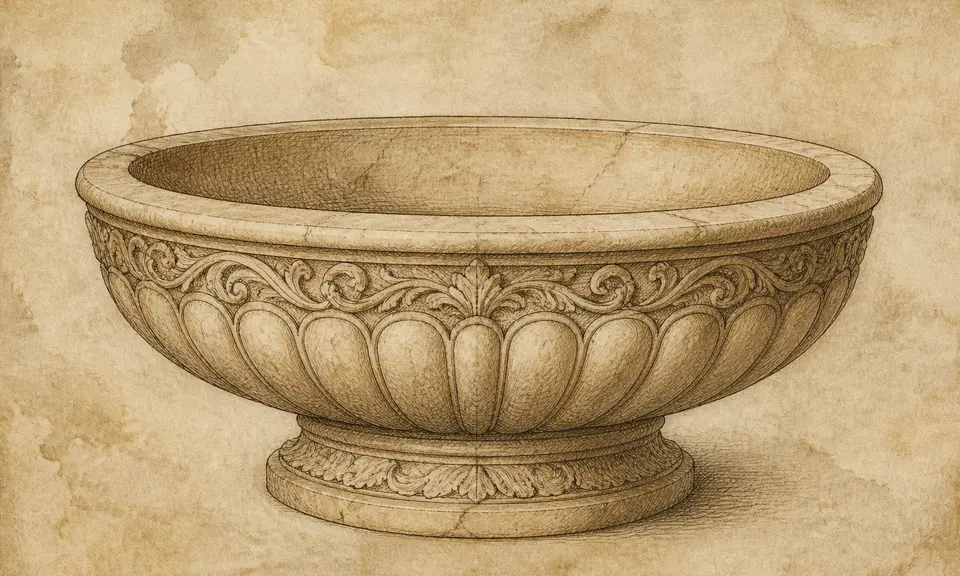
Marble

2 readings from 2 sources.

The image was generated by a model. It is not a period engraving and comes from none of the sources.

Miller reads marble by how it is handled: a marble quarry means a life financially successful but socially void of affection, polishing marble means a pleasant legacy, and seeing it broken means falling into disgrace among one's fellows. an-Nabulsi reads it as rank itself — might, raised standing, money, fair spouses, and for whoever is fit for it knowledge, verse and prose and righteous children — and then names everything that gets made of it: basins and pools, the measures under the jars, the lions with water running from their mouths, the bases, the pillars, the thresholds, and the graves. The graves are the one part he reads toward the next world: carved marble over the dead means a good hereafter and fair praise. And the reading ends on the word, not the stone: marmar read backwards and said twice is what left a man coming back to him.

This paragraph was generated by a model. It sums up the sources above, comes from none of them and is attributed to no one.

Arabic dream book

In a dream it points to might and the raising of rank and money and fair spouses and slaves, men and women. Whoever sees by him in a dream something of that becomes rich after his poverty and marries or takes a concubine or buys slaves and profitable trades; and perhaps he attains knowledge and verse and prose and righteous children, if he is fit for that; and perhaps he attains a noble office according to his measure. As for what is made of marble — the channel wall, the basins, the pools, the measures beneath the jars, the lions from whose mouths the waters come down, the bases, the columns, the thresholds — all of that, for whoever owned it or it came to be his or he disposed of it, is a sign of the going away of cares and troubles, and of joys and gladnesses, and of noble women and fair children and benefits and lofty dwellings and provisions. As for the marble graves and columns and the carved ones, that is a sign of a good hereafter and of fair praise and of lasting blessed times. As for marble set one piece within another, it points to fair writing and to marriage with large dowries — unless he goes too far in the marble, or there comes down into it what does not befit it, for then it points to doubtful things in money and child and spouse. As for the bases of victory, they point to benefits and livelihoods and the spreading of renown. As for the jar of marble or of alabaster, it points to beautiful women and to women of noble office; and perhaps the jar of alabaster or the basin points to what passes over a man while he is heedless of it, of good or of evil, or to the return of what went out from him, from the reverse of its name and its being said twice over: marmar.

Section letter ra

The Perfuming of Mankind in the Interpretation of Dreams

Abd al-Ghani al-Nabulsi

before 1731; first printed Cairo 1858 · Arab-Islamic

carries the ancient tradition after Artemidorus

About this source

An Arabic dream book by the Damascene scholar al-Nabulsi, an alphabetical dictionary of two and a half thousand headwords. It draws on the ancient tradition directly: Artemidorus was translated into Arabic by Hunayn ibn Ishaq in the ninth century. The readings here almost always address the dreamer’s standing, property and faith rather than their feelings.

Rights: public domain

Where the text is from: https://shamela.ws/book/1217

Miller

To dream of a marble quarry, denotes that you life will be a financial success, but that your social surroundings will be devoid of affection. To dream of polishing marble, you will come into a pleasing inheritance. To see it broken, you will fall into disfavor among your associates by defying all moral codes.

Ten Thousand Dreams Interpreted; Or, What's in a Dream

Gustavus Hindman Miller

1901 · American Victorian

carries fragments of the ancient tradition without its system

About this source

An American dream book, the only one here that knows the telephone, the railroad or the elevator. Doctrinally it is the most degraded: it keeps fragments of the ancient tradition without the system that once held them together.

Rights: public domain

Where the text is from: https://www.gutenberg.org/ebooks/926