Knee

7 readings from 3 sources.

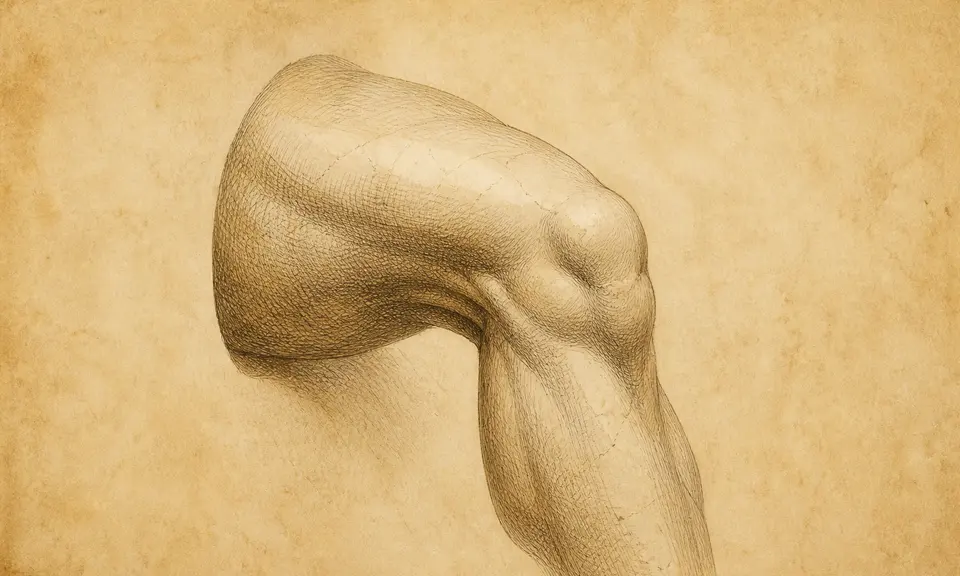
The image was generated by a model. It is not a period engraving and comes from none of the sources.

Miller reads the knee by its looks and calls the dream unlucky whatever it shows: knees too large mean sudden ill luck, stiff and painful ones a swift and fearful calamity, soiled ones sickness from dissipation, and smooth well-formed knees, for a woman, many admirers but none who will marry her. an-Nabulsi reads the joint as the work it carries, since the knee is a man's toil in his livelihood, its skin strong means that livelihood is strong, and its skin flayed means toil and weariness. From there he reads it as movement itself — journeys, works, taking and giving, stillness and staying — so that a broken or unjointed knee stops the movement: the journey is sat out, the money cannot be used, an affection is severed. Artemidorus reads the knees as strength and manly vigour, and as movements and actions, for sound and whole they allow travel abroad and any other movement and suggest activity and health, and if anything happens to them, the opposite. They reach to brothers and to partners, since the knees too are brothers of one another and share in the walking. And whatever plant a man dreams has grown out of his knees, he will have idle knees to use, which he proves from a case: a man dreamed that he saw a reed grown out of his right knee, and a fistula formed in that knee, for the reed too has knees, and a pipe is made of it.

This paragraph was generated by a model. It sums up the sources above, comes from none of them and is attributed to no one.

Greek dream book

The knees are to be taken as standing for strength and manly vigour, and for movements and actions. Hence when they are sound and whole they allow travel abroad and the making of any other movement, and they suggest activity and health for the dreamer; but if anything happens to them, the opposite.

Passage Book I, 47

Whatever plant a man dreams has grown out of his knees, he will have idle knees to use.

Passage Book I, 47

I know a man who dreamed that he saw a reed grown out of his right knee. It came about that a fistula formed in that knee: for the reed too has knees, and a pipe is made of it.

Passage Book I, 47

Often the knees reach to brothers and to partners, since they too are brothers of one another and share in the walking.

Passage Book I, 47

They mean freedmen as well: for they serve equally with the feet, except that, being above the feet, they reasonably mean not slaves but freedmen.

Passage Book I, 47

Ὀνειροκριτικά (Oneirokritika)

Artemidorus of Daldis; edited by Rudolf Hercher

second century; Hercher’s edition 1864 · Greco-Roman

the source of the ancient tradition itself, which the others draw on

About this source

Five books of second-century Greek prose, not an alphabetical dictionary: the readings sit inside argued chapters and the author says of each one why it reads as it does. It is the source the other European and Arabic dream books draw on, including where they do not name it.

Rights: public domain

Where the text is from: https://archive.org/details/bub_gb_CRwTAAAAQAAJ

Arabic dream book

In a dream it is the man's toil and his labour in his livelihood and in what he seeks. If he sees that its skin is strong, that is the strength of his livelihood; and if he sees its skin flayed off, toil and weariness in his livelihood reach him; and if he sees its skin thick and with swelling and scab in it, he attains money from the toil of his livelihood, and money he had gathered by toil and weariness goes from him. The two knees are the strength of the body and its movement and the goodness of its work: if they were sound and strong, that is a sign of a journey or of some other movement, and of works he does, and of the health of the body; and if pain or ailment was seen in them, that points to the heaviness of the knees in works, and if he was sick, it points to his death. The knee, for the traveller, is his mount and his stirrup and his beast, so whatever happened in it, refer it to what we have said. The two knees are read as brothers and partners, and they may be read as patrons, and the two legs serve them. And out of the knee the distress may be split, just as the taking is out of the thigh. And perhaps the knee points to the completing of the bowing and the prostration; and it points to a man's taking and his giving and his movement and his stillness and his journey and his staying, and to what he gathers of money and what he spends, and to companionship and familiarity and love. Whoever sees that his knee has grown large, or its bone has grown strong, or its state has become fair — if he was in distress, God relieves him of it; and perhaps that points to his keeping to the prayer and to his fulfilling of its conditions. And if he sees it unjointed or broken, or that a sore or flowing blood came to be in it, it points to his movement being stopped or his stillness being stirred up; and if he intended a journey, he sits back from it; and perhaps the benefit of his money becomes impossible for him; and if there was affection between him and somebody, it is severed; and perhaps it points to the mount and the beast being put out of use.

Section letter ra
The Perfuming of Mankind in the Interpretation of Dreams

Abd al-Ghani al-Nabulsi

before 1731; first printed Cairo 1858 · Arab-Islamic

carries the ancient tradition after Artemidorus

About this source

An Arabic dream book by the Damascene scholar al-Nabulsi, an alphabetical dictionary of two and a half thousand headwords. It draws on the ancient tradition directly: Artemidorus was translated into Arabic by Hunayn ibn Ishaq in the ninth century. The readings here almost always address the dreamer’s standing, property and faith rather than their feelings.

Rights: public domain

Where the text is from: https://shamela.ws/book/1217

Miller

To dream that your knees are too large, denotes sudden ill luck for you. If they are stiff and pain you, swift and fearful calamity awaits you. For a woman to dream that she has well-formed and smooth knees, predicts she will have many admirers, but none to woo her in wedlock. If they are soiled, sickness from dissipation is portended. If they are unshapely, unhappy changes in her fortune will displace ardent hopes. To dream of knees is an unfortunate omen.

Ten Thousand Dreams Interpreted; Or, What's in a Dream

Gustavus Hindman Miller

1901 · American Victorian

carries fragments of the ancient tradition without its system

About this source

An American dream book, the only one here that knows the telephone, the railroad or the elevator. Doctrinally it is the most degraded: it keeps fragments of the ancient tradition without the system that once held them together.

Rights: public domain

Where the text is from: https://www.gutenberg.org/ebooks/926