A king and a temple and a soldier and a king's letter and silver and all things like these are signified by one another.
Passage Book IV
5 readings from 3 sources.
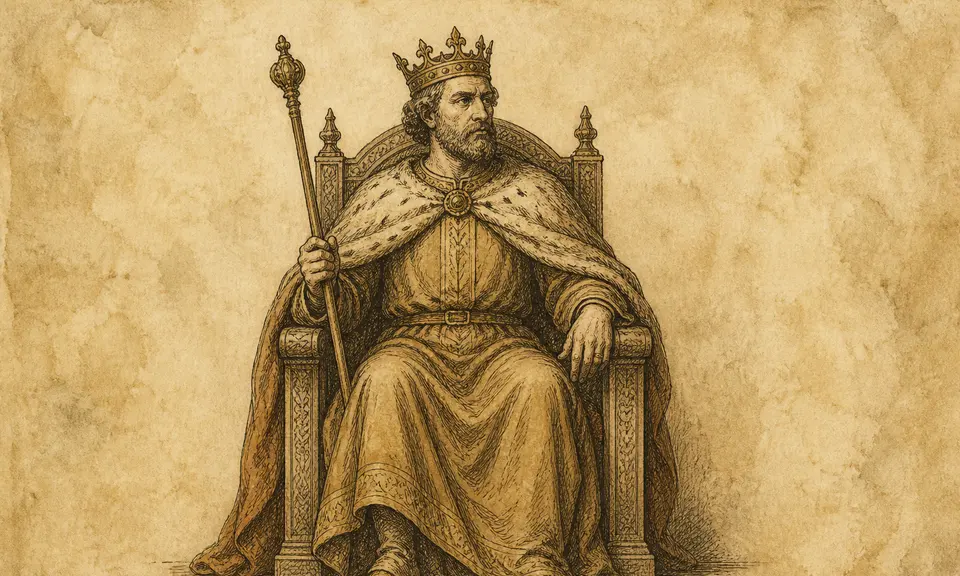
Miller needs five lines: a king means you are struggling with all your might and ambition is your master, being crowned means rising above your fellows, being censured a reproof for a neglected duty, and a young woman in his presence will marry a man she fears. an-Nabulsi needs the longest reading in his whole book, and opens it with the one sentence Miller could never write: the sultan in a dream is God. From there it never settles. Seeing him pleased is God’s pleasure, seeing him scowl that the dreamer has spoiled something in his own prayer. Becoming a king is death for a sick man, freedom for a slave, irons for a cheat, and the end of a whole family for a sound man. Then it turns into a court: his table, his quilt, his door, his brocade. The subjects throw things at the sultan and each thing is a kind of speech — silver is fair words, stones hard ones, arrows curses all night long. And at the end his own body is read piece by piece, a ram’s head for justice and a dog’s head for baseness, until the last line: fingers added to his hand mean greed added to the man. Artemidorus has three lines, each taking the king as a thing, not a man: a king and a temple and a soldier and a king’s letter and silver all signify one another; what the king gives out of his mouth benefits the receiver by a verdict; and Stratonicus, who thought he was kicking the emperor, went out and found a gold coin he had trodden on, since it made no difference whether he kicked the emperor or his image.
This paragraph was generated by a model. It sums up the sources above, comes from none of them and is attributed to no one.
A king and a temple and a soldier and a king's letter and silver and all things like these are signified by one another.
Passage Book IV
Stratonicus thought he was kicking the emperor. Going out, he found a gold coin which he happened to have trodden on; for it made no difference whether he kicked or trod on the emperor or his image.
Passage Book IV
Whatever the king gives out of his mouth will benefit the receiver by a verdict.
Passage Book IV
He is God in a dream, and seeing him pleased points to the pleasure of God, just as his wrath gives warning of God's wrath. Whoever sees him scowling for no cause — the dreamer has brought something new into his prayer or into his obedience, or there is a spoiling in his religion, in the measure of the scowl. And if he sees him glad, he gets good in his religion and in his world, and a raising and plenty and a sound state, in the measure of his safety with him. And if he sees that God made him a ruler in the earth, he attains a rule, if he is fit for office; and if he is not, then a strife falls there in which the shedder of blood perishes and the people of knowledge and of the fear of God live. And if he sees that he became a caliph or an imam, he gets honour and nobility, and he gets the caliphate or the imamate if he is fit for it — but his children will not inherit it, if they are wrongdoers. And if he sees that he was turned into a caliph, there is no good in it unless he is fit for it; otherwise humiliation reaches him and his affair falls apart, until those around him and his servants rise above him, and his enemies gloat over him, and calamities strike him. And if he sees that he killed the caliph, he seeks a great matter and wins it. Whoever sees that he was turned into one of the greatest kings and sultans gets a newness in religion together with a spoiling of religion. Whoever sees that he was turned into a king and is not fit for it dies quickly; and if he was able to carry it, he gets headship and a state and rule and strength. Whoever sees that he became a king while he was ill in waking — his dream points to his death; and if he was sound of body, it was the perishing of all his kin and his parting from them; and if he was a man of cunning and debauchery, his dream points to his captivity and to his being put in irons. And this dream also points to hidden things coming out. And a slave who sees that he is a king — it points to his being set free. And if a philosopher or a soothsayer sees that he became a king, that is praised for him and is a sign of good, so long as in that state of his he needed nobody else and was not deficient in it. And if he sees in his dream that he is the head of a company, or the head of a house, or a trustee, it points to cares and griefs that will be his in his living, and to loss — and above all in illness and in soothsaying. And all headships, when a woman sees them, point to her death; just as with every headship and rank that does not fall to men but suits a woman by custom, a man who sees that he came into it is seeing his own death. Whoever sees that he became a sultan in people's eyes grows great in people's eyes and reaches what he wants. Whoever sees that he is Khosrow comes into a great kingdom and much money. Whoever sees that the sultan reproved him with words of righteousness and wisdom — that is soundness between the two of them; and if he disputed with a just sultan in words of righteousness and wisdom, it is the winning of his need from him. And if he walked along with the sultan, he runs whatever his hand owns the way the sultan runs it and goes about in it after his manner; and if he rubbed against him on the way, he disobeys him and sends his order back to him. And if he sees that he rides pillion behind the sultan on a beast, he works at his side and follows him, or succeeds him in his affair, in his lifetime or after his death. And if he ate with the sultan, he gets nobility and meets with a victory in the measure of what he ate, and war and an open breach in the measure of the amount of the food. And if he entered the sultan's house, he takes charge of the affairs of his women, and the world is widened for him in the measure of his entering into the sultan's house; and if he entered it bowing low, he gets headship and a pardon. And if he sees that he went in upon the sultan's womenfolk, or lay with them, then if there were signs of good there pointing to righteousness and wisdom, he will have a closeness with him or a place among his intimates; and if there were not, he slanders his womenfolk or goes into what is not lawful for him among them. And if he went back and forth to his door, he wins over his enemies and they are not able to harm him. And if he gave him something of the goods of this world, he gets glory and pride in the measure of that gift and of its substance; and if he gave him brocade, he gives him a fair slave girl, or marries him to a woman attached to a sultan. And if he sees the door of the king's house moved, then one of the king's officials is moved out of his rule, or the king marries another wife. And if a man sees that the sultan gave him office as his deputy in the farthest edges of the frontiers of the Muslims, it is honour and nobility and a name, in the measure of the distance of that edge from the sultan's place and from his city and from the cities of the Muslims. And if he sees that he spoke with him, he gets nobility and a raising, and perhaps he speaks with him in waking, if he is fit for it; and if not, he gets fame and bounty. And if he was a prisoner, he is released; or poor, he grows rich; and if he was a merchant, his trade is made great; and if he was in a quarrel, he prospers in it. And if a governor sees that his commission came to him, that is his removal from office at once; and so it is if he looked in a mirror, that is his removal — and he does not delay, if he sees another like himself in his place, unless he was awaiting a child, and then he gets a boy. And so too if he saw that he divorced his wife: he is removed. And if he sees himself asleep with the sultan under one quilt with no screen between them, and the sultan got up while he stayed asleep, he mixes with the sultan in a way that is held against him, and the sultan's money comes to him in his life or at his death. And if he got up from the bed before the sultan, he escapes what he had risked in himself by sleeping with the sultan, and he gets good after that. And if he sees that he is asleep on the sultan's bed and the bed was one he knew, he gets from the sultan — or through the tress of a wife or a slave girl — money that he will spend on a wife or a slave girl, in the measure of that bed; and if it was a bed he did not know, the sultan shares his rule and his office with him and gives him land to govern in the measure of the width of that bed and of its state. And if he sees that the sultan walks on foot, he keeps a secret and shows himself above his enemy. And if the sultan sees that his subjects praised him, his name and his good report spread and his kindness shows and he wins over his enemy. And if the sultan sees that his subjects scatter gold coins over him, they will make him hear something he dislikes; and if they scattered silver coins over him, they will make him hear fair words; and if they scattered sugar over him, they will make him hear gentle words; and if they threw stones at him, they will make him hear words with hardness in them. And if they shot arrows at him, he is tyrannical over them and they call down curses on him all night long; and if an arrow struck him, he gets a punishment. And if he overpowered them as to their sheep and their necks, he overpowers their noblemen. And if he threw them into the fire, he is calling them to unbelief and to innovations. And if the sultan sees that he has two horns, he gets the kingdom of the east and the west, by the story of the man of the two horns, and he will be just and fair and an opener of lands. And if the sultan sees that he rode an obedient eagle, he gets the kingdom of the east and the west and is then forsaken, by the story of Nimrod. And if the sultan sees that people prostrate themselves to him, they are humbling themselves before him; and if he sees that they pray over him, they are praising him for good. And if the sultan sees that he acts on his wife's opinion, his kingdom goes, or he falls into a great grief, or he is shut up; and if he went against her, he escapes a great grief and comes into money — and otherwise he stands on the edge of ruin. And if the sultan sees that he fought a king and threw him down, the one thrown is the winner. And if he fought a lion and threw it down, he overpowers a king who is tyrannous and murderous. And if the sultan sees that he rode a horse with weapons upon him and a shield that guards him. And if he sees that he is going along his road and a common man came up to him and whispered in his ear, he dies suddenly. And if a king sees a servant giving him drink and food without his seeing it done, he gets a kingdom in which he has nobody to oversee him, with no enemy and no rival. And if a boy fed him, his enemies hold back from him and bow to him and he sees no evil from them. And if a slave girl fed him, he gets a kingdom with gladness and comfort, if the food was rich, and that comes with riches and a long life. And if the sultan sees that a boy fed him a morsel, he gets a misfortune from his enemy; and if he swallowed it, he escapes his enemy's scheming; and if he choked on the bitter morsel, he dies. And if all of that is seen by a chief or a merchant or a man of learning, they get a headship and a trade and a learning in which nobody will cross them. And if the king sees that he lays out a table and adorns it, a wrongdoing people will oppose him and he will take counsel with them and win over them. And if he sees that he set food on the table, a messenger comes to him about a dispute: if the food was sweet, it is gladness; and if it was rich, the dispute will last. And if he took away the sweet and brought the sour and the rich, it is good and firmness; and if it was without richness, there will be no firmness in it. And if the taking away of the food and the setting down of it went on long, that dispute will go on long. And eating at the table of a just sultan is nobility and good in religion and in the world, and a grief in the path of God. And if the sultan sees that he moved out of his rule of his own accord, he does something he will regret; and if his moving was by another's hand, it is weakness and contempt in his affair at another's hand. And if he sees that he is a sultan while he walks in the markets with other men, all of that is humility and it makes his rule stronger; and if it was for anything other than that, he is putting himself among his subjects in a place that is obscure in rank and in weight. And if the sultan sees his appearance to be the appearance of common market folk, that does him no harm but rather increases his good, if by it he seeks God's pleasure and the humbling of himself before him. And if he sees that the sultan prays without having washed, or in a place where prayer is not allowed, such as a dunghill or a graveyard, he is seeking a matter that has already passed by; and if it was an office, it has no soldiery. And if he sees that he is ill, it is the sickness of his religion and his tyranny over his subjects — and the health of his body in that year. And if he sees that he died and saw nothing of the look of death, then in that year a part of his rule is taken from him, or a part of his house falls down, or a care reaches him in which he is bewildered and struck dumb. And if he sees that the sultan was carried on the necks of men, it is a spoiling in his religion and a strength of his rule, and his riding on the necks of men is against his justice and the mildness of his side. And if he sees that the sultan died and was not buried, it is a spoiling of religion for him and for the common people — and their religion may yet be hoped to be set right and they may yet turn back, so long as he is not buried and the earth not levelled over him; and if he died and was buried and the earth was levelled over him and the people went away from him, it is despair of that matter, unless God wills otherwise. And every dream seen of a dead king being alive is read as the successor of that dead king, and the life of his way among his subjects in the days of his life, and of his household and his people, after the manner in which they were reckoned in the days of his kingship. And if the sultan sees that his forepart is higher than what he stands in, his rule rises and climbs; and if he sees that his seat is lower than what he was in, his rule sinks and his affairs are spoiled. Whoever sees the just sultan enter a quarter or a place — the mercy of God covers that place and justice comes down upon it. And if a proud king sees that he entered a house or a quarter or a land where his entering would be objected to in waking, it is a calamity pointing to the people of that place, in the measure of that sultan; and if his entering there would not be objected to, his entering does not harm the people of that place. Whoever sees that he goes to and fro at the doors of kings gets a victory through giving and reaches what he wishes. And if he sees that he went in to a king, he gets nobility and a state and gladness and money. And if he sees that he passes by his sultan, he gets honour and dignity. And if he sees that he carried food to a sultan, or to a noble man, a distress meets him and then he escapes it and gets money from where he did not reckon. Whoever sees that he quarrelled with a king gets a delight of the eye and gladness, and much good runs through his hands. And seeing dead kings points to what they left behind, or laid down and fixed after them; and seeing the living of them in a town or in a particular place is a sign of conditions being spoiled and of lowliness among the people. And seeing the king points to victory over enemies and to debauchery; and seeing him points to the lion, as seeing the commander points to the wolf, and the merchant to the fox, and the broker to the dog, and the believer to the sheep — he said, peace be upon him: what a sheep that is, between a lion and a fox and a dog. And seeing a sultan one does not know points to fire and to the sea and to the sleep that overpowers a man. And if he says, I saw the sultan in a dream, it was a sign of his having power over those beneath him, or of power being had over him in some matter by a man of power; then he is the child and the mother and the teacher and the tutor — and the wife is a sultan to her own rule, and her will usually overpowers the man's will. So whoever sees the king in a fair condition — it was a sign of the good state of his subjects and of their safety and of their livings flowing; and if he saw him in a poor condition, it was a sign of his bad management of the subjects and of the enemy overcoming his lands and of the weakness of his army. And the king one does not know, or the judge, or the tutor, may point to the Truth, be he glorified; and perhaps seeing the king points to the coin struck from his silver or his gold. And if the king in a dream came to have an army such as the Prophet had in the year of the opening, or on the day of Hunayn, he is upheld and given victory and helped. Whoever sees a commander or a sultan in a dream may come to have power over people's honour, or may practise alchemy or strike false coin; and so too if he became a judge, he forges the judges' own hands upon documents; and perhaps he was inventing lies. And if he sees that he became a king, his worth rises as far as suits him: if he was poor, he grows rich; if he was a man of learning, he carried out by it what was due; if he was unmarried, he marries; if he was a man of a craft, people point to him for his knowledge of it; and if he was of the common people, his evil and his wrongdoing get power over people. And if the sultan died, the seer's state weakens and people think little of him, or he is parted from the man through whom he had power over people; and perhaps he draws his hand back from the oath of allegiance and betrays his sultan. Whoever sees that he embraces the sultan or shakes his hand, and there were words of righteousness between them, his state is set right with him, or with another of the men of his rule. Whoever sees that he quarrels with a sultan argues with the Qur'an and disputes by it, because the sultan, in the language, is the proof. And if he sees that he eats food with the sultan, a grief reaches him from his side in the measure of the food, by way of the fire that touched it. Whoever sees the sultan come to his dwelling will need his help and will be safe on his side and will be one of his intimates. Whoever sees that the sultan took him on a suspicion and set somebody over him to hold him until there was got from him what is got from a suspected man — his need is granted; and if he slipped away from him before that and was safe on his side, his need escaped him, and he will not get that need for a long time, though he gets it in the end. And if a sick man sees that a sultan he does not know sent for him, or a judge sent his helpers for him, they are the messengers of the angel of death — and God is the sultan and he is the judge between his servants. Whoever sees that the sultan took his cap — he takes his money; and if he was an official, he dismisses him. And if he sees that the sultan is in his death throes, he is in distress or on the edge of dismissal, and it falls upon him. Whoever sees that the sultan is mad is a man in care within a rule. Whoever sees that the sultan stepped aside from his seat, or that it was taken from him, or that he was overcome, or that part of his rule or his robe or something of what he wore was pulled off him there — that is the lessening of his rule or its going, and there is no good in it, unless he sees that he was moved to something better than what he was in, and then his moving is of that kind. Whoever sees that a sultan went out of his house as one who parts and does not mean to come back — it is his going out of his rule in any case. Whoever sees that the sultan's pulpit broke under him, or that he fell from it, or that he prayed with his subjects and did not complete the prayer, or that his head was shaved and his cloak pulled off him, or his sword taken from his neck, or that his house was pulled down, or that a net or the like was set for him and he fell into it, or that a bull gored him, or a beast trod on him, or people trod on him — all of that is his dismissal from his rule, and there is no good in it. Whoever sees that the sultan's head is great, or his neck thick, is in an increase of strength in his rule and his headship and an increase in his money and his kingdom; and if he sees a shortfall in either of them, or a weakening of strength, it is a shortfall in his rule and a weakening of his strength. Black clothes for the sultan are an increase of strength, and white are splendour and a coming out of a sin; cotton clothes are the showing of his piety and his humility and the fewness of his enemies and the gaining of safety as long as he lives; woollen clothes are much blessing in his kingdom and the showing of fairness; and clothes of brocade are the showing of the deeds of the pharaohs and an ugly way of life. And the sultan's or the commander's laying aside of his cap or his robe or his belt is a weakness in his rule; and his wearing a boot of iron is his winning the money of the people of idolatry and of the protected peoples; and his flying with his wing is strength for him, and his taking a people captive, and his getting money from where he did not reckon, and the opening of lands, and victory over his enemies. And if he sees the sultan following the Prophet, he treads in his track in his custom. And if he sees that he was dismissed and a young man was given his office in his place, something he dislikes reaches him in his office from some of his enemies. And as for thieves and deceivers: whoever of them sees that he became a sultan is put in irons and shut up and his state becomes known; and likewise the spy, if he sees that he became a sultan, the state he was hiding comes out. And a woman, if she sees that she is a sultan or a caliph, is disgraced; and if she was ill, she dies. Whoever sees a just sultan living in a town — justice spreads through that town; and likewise, if he sees a tyrannous sultan living in a place, wrongdoing comes down on that place. Whoever sees a sultan enter a village — wrongdoing and spoiling come down upon it. Whoever sees a bone in a sultan's head — it is headship and strength in his rule. And if he sees blindness in the sultan's eye, the news of his people is blinded to him. And if he sees his tongue grown long and thick, he has complete weapons and killing swords, and it gives notice that he will get money and benefit at the hand of an interpreter who speaks for him out of his tongue. And if he sees that the sultan's head is a ram's head, he begins in justice and fairness and gentleness; and if he sees his head a dog's head, he begins his dealings with foolishness and baseness. And if he sees a width in his cheek beyond measure, it is an increase of his honour and his splendour. And if he sees a thickness in his neck, it is his strength in his justice and his fairness and his routing of his enemies. And if he sees his breast turned to stone, he will be hard of heart. And if he sees fatness and strength in his body, it is the strength of his religion and his Islam and his world. And if he sees that his hand turned into a sultan's hand, he gets a rule, and there runs at his hand the like of what ran at that sultan's hand, of justice or of wrong. And if he sees that his body is a dog's body, he acts with foolishness and baseness; and if he sees that his body is a snake's body, he shows what he hides of enmity; and if he sees that his body is a ram's body, generosity and fairness show from him; and if he had a tail like a ram's tail and was licking it with his tongue, he has a child well provided for, off whom he lives. And if he sees that his belly turned to brass, he will be of much benefit. And if he sees a bone in his belly, it is an increase in his money and his children and his household. And if he sees his hands with strength and length in them, his helpers are men of strength and force; and if he sees a bone in them, it is an increase of his money. And if he sees his legs longer than they were, it is an increase of his life and the length of his remaining. And if he sees that they turned to marble, he will be long in living, splendid and glad. And if he sees that his thighs turned to copper, his kin will be bold in disobedience. And if he sees that his legs turned to lead, he will be a man of much money wherever he comes. And whoever sees a sultan flying with wing and feather — he will be a strong and lofty sultan. And if he sees his fingers added to, he increases in greed and in wrong and in the fewness of his fairness.
Section letter sin
To dream of a king, you are struggling with your might, and ambition is your master. To dream that you are crowned king, you will rise above your comrades and co-workers. If you are censured by a king, you will be reproved for a neglected duty. For a young woman to be in the presence of a king, she will marry a man whom she will fear. To receive favors from a king, she will rise to exalted positions and be congenially wedded.