Ice

2 readings from 2 sources.

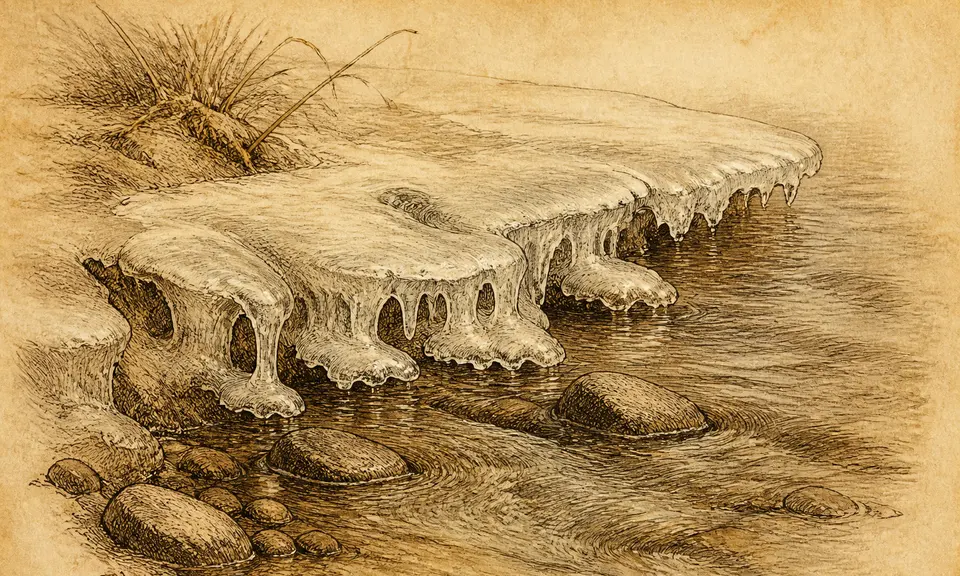
The image was generated by a model. It is not a period engraving and comes from none of the sources.

an-Nabulsi contradicts himself inside one reading, and does it in the open. Ice seen in its season points to the going away of cares and griefs and to the subduing of enemies and enviers — and then, flatly, there is no good in ice, argued from the substance itself: its turning to stone, the abundance of its dryness. Out of season it freezes the water and destroys the trees and blocks the doors, which is the undoing of livelihood and the halting of journeys; ice that comes down upon the dreamer, or that he falls into, is an affliction in which he must steel himself, and that may be a flogging from the ruler. One exception survives, and it is a material one: water drawn and put in a vessel that freezes in its place is silent wealth that congeals and remains, and the icehouse is the treasury of the king. Miller argues from nothing; he counts positions. Ice floating in a stream of clear water means happiness interrupted by ill-tempered and jealous friends, walking on ice means solid comfort and respect risked for evanescent joys, and for a young woman on the ice only a thin veil hides her from shame. Even his icicles are sorted by where they hang — on the eaves misery and want of comfort, on the fence bodily and mental suffering, on trees hopes grown gloomier. And where an-Nabulsi stores ice, Miller swallows it: eating ice foretells sickness, and to make ice is to make a failure of one's life through egotism.

This paragraph was generated by a model. It sums up the sources above, comes from none of them and is attributed to no one.

Arabic dream book

It is in a dream, if it is seen in its season, a pointer to the going away of cares and griefs and to the subduing of enemies and enviers. And if the water froze and destroyed the trees and the doors were blocked, it points to the undoing of livelihood and to the halting of journeys. And perhaps the ice points to the hardy one among men and to flogging by beating. And there is no good in ice, because of its turning to stone and the abundance of its dryness and what is derived from its name. So whoever it came down upon, or who fell into it, an affliction came down upon him in which he must steel himself; and that may be a flogging from the ruler or from another. And the frozen thing is care and torment, unless a person sees that he drew water and put it in a vessel and it froze in its place, for that is silent wealth that congeals and remains. And the icehouse is the treasury of the king.

Section letter jim

The Perfuming of Mankind in the Interpretation of Dreams

Abd al-Ghani al-Nabulsi

before 1731; first printed Cairo 1858 · Arab-Islamic

carries the ancient tradition after Artemidorus

About this source

An Arabic dream book by the Damascene scholar al-Nabulsi, an alphabetical dictionary of two and a half thousand headwords. It draws on the ancient tradition directly: Artemidorus was translated into Arabic by Hunayn ibn Ishaq in the ninth century. The readings here almost always address the dreamer’s standing, property and faith rather than their feelings.

Rights: public domain

Where the text is from: https://shamela.ws/book/1217

Miller

To dream of ice, betokens much distress, and evil-minded persons will seek to injure you in your best work. To see ice floating in a stream of clear water, denotes that your happiness will be interrupted by ill-tempered and jealous friends. To dream that you walk on ice, you risk much solid comfort and respect for evanescent joys. For a young woman to walk on ice, is a warning that only a thin veil hides her from shame. To see icicles on the eaves of houses, denotes misery and want of comfort. Ill health is foreboded. To see icicles on the fence, denotes suffering bodily and mentally. To see them on trees, despondent hopes will grow gloomier. To see them on evergreens, a bright future will be overcast with the shadow of doubtful honors. To dream that you make ice, you will make a failure of your life through egotism and selfishness. Eating ice, foretells sickness. If you drink ice-water, you will bring ill health from dissipation. Bathing in ice-water, anticipated pleasures will be interrupted with an unforeseen event.

Ten Thousand Dreams Interpreted; Or, What's in a Dream

Gustavus Hindman Miller

1901 · American Victorian

carries fragments of the ancient tradition without its system

About this source

An American dream book, the only one here that knows the telephone, the railroad or the elevator. Doctrinally it is the most degraded: it keeps fragments of the ancient tradition without the system that once held them together.

Rights: public domain

Where the text is from: https://www.gutenberg.org/ebooks/926