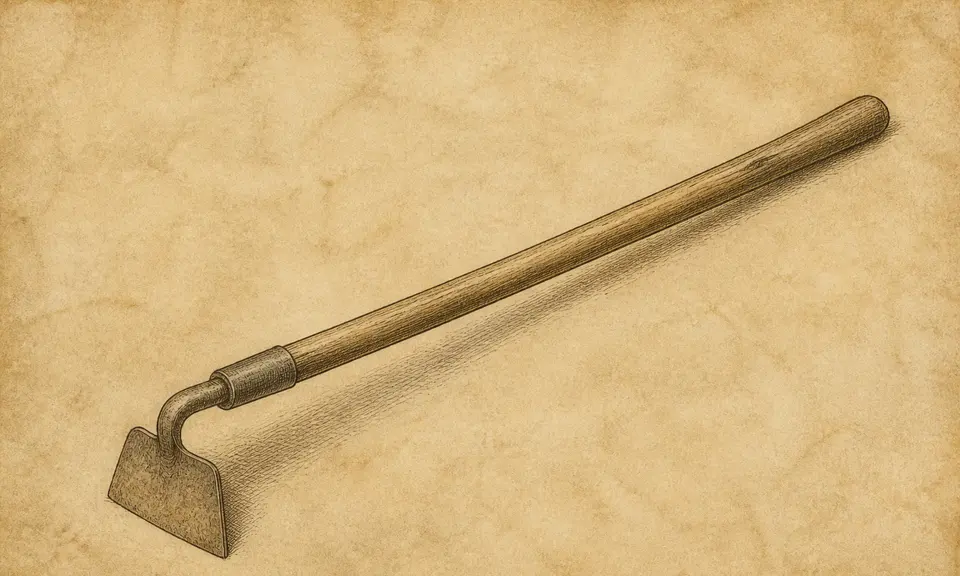
Hoe

2 readings from 2 sources.

The image was generated by a model. It is not a period engraving and comes from none of the sources.

Miller reads the hoe as work others depend on: seeing one means no time for idle pleasure because others depend on the dreamer's labour, using one means escaping poverty by turning one's strength into safe channels, a woman hoeing means independence by her own keep, and an enemy striking at the dreamer with a hoe means interests threatened. an-Nabulsi reads it as a servant of benefit, and gives the reason in the same breath: it scoops up earth and dung, and that is money nobody needs except the man who has it by him. From there it becomes the people the work is done for — a marriage for the unmarried, a turn of fortune for the man whose provision is straitened, a child if he does not work with it and a servant if he does — and finally a woman patient under toil.

This paragraph was generated by a model. It sums up the sources above, comes from none of them and is attributed to no one.

Arabic dream book

It is in a dream a servant of benefit, because it scoops up earth and dung, and all of that is monies that nobody needs except the one who has that by him. And it is, for the unmarried man and for the one who hopes to buy a slave girl, a marriage and a gladdening; and for the one whose provision is straitened, a turn of fortune; and for the one who has a ladder, good news of his gathering; and for the one who has food in the ground, it points to his getting it in — and how much more so if he scooped up earth or dung or chaff with it, for that is more wondrous in abundance. And scooping with it may point to a turn of fortune in food, because it does not care what it scoops up and it leaves nothing behind. And perhaps it points to the ladle. And it is said: it is a child if he does not work with it, and if he works with it, it is a servant. The hoe — its owner attains a fair world and is a man of might, trusted, worn out and tired, whom every man takes for help and who complies with him and reaches the end of the matter. And the hoe is a woman patient under toil and weariness; and perhaps it points to provision and benefit and to briskness after sicknesses.

Section letter mim

The Perfuming of Mankind in the Interpretation of Dreams

Abd al-Ghani al-Nabulsi

before 1731; first printed Cairo 1858 · Arab-Islamic

carries the ancient tradition after Artemidorus

About this source

An Arabic dream book by the Damascene scholar al-Nabulsi, an alphabetical dictionary of two and a half thousand headwords. It draws on the ancient tradition directly: Artemidorus was translated into Arabic by Hunayn ibn Ishaq in the ninth century. The readings here almost always address the dreamer’s standing, property and faith rather than their feelings.

Rights: public domain

Where the text is from: https://shamela.ws/book/1217

Miller

To dream of seeing a hoe, denotes that you will have no time for idle pleasures, as there will be others depending upon your work for subsistence. To dream of using a hoe, you will enjoy freedom from poverty by directing your energy into safe channels. For a woman to dream of hoeing, she will be independent of others, as she will be self-supporting. For lovers, this dream is a sign of faithfulness. To dream of a foe striking at you with a hoe, your interests will be threatened by enemies, but with caution you will keep aloof from real danger.

Ten Thousand Dreams Interpreted; Or, What's in a Dream

Gustavus Hindman Miller

1901 · American Victorian

carries fragments of the ancient tradition without its system

About this source

An American dream book, the only one here that knows the telephone, the railroad or the elevator. Doctrinally it is the most degraded: it keeps fragments of the ancient tradition without the system that once held them together.

Rights: public domain

Where the text is from: https://www.gutenberg.org/ebooks/926