Fountain

5 readings from 3 sources.

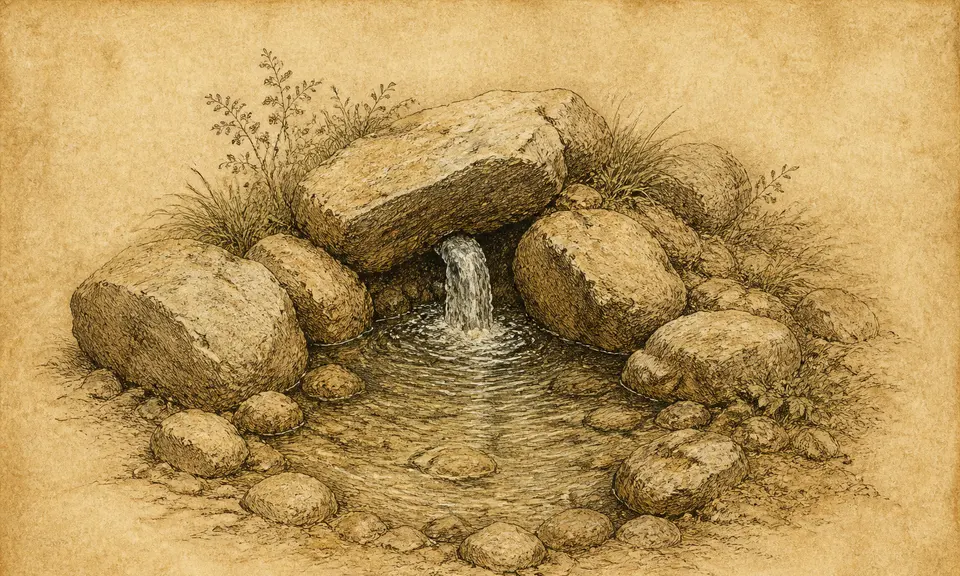
The image was generated by a model. It is not a period engraving and comes from none of the sources.

Miller reads the fountain by how it looks: clear and sparkling in sunlight it means vast possessions and pleasant journeys, clouded it means insincere companions and unhappy love, and dry and broken it means death and the end of pleasures. an-Nabulsi reads the spring by who owns it and where it breaks out, since for a man of covered faults it is bounty and a wish reached, while for a man whose faults are open, springs bursting out in his house are a calamity his household weeps over; out of a wall it is care through a brother or an in-law, inside the room grief through the women, and if all the water leaves the house, the care leaves quickly with it. He agrees with Miller on the two extremes and says so plainly: clear running water is good for everybody, most of all for the sick and the poor, and a dried-up spring is the opposite for everybody alike. Artemidorus has those same two extremes in two lines, and the same reason for them, for nothing is so nourishing as water. His case turns the failing spring into a whole career: a runner about to compete in a sacred contest dreamed that he came to a spring with a jar, and the water stopped flowing each time he reached it, three times over, until in anger he broke the jar — he ran three dead heats and was deprived of the crown by a president of the games who favoured his rival, the spring being the contest, the water the crown, and the broken jar his training wasted.

This paragraph was generated by a model. It sums up the sources above, comes from none of them and is attributed to no one.

Greek dream book

Springs and fountains and water sources brimming with clear water are good for all alike, and most of all for the sick and the destitute: to the one they signify recovery, to the other plenty; for nothing is so nourishing as water.

Passage Book II, 27

But when they are drying up and have no water, they mean the opposite.

Passage Book II, 27

A runner who was about to compete in a sacred contest dreamt that he had come to a spring with an earthen jar to draw water. And while he was on his way to the spring the water was flowing; but just as he came up and wanted to take some, it stopped flowing. And when, after waiting, he came up again, again in the same way it stopped flowing just as he came up, and a third time likewise. In the end it failed altogether, so that in anger he smashed and broke the jar. He ran a dead heat with another man, and although the verdict was more in his favour he was forced to run again. And a second time, having come level with his rival at the finish, he ran a third time, and although the verdict was much in his favour he was deprived of the crown: for the man who was conducting the contest happened to be eager for his rival. One could liken the spring to the contest, the conduit to the president of the games, the water to the crown, the jar to his training; and the failure of the water, because the conduit did not supply it, to the failure of the crown, because of the president who pressed matters on; and his vain training to the breaking of the jar.

Passage Book V

Ὀνειροκριτικά (Oneirokritika)

Artemidorus of Daldis; edited by Rudolf Hercher

second century; Hercher’s edition 1864 · Greco-Roman

the source of the ancient tradition itself, which the others draw on

About this source

Five books of second-century Greek prose, not an alphabetical dictionary: the readings sit inside argued chapters and the author says of each one why it reads as it does. It is the source the other European and Arabic dream books draw on, including where they do not name it.

Rights: public domain

Where the text is from: https://archive.org/details/bub_gb_CRwTAAAAQAAJ

Arabic dream book

In a dream it is bounty and good and blessing and the reaching of a wish, if its owner is a man of covered faults. Whoever sees springs burst out in his house and was not a man of covered faults is reached by a calamity his household weeps for. Whoever sees that he washed for prayer from the water of a spring — that is good, clear or muddy, hot or cold, so long as it is clean enough that washing for prayer with it is allowed, because the washing is stronger in the reading than where the water comes out and how it differs. Whoever sees in his house, or in a place that harms him, that the water of a spring burst out of it and went out of the house attains a living and good and benefit. If it burst out inside his room, it is grief by way of the women; and if it burst out of a wall, it is care that reaches him by way of a man in that house, such as a brother or an in-law or a friend. And if it burst out and went out of the house until all of it was gone, they escape the care quickly; and if it did not go out, the care stays. If it was clear, it is care with soundness of body — for what is disliked among springs is the one whose water is muddy and does not run. If he sees a spring of water running for its owner in a bounded channel, then whether its owner is living or dead, the reading of that goes to his religion and his work, running on until the day of resurrection. And if he sees a spring of water burst out in a quarter or a house, whether it overflowed or not, grief and weeping fall there; and so too if he drank of the water of the spring, it is care or grief — and if the water was muddy, it is worse and the ruin in it is stronger. And it is said: whoever sees that water burst out in his house or in a place buys a servant. And if he sees springs burst out of the ground, the people of that place come into money and much fruit, along with filth and spoiling. And the springs and the water that wells up out of the valleys, when it is clear, are a sign of good for all people, and above all for the sick and the poor, because it points to ease and to recovery, since there is nothing sweeter than water; and if he sees them dry, it is the opposite of that, a sign for all people alike. And whoever washes for prayer from the water of a spring: if he was in care, God gives him relief; or afraid, or ill, he is healed; or in debt, his debt is paid; or a man of sins, God covers them for him. Whoever sees a clear spring — it is a revenue for the man who owns it; and if he sees it running between the houses, it is life for the common people. Whoever sees a clear spring running to his house, as much as a man can stop with his hand, that is provision and good driven to him.

Section letter ayn
The Perfuming of Mankind in the Interpretation of Dreams

Abd al-Ghani al-Nabulsi

before 1731; first printed Cairo 1858 · Arab-Islamic

carries the ancient tradition after Artemidorus

About this source

An Arabic dream book by the Damascene scholar al-Nabulsi, an alphabetical dictionary of two and a half thousand headwords. It draws on the ancient tradition directly: Artemidorus was translated into Arabic by Hunayn ibn Ishaq in the ninth century. The readings here almost always address the dreamer’s standing, property and faith rather than their feelings.

Rights: public domain

Where the text is from: https://shamela.ws/book/1217

Miller

To dream that you see a clear fountain sparkling in the sunlight, denotes vast possessions, ecstatic delights and many pleasant journeys. A clouded fountain, denotes the insincerity of associates and unhappy engagements and love affairs. A dry and broken fountain, indicates death and cessation of pleasures. For a young woman to see a sparkling fountain in the moonlight, signifies ill-advised pleasure which may result in a desertion.

Ten Thousand Dreams Interpreted; Or, What's in a Dream

Gustavus Hindman Miller

1901 · American Victorian

carries fragments of the ancient tradition without its system

About this source

An American dream book, the only one here that knows the telephone, the railroad or the elevator. Doctrinally it is the most degraded: it keeps fragments of the ancient tradition without the system that once held them together.

Rights: public domain

Where the text is from: https://www.gutenberg.org/ebooks/926