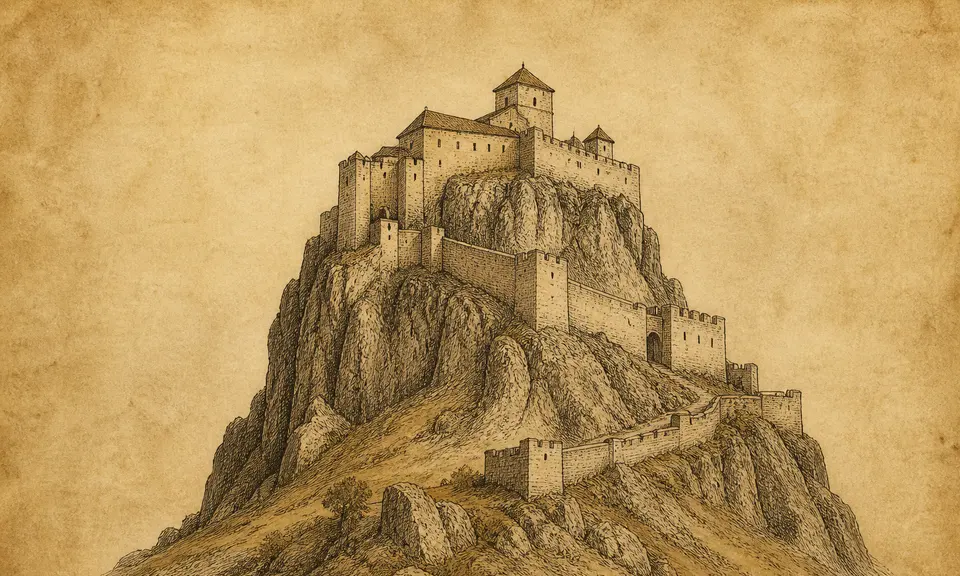
Fortress

2 readings from 2 sources.

The image was generated by a model. It is not a period engraving and comes from none of the sources.

Miller reads the fortress as a place one is put into: being confined in one means enemies succeeding in placing the dreamer in an undesirable situation, and putting others in one means the ability to rule in business or over women. an-Nabulsi reads it as a thing to stand on, because it is said that truthfulness is a fortress; and then he takes the building apart and gives every part a man: the towers are its commanders, the battlements its guards, the loopholes its spies, the gates its chamberlains, the citadel its vizier, and the outskirts its people and kin. It may also be knowledge, or the Qur'an, or whatever a man takes refuge in from Satan.

This paragraph was generated by a model. It sums up the sources above, comes from none of them and is attributed to no one.

Arabic dream book

In a dream it is the relying on truthfulness, because it is said: truthfulness is a fortress. And the fortress may point to its owner, or to whoever is in it, whether soldiers or an enemy; and it may point to knowledge and to the Qur'an and to what a man takes refuge in from Satan and his hosts. Its towers are its commanders, its battlements its guards or its soldiers, its loopholes its spies, its gates its chamberlains, its citadel its vizier, and its outskirts its people and kin, or the stores it spends from and brings into. And if he saw as though he is in a fortress: if kingship befits him, he reigned; or he married if he was unmarried; or he was granted a child; or he bought a property; or he came to Islam if he was an unbeliever; or he repented and asked God Most High to release him from his sins. And the fortress points to Islam. So whoever sees that he is in a fortress or in a citadel is granted devotion in his religion, and righteousness, and a leaving off of his sins, in the measure of his place in the fortress and of his firmness in it. And if the fortress was in water in waking and he saw in his sleep that it came to be in a waste, his enemy got the better of him and took him; and if it was in a waste and he saw that it came to be on a mountain or in water, he was fortified against the one who makes war on him, and that one went back from him disappointed. And whoever sees that he built a fortress fortifies himself against his enemies, or he guarded his private parts from the forbidden, and his money and his own self from affliction and from lowness. And whoever sees that he ruined his fortress or his house or his palace — it is the spoiling of his religion and of his world, or the death of his wife. And whoever sees as though he is seated on the height of a fortress gained a brother, or a chief, or a child, by whom he is saved. And it is said the fortress is a well-guarded man whom no one can overcome. So whoever saw it from afar — then it is the rising of his name and the guarding of his private parts.

Section letter ḥa

The Perfuming of Mankind in the Interpretation of Dreams

Abd al-Ghani al-Nabulsi

before 1731; first printed Cairo 1858 · Arab-Islamic

carries the ancient tradition after Artemidorus

About this source

An Arabic dream book by the Damascene scholar al-Nabulsi, an alphabetical dictionary of two and a half thousand headwords. It draws on the ancient tradition directly: Artemidorus was translated into Arabic by Hunayn ibn Ishaq in the ninth century. The readings here almost always address the dreamer’s standing, property and faith rather than their feelings.

Rights: public domain

Where the text is from: https://shamela.ws/book/1217

Miller

To dream that you are confined in a fortress, denotes that enemies will succeed in placing you in an undesirable situation. To put others in a fortress, denotes your ability to rule in business or over women.

Ten Thousand Dreams Interpreted; Or, What's in a Dream

Gustavus Hindman Miller

1901 · American Victorian

carries fragments of the ancient tradition without its system

About this source

An American dream book, the only one here that knows the telephone, the railroad or the elevator. Doctrinally it is the most degraded: it keeps fragments of the ancient tradition without the system that once held them together.

Rights: public domain

Where the text is from: https://www.gutenberg.org/ebooks/926