A forehead that is sound and well fleshed is good for everyone, and means freedom of speech and manly vigour.
Passage Book I, 23
5 readings from 3 sources.
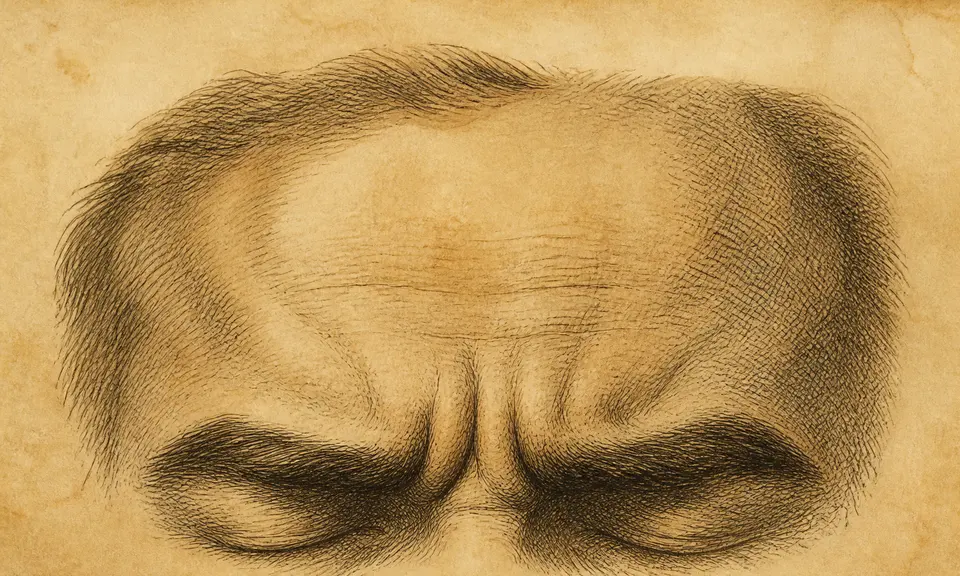
Miller reads the forehead as a face to be judged by: a fine and smooth forehead means being thought well of for one's judgment and fair dealing, an ugly one displeasure in private affairs, a hand passed over a child's forehead sincere praise from friends, and a young woman kissing her lover's forehead his displeasure at her indiscreet conduct. an-Nabulsi says eight words and they cover all of it: in a dream the forehead is a man's standing among people and the force of his word. Artemidorus reads the same brow and reaches the same odd exception. A forehead that is sound and well fleshed is good for everyone, and means freedom of speech and manly vigour, while one that is ulcerated or diseased shows shame and harm together — and then the exception, which is an-Nabulsi’s iron forehead in Greek: to dream of having such a forehead profits only tax-collectors and hucksters and those who live by shamelessness, and for the rest it works hatred.
This paragraph was generated by a model. It sums up the sources above, comes from none of them and is attributed to no one.
A forehead that is sound and well fleshed is good for everyone, and means freedom of speech and manly vigour.
Passage Book I, 23
But one that is ulcerated or diseased shows shame and harm together.
Passage Book I, 23
To dream of having such a forehead profits only tax-collectors and hucksters and those who live by shamelessness; for the rest it works hatred.
Passage Book I, 23
In a dream it is a man's standing among people and the force of his word. And if he saw in it a flaw, of a break or of something else, then it is a lessening of his awe and of his standing and of the force of his word. And if he saw in it a growth like a walnut, or less or more, then a son is born to him who becomes the master of his household. And whoever saw as though his forehead is of iron or of copper or of stone — that is praised for the police and for the common folk and for the man whose living is managed with brazenness; and as for the rest, this vision makes them hateful to people. And whoever saw another man's forehead narrower than it was — that other man's character went bad after having been good; and if he saw it wider than it was, he became a fool after sense and ignorant after knowledge. And sometimes the forehead points to stinginess and to generosity. So whoever saw his forehead blackened, or that there are brand-marks upon it — and sometimes that points to stinginess, and to it in what is due to God the Exalted. And the beauty of it and its light are a sign of agreement and of sharing with others. And sometimes the forehead points to what a man prostrates upon, of a prayer mat or a cloth or something else; so its largeness in a dream, or its becoming of iron or of stone, is a sign of striving in prayer, or of brazenness. And whoever saw in his forehead a wound or a sore is neglectful in his prayer, or one of those who do not complete their prostration in it, or someone faces him with ugly speech.
Section letter jim
To dream of a fine and smooth forehead, denotes that you will be thought well of for your judgment and fair dealings. An ugly forehead, denotes displeasure in your private affairs. To pass your hand over the forehead of your child, indicates sincere praises from friends, because of some talent and goodness displayed by your children. For a young woman to dream of kissing the forehead of her lover, signifies that he will be displeased with her for gaining notice by indiscreet conduct.