Flies

2 readings from 2 sources.

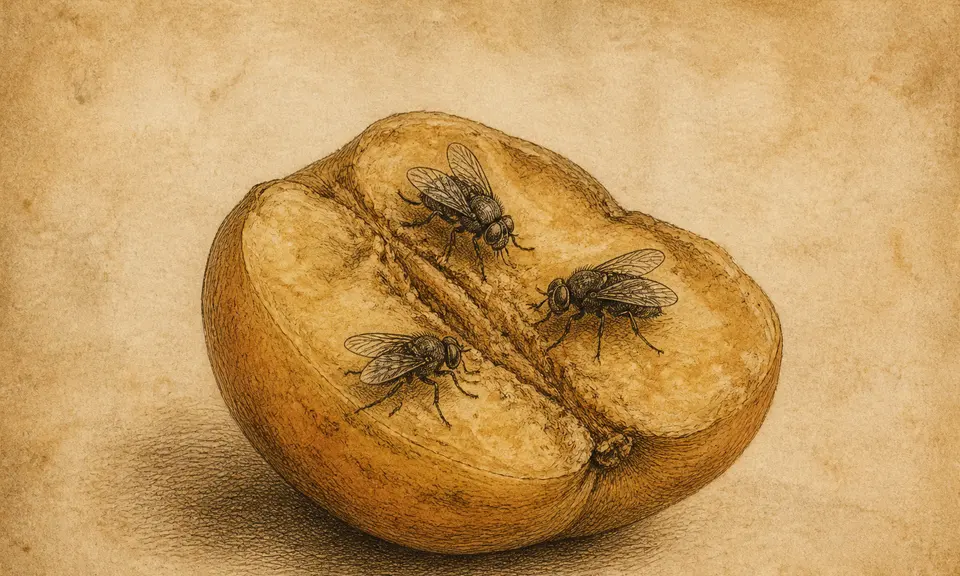
The image was generated by a model. It is not a period engraving and comes from none of the sources.

Miller reads flies as contagion: sickness and contagious maladies, and enemies all around the dreamer; for a young woman they mean unhappiness, though if she kills or exterminates them she will reinstate herself in the love of her intended by her ingenuity. an-Nabulsi reads the fly as a man — reviling, weak, wretched, base. If the dreamer profited from it, he gives profit to a man of that sort; if he ate it, a base provision has come to him; what is in their bellies is wealth from a base man. A fly that enters his inside means he mixes with foolish people and takes from them unlawful wealth that has no permanence, and the large ones, in their number, harm people and spoil wealth. The last image is political: flies flying above his head are a weak enemy with little power and little guile, who wants to rise above him by way of a chief who threatens him with some matter — and the dreamer neither takes fright at him nor is daunted. Miller's flies carry disease; an-Nabulsi's carry a person, and the whole reading takes as a catalogue of the men a dreamer is worth nothing to.

This paragraph was generated by a model. It sums up the sources above, comes from none of them and is attributed to no one.

Arabic dream book

It is in a dream a reviling man, weak, wretched, base. And if he profited from it, then he gives profit to a man of that sort. And if he ate it, a base provision came to him. And what was in its bellies is wealth from a base man. And if he saw that the fly entered his inside, he mixes with foolish people and gets from them unlawful wealth that has no permanence. And the large ones of it, in their number, harm people and spoil wealth. And if he saw flies flying above his head, then he has an enemy weak in power and in guile who wants to rise above him by way of a chief who threatens him with some matter; and he does not take fright at him, nor does it daunt him.

Section letter dhal

The Perfuming of Mankind in the Interpretation of Dreams

Abd al-Ghani al-Nabulsi

before 1731; first printed Cairo 1858 · Arab-Islamic

carries the ancient tradition after Artemidorus

About this source

An Arabic dream book by the Damascene scholar al-Nabulsi, an alphabetical dictionary of two and a half thousand headwords. It draws on the ancient tradition directly: Artemidorus was translated into Arabic by Hunayn ibn Ishaq in the ninth century. The readings here almost always address the dreamer’s standing, property and faith rather than their feelings.

Rights: public domain

Where the text is from: https://shamela.ws/book/1217

Miller

To dream of flies, denotes sickness and contagious maladies. Also that enemies surround you. To a young woman this dream is significant of unhappiness. If she kills or exterminates flies, she will reinstate herself in the love of her intended by her ingenuity.

Ten Thousand Dreams Interpreted; Or, What's in a Dream

Gustavus Hindman Miller

1901 · American Victorian

carries fragments of the ancient tradition without its system

About this source

An American dream book, the only one here that knows the telephone, the railroad or the elevator. Doctrinally it is the most degraded: it keeps fragments of the ancient tradition without the system that once held them together.

Rights: public domain

Where the text is from: https://www.gutenberg.org/ebooks/926