Fingers

5 readings from 3 sources.

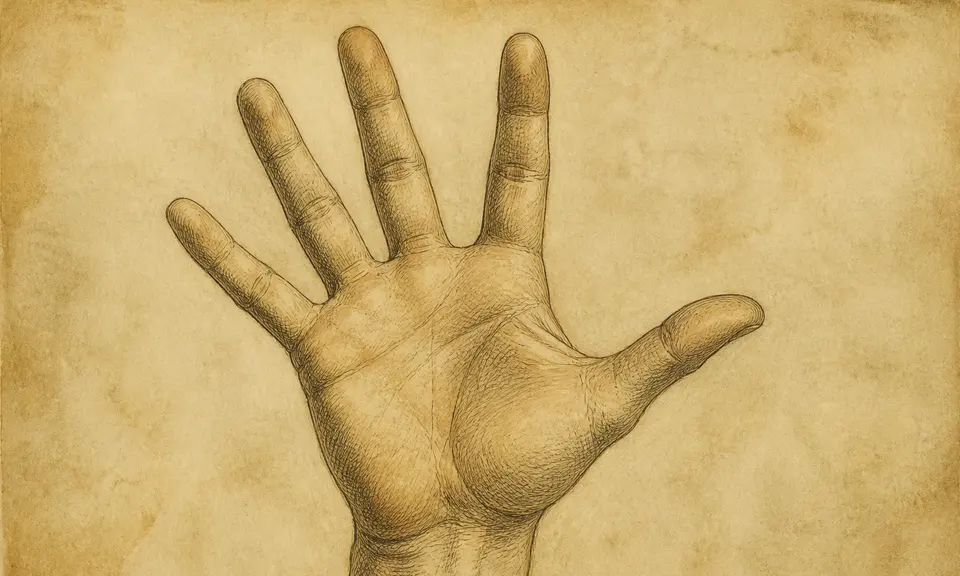
The image was generated by a model. It is not a period engraving and comes from none of the sources.

Miller reads the fingers by how they look: soiled or scratched fingers with blood on them mean much trouble and suffering, beautiful hands with white fingers love requited and renown for benevolence, and fingers cut clean off the loss of wealth and a legacy through enemies. an-Nabulsi reads them as what they do — they help a man in his craft in this world and in bidding right and forbidding wrong in the next — and then as people: children, spouses, fathers, mothers, and also money, beasts, property, a craft. Fingers that grow mean an increase in all of that, while fingers cut or withered mean the help of parents or children becoming impossible, or beasts dying, or a craft going slack. Artemidorus reads the fingers as servants and as idleness, and his best reading is about what is missing: fingers of the hands lost, all of them or in part, signify injuries and the loss of servants, and to scribes and men of letters leisure and idleness, and to debtors that they will pay back more than they should while lenders will get back less. His case turns that into a man's credit, since he knew a man who, when he was about to borrow, dreamed that he had no fingers, and the lender trusted him even without a signed bond. And he keeps a correction for the other direction, that all the fingers added to those nature gives are themselves idle and make idle those from whom they have grown.

This paragraph was generated by a model. It sums up the sources above, comes from none of them and is attributed to no one.

Greek dream book

Fingers of the hands lost, all of them or in part, signify injuries and the loss of servants; to scribes and men of letters, leisure and idleness; to debtors, that they will pay back more than they should, and to lenders, that they will get back less.

Passage Book I, 43

I know a man who, when he was about to borrow, dreamed that he had no fingers; the lender trusted him even without his signing a bond.

Passage Book I, 43

For all the fingers that are added to those nature gives are themselves idle and make idle as well those from whom they have grown. But some, going astray, have taken such a thing to be good.

Passage Book I, 42

Ὀνειροκριτικά (Oneirokritika)

Artemidorus of Daldis; edited by Rudolf Hercher

second century; Hercher’s edition 1864 · Greco-Roman

the source of the ancient tradition itself, which the others draw on

About this source

Five books of second-century Greek prose, not an alphabetical dictionary: the readings sit inside argued chapters and the author says of each one why it reads as it does. It is the source the other European and Arabic dream books draw on, including where they do not name it.

Rights: public domain

Where the text is from: https://archive.org/details/bub_gb_CRwTAAAAQAAJ

Arabic dream book

They are what help a man in his world, in his craft, and in the next world, in bidding what is right and forbidding what is wrong. The finger, in interpretation, is children and spouses and fathers and mothers, and money and beasts and property and a craft. Whoever saw that his fingers had increased in a good increase, it points to an increase in what we have named; and their lessening to whoever they pointed to. And cutting them, or their withering, or their use being lost, may point in a dream to the help of fathers and mothers or children becoming impossible, or to his money going, or his beasts dying, or his property lying idle, or his craft going slack. And the fingers may point to the king's deputies, who differ in their ranks and in their usefulness. And whoever sees that he bites his fingertips in a dream: if he was sick, he died. And whoever sees that his fingers were cut off, or that a blight came down upon them, then it is a weakness in his troops or his children or his kin or his acquaintances. And perhaps the fingers point to the five prayers: so the thumb is the dawn prayer, and the forefinger the noon prayer, and the middle finger the afternoon prayer, and the ring finger the sunset prayer, and the little finger the night prayer. And it is said the middle finger is the dawn prayer, for the lengthening that is liked in it, and the ring finger the noon prayer, and the little finger the afternoon prayer, because it is the end of the day. And if the fingers are made prayer, then the nails were its custom or the voluntary prayers; and if the fingers were money, then the nails were the alms; and if the fingers pointed to the soldiery and the helpers, then the nails were their weapons and their gear. And the knotting of the fingers is the knotting of moneys; and the fingers are days or months or years. And perhaps the fingers point to the children of the brother, because the shoulder is a brother and the fingers are in the place of the children, and they are the money. And whoever sees a person who cut off a finger for him — then he harms him in the money he leans upon. And whatever happened in the fingers, of soundness or of spoiling, ascribe it to the obligatory prayers, or to the brother among the brothers. And the length of the fingers points to an increase of greed; and if he saw a finger that increased along with his fingers, then it is an increase in his kin, or in his prayer, or in what he does openly. And if he saw one of the fingers move to another place, then he puts off the prayer to the time of the other. And whoever sees that he interlaced his fingers joins his prayers at one time; and perhaps his kin gathered over a matter in which they take counsel together and help one another. And it is said the interlacing of the fingers without working with them is tightness of the hand, and he has matters that busy the people of his house and the sons of the brothers with an affair that has struck them, from which they fear for themselves, and they have backed one another in warding it off and in sufficing for it. And it is said that the fingers of the right hand are the five prayers, and their shortness points to falling short and to sloth in them, and their length points to the keeping of the prayers, and the falling of one of them points to the leaving off of the prayer. And whoever sees as though he bit the fingertip of a person, it pointed to the bad manners of the one bitten and to the biter's going far in disciplining him. And whoever sees as though milk comes out of his thumb and blood out of his forefinger, and he is drinking from them both, then he lies with the mother of his wife or with her sister. And the cracking of the fingers points to ugly speech falling from his kin. And if the imam saw an increase in his fingers, that pointed to an increase in his greed and in his injustice and to the scantness of his fairness. And the fingers of the left hand are the children of the brother and of the sister. And the dyeing of the fingers of men with henna is a sign of much praising of God; and the dyeing of the fingers of the woman with henna points to her husband's doing well by her; and if she saw as though she dyed them and the dye did not take, then her husband does not show his love for her.

Section letter alif
The Perfuming of Mankind in the Interpretation of Dreams

Abd al-Ghani al-Nabulsi

before 1731; first printed Cairo 1858 · Arab-Islamic

carries the ancient tradition after Artemidorus

About this source

An Arabic dream book by the Damascene scholar al-Nabulsi, an alphabetical dictionary of two and a half thousand headwords. It draws on the ancient tradition directly: Artemidorus was translated into Arabic by Hunayn ibn Ishaq in the ninth century. The readings here almost always address the dreamer’s standing, property and faith rather than their feelings.

Rights: public domain

Where the text is from: https://shamela.ws/book/1217

Miller

To dream of seeing your fingers soiled or scratched, with the blood exuding, denotes much trouble and suffering. You will despair of making your way through life. To see beautiful hands, with white fingers, denotes that your love will be requited and that you will become renowned for your benevolence. To dream that your fingers are cut clean off, you will lose wealth and a legacy by the intervention of enemies.

Ten Thousand Dreams Interpreted; Or, What's in a Dream

Gustavus Hindman Miller

1901 · American Victorian

carries fragments of the ancient tradition without its system

About this source

An American dream book, the only one here that knows the telephone, the railroad or the elevator. Doctrinally it is the most degraded: it keeps fragments of the ancient tradition without the system that once held them together.

Rights: public domain

Where the text is from: https://www.gutenberg.org/ebooks/926