David

2 readings from 2 sources.

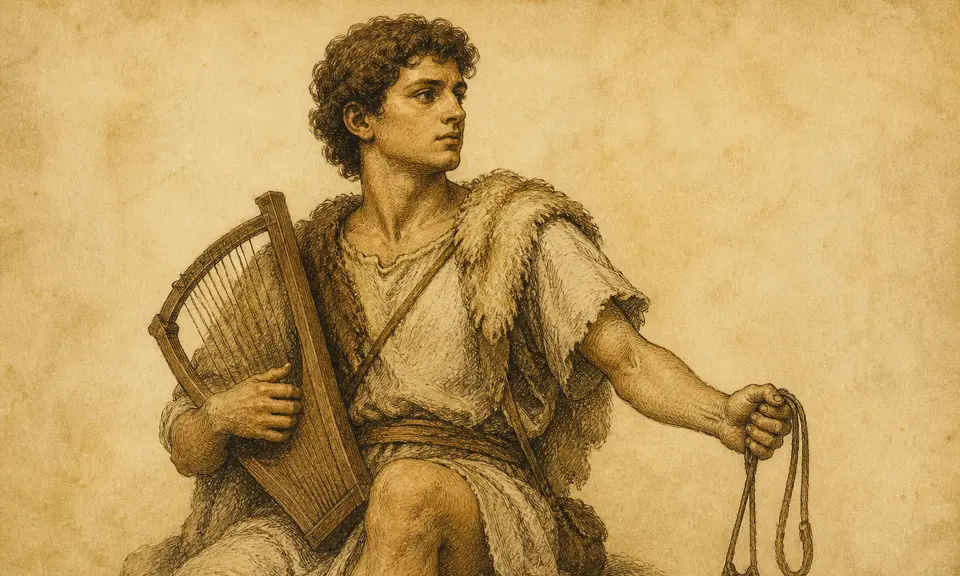
The image was generated by a model. It is not a period engraving and comes from none of the sources.

The same king, two traditions, and only one of them tells a story. Miller is dry and domestic: dreaming of David of Bible fame means divisions in the family and unsettled affairs that will tax the dreamer's nerves. an-Nabulsi reads the whole life of the prophet into the dream — the dreamer attains strength and authority, falls into a wrong deed, repents of it and lives austerely, is tried by an unjust ruler, and is then delivered, given the upper hand, and granted kingship and honour. One book sees a quarrelling household; the other sees sin, penance and a throne.

This paragraph was generated by a model. It sums up the sources above, comes from none of them and is attributed to no one.

Arabic dream book

Whoever saw him in a dream attains strength and authority, and falls into a wrong deed and then repents of it and lives austerely, and is tried by an unjust ruler; then God, be He exalted, delivers him from him and gives him the upper hand and makes him victorious over him, and God grants him kingship and honour. And it is said whoever sees David, peace be upon him — then there will be in that town a just king, or an excellent chief, or a wise and equitable judge; and if the chief of that town was an oppressor, God Most High exchanges him for a just chief; and if he was a judge who swerves from justice, God Most High puts in his place a judge just in his judgement; and if he was fit to bear the judgeship, he attained it. And the sight of David, peace be upon him, points to the caliphate, and it may point to being tried by women and to vexations from their side; and the sight of him may point to recitation and to the glorifying of God and to music and to chanting in the reading. And the sight of him points to the leaving off of sins and to repentance and to turning back, and calamities may become light upon him; and the sight of him points to a good end. And whoever sees that he was changed into the form of David, peace be upon him, or wore a garment of his garments — if he was of those to whom the judgeship and the rule are fitting, he attained that; and if that was not fitting to him, then if his living and his craft were from iron or by it, he gained money; and if he had nothing of that, then if he was a righteous man he is given good tidings of the increase of good and of much weeping and humility and sorrow; and if he was an oppressor who swerves from justice, and he saw him grieving him or threatening him, or saw him frowning in his face, then let him fear God Most High and set his state right.

Section letter dal

The Perfuming of Mankind in the Interpretation of Dreams

Abd al-Ghani al-Nabulsi

before 1731; first printed Cairo 1858 · Arab-Islamic

carries the ancient tradition after Artemidorus

About this source

An Arabic dream book by the Damascene scholar al-Nabulsi, an alphabetical dictionary of two and a half thousand headwords. It draws on the ancient tradition directly: Artemidorus was translated into Arabic by Hunayn ibn Ishaq in the ninth century. The readings here almost always address the dreamer’s standing, property and faith rather than their feelings.

Rights: public domain

Where the text is from: https://shamela.ws/book/1217

Miller

To dream of David, of Bible fame, denotes divisions in domestic circles, and unsettled affairs, will tax heavily your nerve force.

Ten Thousand Dreams Interpreted; Or, What's in a Dream

Gustavus Hindman Miller

1901 · American Victorian

carries fragments of the ancient tradition without its system

About this source

An American dream book, the only one here that knows the telephone, the railroad or the elevator. Doctrinally it is the most degraded: it keeps fragments of the ancient tradition without the system that once held them together.

Rights: public domain

Where the text is from: https://www.gutenberg.org/ebooks/926