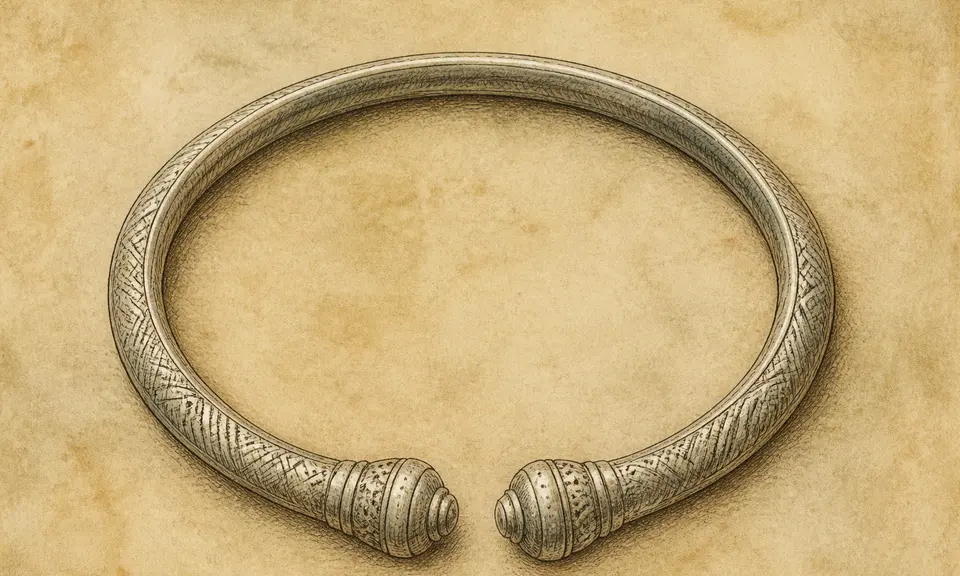
Collar

2 readings from 2 sources.

The image was generated by a model. It is not a period engraving and comes from none of the sources.

Miller reads the collar as honour badly worn: wearing one means high honours thrust upon the dreamer which he will hardly be worthy of, and for a woman many admirers but none sincere. an-Nabulsi reads the neck-ring the same two ways at once and keeps them apart by the metal: for a man it is of the sultan, and collared together with a white or green robe of honour he attains victory and rank from a quarter he cannot see — but a weak collar makes him a miser in religion by whom nobody profits, a scholar who hides his knowledge, a ruler stingy with judgment. For a woman the collar is her husband, and what he is made of is what it is made of: silver and wide, he is generous and rich; thin, his state is bad; iron, he is strong; wood in the middle of it, he is a hypocrite.

This paragraph was generated by a model. It sums up the sources above, comes from none of them and is attributed to no one.

Arabic dream book

Whoever sees a collar on his neck in a dream is a miser. The collar is the woman's kindness to her husband and an honour that remains and a thing that falls into her hand out of his money. The collar, for the woman, is her husband: if it was of silver and wide and well made, the husband is generous, forbearing, rich; and if it was thin, that is the badness of his state; and if it was of iron, he is strong; and if there was wood in the middle of it, the man is a hypocrite. The collar, for the man, is of the sultan; and if he is collared together with a white or a green robe of honour, he attains victory and mastery, and he attains them from where he does not know the face of it. And if he is a merchant, it is profit and fortune and a name and standing; and if he is a market man, it is a name for him and a rank. And if he sees that he is collared and his collar was weak, he is a miser in the matter of religion by whom nobody profits; and if he is a scholar, he conceals knowledge; and if he is a sultan, he is miserly with judgment and ruling. And whoever buys a slave girl with a collar of silver on her neck trades a trade and gains from that trade strength and the upper hand, and perhaps he gains from that trade a woman or a slave girl. And it is said that the collar, of whatever kind it was, is corruption in religion, and that wearing the collar points to miserliness; and perhaps its wearer points to kingship and to the child and to what is entrusted. And whoever sees that upon him is a collar of gold or of silver or of iron or of brass or of lead or other than that has gone deep into corrupting his religion, or has wasted what was entrusted to him. And whoever sees that he wears a collar of gold or silver or iron or brass or lead or anything else — he has gone far in the spoiling of his religion, or has lost what was entrusted to him.

Section letter ṭa

The Perfuming of Mankind in the Interpretation of Dreams

Abd al-Ghani al-Nabulsi

before 1731; first printed Cairo 1858 · Arab-Islamic

carries the ancient tradition after Artemidorus

About this source

An Arabic dream book by the Damascene scholar al-Nabulsi, an alphabetical dictionary of two and a half thousand headwords. It draws on the ancient tradition directly: Artemidorus was translated into Arabic by Hunayn ibn Ishaq in the ninth century. The readings here almost always address the dreamer’s standing, property and faith rather than their feelings.

Rights: public domain

Where the text is from: https://shamela.ws/book/1217

Miller

To dream of wearing a collar, you will have high honors thrust upon you that you will hardly be worthy of. For a woman to dream of collars, she will have many admirers, but no sincere ones, She will be likely to remain single for a long while.

Ten Thousand Dreams Interpreted; Or, What's in a Dream

Gustavus Hindman Miller

1901 · American Victorian

carries fragments of the ancient tradition without its system

About this source

An American dream book, the only one here that knows the telephone, the railroad or the elevator. Doctrinally it is the most degraded: it keeps fragments of the ancient tradition without the system that once held them together.

Rights: public domain

Where the text is from: https://www.gutenberg.org/ebooks/926