Further, of cities it is better to see those more one’s own than the others, such as native cities or those in which a man has lived in good fortune; but to see cities not one’s own or not familiar is less good.
Passage Book IV
7 readings from 3 sources.
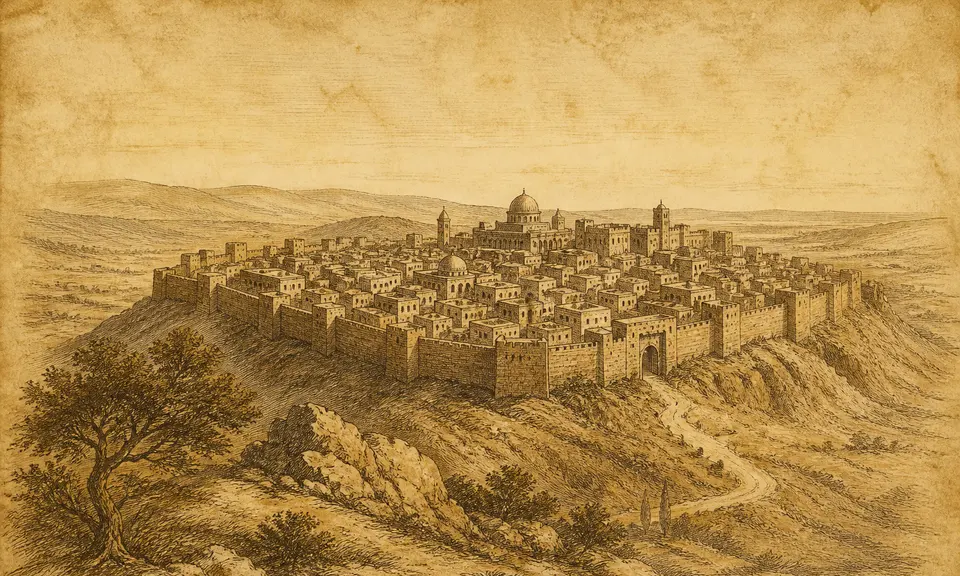
Miller's two readings read the place by whether the dreamer belongs in it: a strange city means a sorrowful occasion to change one's abode or way of living, while a village means good health and being fortunately provided for, and the village of one's youth pleasant surprises — unless it looks dilapidated, and then trouble is coming. an-Nabulsi reads entering and leaving, since whoever entered one of the cities is safe from what he fears, and Ibn Sirin liked entering cities and disliked going out of them, for the verse about the man who went out of it in fear. The city may also be a learned man, by the saying about the city of knowledge and its gate, and a city found in ruins means its learned men are gone, or its king is dead, or there is injustice in it. Artemidorus reads whose city it is: it is better to see cities more one's own than others, native ones or those in which a man has lived in good fortune, and less good to see cities not one's own; all of them are good seen full of men and abounding in costly things, and none is good seen deserted or thrown down. And then he makes the native city a parent — a man dreamed that his native city had fallen in an earthquake, and his father was condemned to death and perished — which is where the Greek and the Arabic book meet without knowing each other, since an-Nabulsi reads the city a man is named after as his father and an earthquake in it as that father's violent death.
This paragraph was generated by a model. It sums up the sources above, comes from none of them and is attributed to no one.
Further, of cities it is better to see those more one’s own than the others, such as native cities or those in which a man has lived in good fortune; but to see cities not one’s own or not familiar is less good.
Passage Book IV
All of them alike it is good to see full of men and well inhabited and abounding in costly things and in everything else that shows the size or the prosperity of a city.
Passage Book IV
To see cities deserted or thrown down is not good, neither one’s own nor other men’s.
Passage Book IV
Native cities stand also for parents. For instance, a man dreamed that his native city had fallen in an earthquake. His father was condemned to death and perished.
Passage Book IV
Whoever saw in a dream that he entered one of the cities is safe from what he fears. Ibn Sirin, may God be merciful to him, liked entering cities and did not like going out of them, for the word of God, be He exalted: and he went out of it in fear, watchful. And it is said the city is read as a learned man, for the saying: I am the city of knowledge and Ali is its gate. And whoever entered a city and found it in ruins — the learned have been lost from it; and it is said the city is the death of its king, or an injustice in it. And whoever sees a city being built up, then the learned grow many in it and their sons keep to the way of their fathers. And any city you see in which there is no ruler, then the price of food grows dear in it. And the unknown city is the hereafter, and the known one is the world, for the one who sees it, or the religion of its people. So whoever sees a city that has fallen down, or part of which has fallen down, and it is known to him, then the religion of its people has gone, and perhaps their world goes by a blow in their religion. And the best of cities in the reading is the great, well-built city, especially if it was greater than the cities he dwells in. And a man's city, the one he is named after, is read as his father; so whoever sees that a city was ruined by an earthquake, his father died by killing. And whoever sees that he is in the upper lands of the Arabs, his yield grows much; or in the lower lands of the Arabs, his trickery and his cunning grow much. And whoever sees that he is in the lands of the lower Upper Country, his life is made vexed and he is wretched in his time; or in the lands of the higher Upper Country, his trustworthiness grows much and his tongue speaks truth. And whoever sees that he is in the lands of Nubia is granted a vast favour. And whoever sees that he is in the lands of Abyssinia, his awe is lessened. And whoever sees that he is in the lands of Egypt and Ayn Shams and the Fayyum, God makes his life good and he will be long-lived. And whoever sees that he is in the lands of the Rif slanders the obligations of the Messenger of God, God bless him and give him peace. And whoever sees that he is in the lands of al-Arish, his good and his favour grew much. And whoever sees that he is in Constantinople loses in his money. And whoever sees that he is in the lands of Jerusalem and of Mount Sinai, then it is a year that comes towards him; and if he saw that he is in Bethlehem and al-Barqa and Khawlan, his prayers grow many and his religion increases. And whoever sees that he is in the lower mountain is brought together with a beloved. And whoever sees that he is in the lands of the east gained a great good. And whoever sees that he looked out over Baghdad is brought before a judge, because Baghdad is the house of the imam under whose obedience every judge is. And every land in which there is great heat and great cold, then that is an affliction coming down upon its people. And whoever sees that he is in the mountain of Hebron and the Jordan and the lake of Tiberias gains a journey or a lowness. And whoever sees that he is in Damascus, God most high grants him much good and favour. And whoever sees that he is in the lands of the coast is granted acceptance among people. And whoever sees that he is in the lands of Rum is a man of trust in God most high, and likewise the lands of the Armenians. And whoever sees that he is in the lands of the Franks, his heart is blinded and his mind is turned away. And whoever sees that he is in the lands of the foreigners learns by slander and shamelessness. And whoever sees that he is in the lands of Sind or of India subdues the one who was his enemy and gets the better of those who envy him. And whoever sees that he is in the lands of Diyar Bakr, his state in his world was made good. And whoever sees that he is in the lands of al-Karkh, something went from his hand. And whoever sees that he is in open country and in an empty waste under the sky is struck in his money. And whoever sees that he is in the lands of the Khazars falls sick. And whoever sees that he is in a ruin in which there is nothing white and no people is afflicted with a people he has no strength against. And whoever sees that he is among monasteries gained a provision with toil. And whoever sees that he is in a salt land or in a land of brimstone falls sick. And whoever sees that he is in a built-up land full of people is granted a favour of good kind from where he does not reckon. And whoever entered a city in a dream, it points to a peace between him and the people, who call him to the truth; and if he entered a palace in it, then if he was a ruler he will overcome. And whoever sees that he entered an ancient city that had been ruined long ago and whose houses had fallen down, and then a people came and laid bare the foundations of its houses and built them more firmly than they had been of old, then there appears or is born there a learned man or a leader who brings forth tradition, godfearing and devout. And if he saw a city full of plenty and of good crops, that is the goodness of the state of its people. And the land is an oath, by the word of the Most High: I swear by this land. And the land is safety from fear. And the city points to safety from fear and to the meeting with the beloved. And the sight of the believers of the people of Egypt points to the reaching of hope and to good tidings. And Badr, the sight of it points to victory over the enemies, by the word of the Most High: and God gave you victory at Badr while you were lowly. And Hunayn, the sight of it points to relief after hardship. And the coming down in Syria is a blessing and a good for one who is in hardship; and perhaps the sight of it points to strife, and likewise if he saw himself in the east. And if he saw himself in Yemen, he was made safe from what he fears and his faith increased. And the lands of the west are might and knowledge and height of rank. And Iram of the pillars is whatever of good is in it, and likewise the cities whose people God made the ground swallow up, for they point to fear and dread and to the giving of short measure and short weight. And perhaps the land in a dream points to repentance and forgiveness. And the region in a dream is might and elevation and wealth; and perhaps the region points to its governor or its ruler or its judge or its learned man, or to what is brought from it. And if he took possession of a land in the dream, or ruled in it, he gains a kingship or a governorship or an office according to his measure and to what befits him; and if he was unmarried, he married; or sick, he was cured of his sickness; or wicked, he repented; or astray, he was guided. And if the dead man was seen in a dream in a city, perhaps he was in the garden, sharing with the people of bliss; just as, if he was seen in a farmstead, it points to his being in the fire, for the toil of its people and their wretchedness and their want of ease and their heedlessness. And perhaps the city points to diversion and to being busied with the affair of the world. And if the city had a sound name, such as Sanaa, it pointed to a favour being conferred; or the city of the Good, for that points to good news; or Zafar, from getting the better of the enemy; or Surra Man Raa, from joy. And the lands of Isfahan in a dream point to evil and to vexations from the side of the Jews; and perhaps the sight of them points to the melodic way, which is a name for a sound known among its people. And perhaps the Hijaz in a dream points to faith. And whoever went out in a dream from a place of tyranny into the city of Egypt is delivered from tyranny and reaches his request and is made safe from his fear. And if his going out was from Surra Man Raa to Khurasan, he moved from joy to an evil whose time has come. And likewise the one who goes out of Mahdiyya and enters Susa goes out of guidance and truth into evil and corruption, and in this manner it is taken in the rest of the villages and cities that are known. And the gates of the city that is known are its governors and its judges and those who guard it and keep it; and its houses are its people of the chiefs. And whoever sees that he is in an unknown city he does not know, that is the mark of the righteous, and perhaps he gains what he asked for. And whoever sees that he enters a city, and he has already entered it, will not die until he enters it; and perhaps that was a safety from fear; and perhaps he saw someone of that city who changes with regard to it and to its people. And whoever sees the wall of the city pulled down, its agent died or was put out of his work. And whoever sees that a breach was made in the wall of the city so that a lion or a flood or a thief came into the city, Islam grew weak in it, or the market of knowledge grew slack.
Section letter mim
To dream that you are in a strange city, denotes you will have sorrowful occasion to change your abode or mode of living.
To dream that you are in a village, denotes that you will enjoy good health and find yourself fortunately provided for. To revisit the village home of your youth, denotes that you will have pleasant surprises in store and favorable news from absent friends. If the village looks dilapidated, or the dream indistinct, it foretells that trouble and sadness will soon come to you.