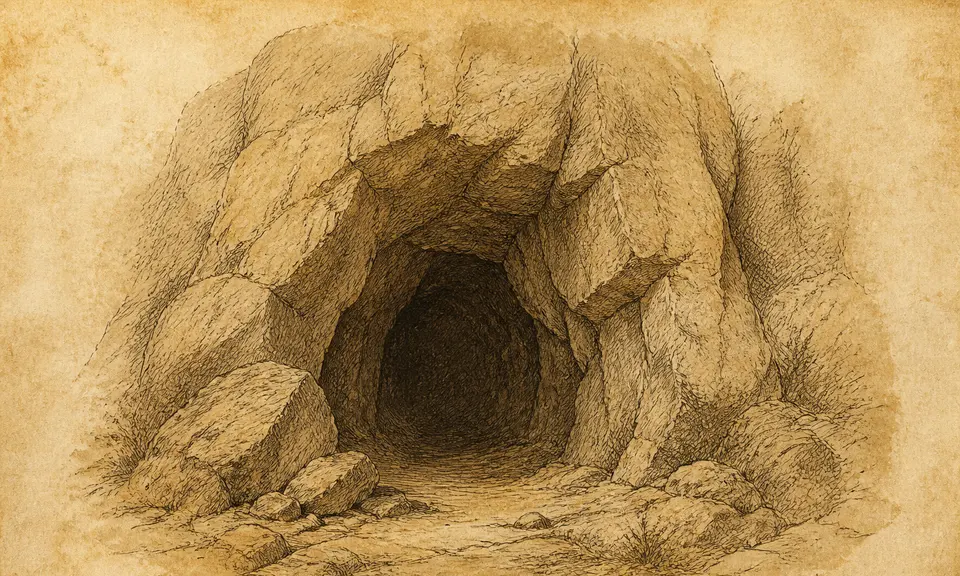
Cavern or cave

3 readings from 2 sources.

The image was generated by a model. It is not a period engraving and comes from none of the sources.

Miller reads the cave as a place that costs the dreamer something: a cavern yawning in the moonlight means perplexities and advancement blocked by adversaries, being inside one means change and estrangement from those he loves, and a young woman walking in one with her lover will fall in love with a villain. an-Nabulsi reads it as the safest place in the book: the cave is safety for the frightened, by the verse about the two in the cave — the Prophet and Abu Bakr — so it also stands for the friends a man has. Only at the end does it turn: a man entering a cave in a mountain is scheming against someone powerful. Another Arabic reading makes the cave whoever a man takes shelter with: a master, an imam, a father, a teacher, a wife, a craft. For the idle man it points to service and nearness to kings, and for the sick man or the prisoner to deliverance from all of that, by analogy with the story of the Companions of the Cave.

This paragraph was generated by a model. It sums up the sources above, comes from none of them and is attributed to no one.

Arabic dream book

In a dream it is safety for the frightened: whoever sees that he flees from his enemy until he enters a cave is made safe from him, by His word, exalted be He: “the second of two, when they were both in the cave”. And the cave is a woman ascribed to the one the mountain points to. And the word for cave comes from jealousy, and from turning aside when its letters are reversed. And perhaps the cave points to the share a man has of friends, by analogy with the story of Abu Bakr with the Messenger of God. And whoever sees that he entered a cave in a mountain schemes against a king or against an unassailable man.

Section letter ghayn

It in a dream points to him with whom a man takes shelter: a master, an imam, a father, a teacher, a wife, a craft. And perhaps the cave points to the covering of matters for him who wishes to cover them. And it points, for the idle man, to service and to nearness to kings and to deliverance from hardships. And if the seer was sick or imprisoned, he was delivered from all of that, and perhaps his life was long and his good was much; and that by analogy with the story of the Companions of the Cave.

Section letter kaf

The Perfuming of Mankind in the Interpretation of Dreams

Abd al-Ghani al-Nabulsi

before 1731; first printed Cairo 1858 · Arab-Islamic

carries the ancient tradition after Artemidorus

About this source

An Arabic dream book by the Damascene scholar al-Nabulsi, an alphabetical dictionary of two and a half thousand headwords. It draws on the ancient tradition directly: Artemidorus was translated into Arabic by Hunayn ibn Ishaq in the ninth century. The readings here almost always address the dreamer’s standing, property and faith rather than their feelings.

Rights: public domain

Where the text is from: https://shamela.ws/book/1217

Miller

To dream of seeing a cavern yawning in the weird moonlight before you, many perplexities will assail you, and doubtful advancement because of adversaries. Work and health is threatened. To be in a cave foreshadows change. You will probably be estranged from those who are very dear to you. For a young woman to walk in a cave with her lover or friend, denotes she will fall in love with a villain and will suffer the loss of true friends.

Ten Thousand Dreams Interpreted; Or, What's in a Dream

Gustavus Hindman Miller

1901 · American Victorian

carries fragments of the ancient tradition without its system

About this source

An American dream book, the only one here that knows the telephone, the railroad or the elevator. Doctrinally it is the most degraded: it keeps fragments of the ancient tradition without the system that once held them together.

Rights: public domain

Where the text is from: https://www.gutenberg.org/ebooks/926