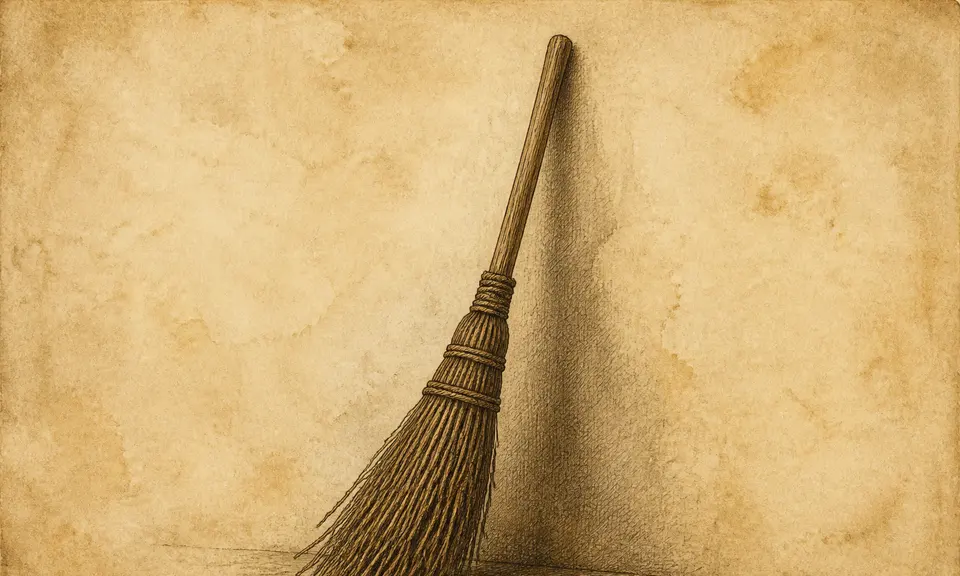
Broom

2 readings from 2 sources.

The image was generated by a model. It is not a period engraving and comes from none of the sources.

Both books read the broom through its use, and come out facing opposite ways. For Miller its condition decides everything: new brooms denote thrift and a rapid improvement in fortune, brooms seen in use mean loss in speculation, and a woman who loses her broom will prove a disagreeable and slovenly wife and housekeeper. an-Nabulsi reads the broom as a person before he reads it as a tool — the rough one is the refractory one among the servants, the soft one is the servant of the servants, and the broom points to the slave girl. Sweeping therefore does something to the household rather than to the floor: if the sweeper was rich, poverty is feared for him, and the sweeping of the house points to the death of a sick man in it, or to a moving from it to another, or to the scattering of his wealth away from him. To sweep open ground and gather its refuse makes him a man enriched by the desert country if that country is his, and if not, a tax collector or a taker of tithes, or a poor man begging and going about. And the reading ends where Miller's new broom began, with the broom as the passing away of care and vexation and the paying off of a debt.

This paragraph was generated by a model. It sums up the sources above, comes from none of them and is attributed to no one.

Arabic dream book

It is in a dream: if it was rough, it is the refractory one among the servants, and the soft one is the servant of the servants. And the broom points to the slave girl. So whoever saw that he swept his house with the broom, if he was rich, poverty is feared for him. And it is said that the sweeping of the house points to the death of a sick man in it, or to a moving from it to another, or to the scattering of his wealth away from him. And if he swept a ground and gathered its refuse or its growth, he gains wealth from the desert country if it is his; and if not, he becomes a tax collector or a taker of tithes, or a poor man begging and going about. And perhaps the seeing of the broom points to the passing away of care and vexation and to the paying off of a debt.

Section letter mim

The Perfuming of Mankind in the Interpretation of Dreams

Abd al-Ghani al-Nabulsi

before 1731; first printed Cairo 1858 · Arab-Islamic

carries the ancient tradition after Artemidorus

About this source

An Arabic dream book by the Damascene scholar al-Nabulsi, an alphabetical dictionary of two and a half thousand headwords. It draws on the ancient tradition directly: Artemidorus was translated into Arabic by Hunayn ibn Ishaq in the ninth century. The readings here almost always address the dreamer’s standing, property and faith rather than their feelings.

Rights: public domain

Where the text is from: https://shamela.ws/book/1217

Miller

To dream of brooms, denotes thrift and rapid improvement in your fortune, if the brooms are new. If they are seen in use, you will lose in speculation. For a woman to lose a broom, foretells that she will prove a disagreeable and slovenly wife and housekeeper.

Ten Thousand Dreams Interpreted; Or, What's in a Dream

Gustavus Hindman Miller

1901 · American Victorian

carries fragments of the ancient tradition without its system

About this source

An American dream book, the only one here that knows the telephone, the railroad or the elevator. Doctrinally it is the most degraded: it keeps fragments of the ancient tradition without the system that once held them together.

Rights: public domain

Where the text is from: https://www.gutenberg.org/ebooks/926