A silver bracelet: husband and wife come to blows.
Section Mirrors, rings, hairpins, bracelets and combs
4 readings from 3 sources.
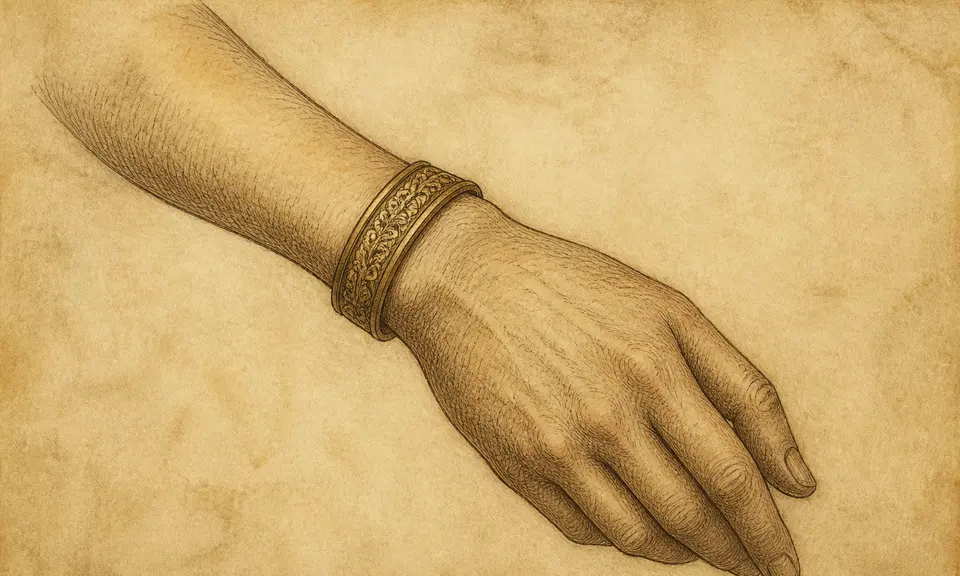
The Duke of Zhou needs six characters and they are the worst of the three: a silver bracelet, and husband and wife come to blows. Miller reads the bracelet as a promise: one on the arm, given by a lover or a friend, is assurance of an early marriage and a happy union, a lost one means losses and vexations, a found one good property coming into a woman's possession. an-Nabulsi reads it as a ring round the wrist and asks first who is wearing it: on a man's hand it is straits — but if the bracelets are of gold or silver, he is a man fit to strive in good works, and if he has enemies God will help him. The same band is an engagement in one book, a shackle in the second until the metal says otherwise, and a marriage coming apart in the third. Another Arabic reading moves the band up the arm and keeps the same division. For women the armlet is an adornment and a pride; for a man it is strength at his brother's hand, because the upper arm and the forearm are a brother. And then the metal turns on him again: a gold armlet counted against him is whips he is beaten with, the tighter the harder, and two silver ones mean his brothers forsake him.
This paragraph was generated by a model. It sums up the sources above, comes from none of them and is attributed to no one.
A silver bracelet: husband and wife come to blows.
Section Mirrors, rings, hairpins, bracelets and combs
If a man saw a bracelet on his hand in a dream, that is straits; but if the bracelets are of gold or of silver, he is a man fit to strive in good works, and if he has enemies, God, be He exalted, will help him.
Section letter sin
It is in a dream, for women, an adornment and a pride and a beauty; and for a man it is strength at his brother's hand, because the upper arm and the forearm are a brother. And if it was of gold, then when it is counted against him it is whips that he is beaten with; and whatever was tight is harder and comes quicker. Whoever sees that he has two silver armlets on him — his brothers forsake him and he sees from them what he dislikes, and whips reach him.
Section letter dal
To see in your dreams a bracelet encircling your arm, the gift of lover or friend, is assurance of an early marriage and a happy union. If a young woman lose her bracelet she will meet with sundry losses and vexations. To find one, good property will come into her possession.