An axe is a sign of faction and of harm and of fighting.
Passage Book II, 24
6 readings from 3 sources.
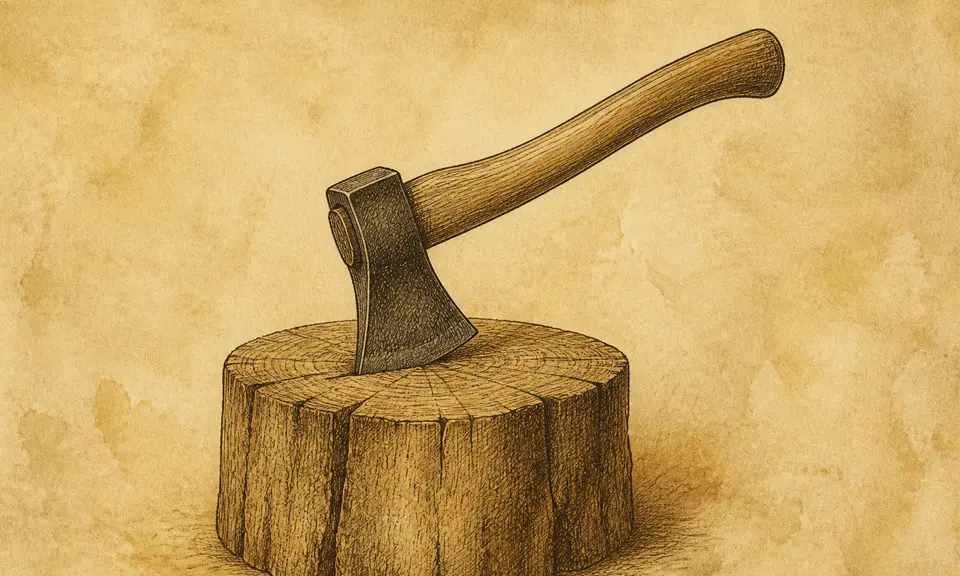
Six readings, and the one book that puts the two tools side by side reads them as opposites. Artemidorus has them one after the other: an axe is a sign of faction and of harm and of fighting, while a hatchet is a sign of a woman and of women's work — of women's work because it brings and draws things toward the one who wields it, and of a woman because of its name. Miller keeps both inside the dreamer's own character and divides them by vice rather than by size, so that seeing an axe foretells that whatever enjoyment he has will depend on his own struggle and energy, and for a young woman it means a lover who is worthy but not possessed of much wealth, while the hatchet means wanton wastefulness that exposes him to the evil designs of envious persons. Both go bad in the same way: broken or rusty, the axe is illness and the loss of money and property, the hatchet grief over wayward people. an-Nabulsi divides them not at all and reads neither as a weapon — the axe points to help and to provision, and if the dreamer was sick in his head he recovers, or else he needs cupping in the hollow of his nape, because the axe is the bone that overlooks that hollow, and then, with no argument offered, the axe is a male child. So the size of the blade is the whole difference in the Greek book, a difference of vice in the English one, and no difference at all in the Arabic.
This paragraph was generated by a model. It sums up the sources above, comes from none of them and is attributed to no one.
An axe is a sign of faction and of harm and of fighting.
Passage Book II, 24
A hatchet is a sign of a woman and of women's work: of women's work, because it brings and draws things toward the one who wields it; of a woman, because of its name.
Passage Book II, 24
Seeing it in a dream points to a man keeping steadily to his course; and perhaps the adze points to a living and provision and to benefits from slaves and a child or a wife. And the adze is the market inspector who disciplines men and sets the crooked straight; and perhaps it points to its owner's mouth, and to his servant and his slave; and it is said he is a greedy man who draws money to himself; and it is said it is a woman of long tongue; and perhaps the adze was an absent man who arrives, as an omen taken from its name.
Section letter qaf
It is in a dream: the seeing of it points to help and to provision; and perhaps, if he was sick in his head, he recovers, or he needs cupping in the hollow of his nape, because the axe is the bone that overlooks the hollow of the nape. And perhaps the axe points, for the sick man who has no need of eating, to the removal of his complaint. And the axe is a male child.
Section letter fa
Seeing an axe in a dream, foretells that what enjoyment you may have will depend on your struggles and energy. To see others using an axe, foretells, your friends will be energetic and lively, making existence a pleasure when near them. For a young woman to see one, portends her lover will be worthy, but not possessed with much wealth. A broken or rusty axe, indicates illness and loss of money and property.
A hatchet seen in a dream, denotes that wanton wastefulness will expose you to the evil designs of envious persons. If it is rusty or broken, you will have grief over wayward people.