Using a seal upon a document: fame.
Section Caps, belts, clothes, shoes and stockings
10 readings from 4 sources.
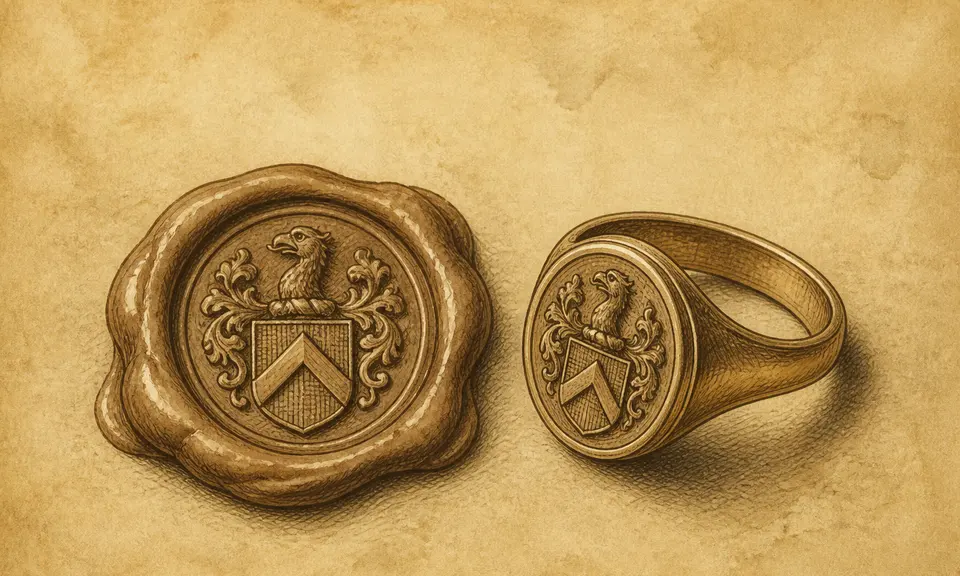
Using a seal upon a document brings fame in the Duke of Zhou, wearing one means your wife will bear a noble son, wearing a seal of trust sends your reputation abroad, and wearing one as a duke is greatly auspicious. Kaluga reads a firm seal as wellbeing for the unlettered — the mark standing in for the writing he cannot do — and Petersburg reads a broken seal as disorder. an-Nabulsi reads it by its material: safety, authority, a wife, a child, an office, and for the ruler the signet is his kingdom, its stone the force of his command. Another Arabic reading takes the act of sealing and turns the motif over: a seal emptied out, or in the hand of a jinn, or set upon the hearing or the sights or the mouths or the hearts, is a sign of God's hatred for a man who came by something through wrongdoing. And then it hears the word — sealing and the putting of a ring through a nose are near neighbours in Arabic — so it ends on nose-ringed camels and reads them as provision and as the subduing of enemies.
This paragraph was generated by a model. It sums up the sources above, comes from none of them and is attributed to no one.
Using a seal upon a document: fame.
Section Caps, belts, clothes, shoes and stockings
Wearing a seal: your wife will bear a noble son.
Section Caps, belts, clothes, shoes and stockings
highly auspicious
Wearing a seal as a duke: greatly auspicious.
Section Documents, brushes, inkstones and weapons
Wearing a seal and holding the staff: you will move house.
Section Documents, brushes, inkstones and weapons
Wearing a seal of trust: your reputation goes abroad.
Section Documents, brushes, inkstones and weapons
The seal changed and transferred: you will beget a noble son.
Section Documents, brushes, inkstones and weapons
In a dream, safety, authority, a wife, a child and an office, according to the stuff it is made of; and it points to the slave girl and to money. Whoever sees a ring of gold and had a wife with child, she bore a male. The signet, for the ruler, points to his kingdom, and its stone to the force of his command, and the engraving on it to what he wants. Whoever sees that the stone of his signet has fallen out, his child died, or he lost something of his money. The breaking of the signet points to the divorcing of the wife. The signet is the buying of a house or a beast, or a governorship; and if it was of gold, it is abasement for a man. And whoever saw that he put on a ring of iron — it points to a good he comes by after toil, because the toil of iron is great toil. And if it was of gold and had a stone, then it is good; and when it was without a stone, it points to works with no benefit in them. And rings of horn or of ivory are praised for women. And whoever saw that the king stamped with his seal — then it is a rule out of his rule, swift, which he does not go back on, because the seal is stronger than the signet. And whoever saw that he put on a ring of silver and made it carry where he wished and that was allowed to him — then he comes by rule, because the kingship of Solomon, peace be upon him, was from God the Exalted in his ring. And whoever saw that he wore the caliph's ring and was of the Banu Hashim or of the Arabs gets a lofty office; and if he was of the freedmen and had a father, then his father dies and he becomes his successor; and if he had no father, then his affair turns to the opposite of what he wishes. And whoever found a ring — money from the foreigners came to him, or a child was born to him, or he married a righteous woman, or he bought a slave girl. And whoever saw the stone of his ring loose — his rule is on the brink of removal. And if he saw that his ring was pulled off him and he was a governor, then it is his removal, or the going of his kingship, or the divorcing of his wife; and for the woman, the death of her husband or of the nearest of people to her. And it is said that the ring, when a man puts it on, points to his being fettered. And if he saw that the hoop broke and went and the stone remained, then his rule goes and his renown and his beauty and his bearing remain. And if the ring was of gold, then an innovation enters into his rule and something hateful reaches him in his religion and a treachery in his kingship, and he wrongs his subjects. And if the ring was tight, then he gets rest from a shrewish woman, or from a kingship with toil in it, or a care and a straitness that came from a king's side is lifted from him. And if he borrowed a ring, then he owns a thing that does not last. And whoever saw that he came by an engraved ring comes by a thing he never owned, like a house or a beast or a wife or a slave girl or a child. And if he saw rings being sold in the market, then it is the buying of the properties of the chiefs of the people. And if he saw that the sky rains rings, then sons are born in that year. And the unmarried man, when he saw that he put on a ring, marries a rich virgin woman; and if the ring was of gold, then she is a woman whose money has gone. And if he put it on his little finger and then took it off it and put it on his ring finger, and then took it off and put it on the middle finger, then he pimps for his wife. And if he saw his ring on his little finger once and on his ring finger once and on the middle finger, and he does nothing with it, then his wife betrays him. And if he sold his ring for dirhams or flour or sesame, then he parts from his wife with fine words or with money. And the stone is a child. And if the stone of his ring was of a jewel, then it is rule with standing and splendour and much money and renown and might. And if its stone was of peridot — then if he was a ruler, he is a brave, awe-inspiring, strong ruler; and if it is of the child, then it is a well-bred, clever child who comes back. And if its stone was a bead, then it is a weak and contemptible rule. And if the stone was a green ruby, then a believing, learned, understanding child is born to him. And the ring of wood is a hypocrite woman. And if a woman was given a ring, then she marries or gives birth. And the ring of gold, for women, when it is ascribed to the husband — then she sees gladness; and when it is ascribed to the child, then it is a beloved child; and when it is ascribed to money, then that kind of money and clothing and the rest holds his mastery. And whoever of the men wore a ring of gold — then the ruler fetters him, or fear or hardship or humiliation or care from his side reaches him, or someone grows angry at his child or his wife or his trade. And it is said whoever got a ring got a beautiful woman and good, or heard news that gladdens him. And whoever put on a ring and set its stone toward his palm — then he commits sodomy, if the dreamer was one who makes his depravity open; and otherwise he is a man who follows the way of the Prophet, God bless him and give him peace. And whoever put on a ring with two stones, one toward the inside of his palm and the other toward the back of the hand, and the engraving of each of them does not differ from the other, then he holds two offices, an outward and an inward. And whoever put on a ring of carnelian — barrenness went from him. And the taking of the ring from the king is a house he lives in, or silver he comes by, or a woman he marries, and its stone is her face. And the taking of the ring from God, mighty and majestic, is, for the ascetic and the worshipper, a keeping from evil at the completing of his end. And the taking of the ring from the Prophet, God bless him and give him peace, or from the learned man, is good tidings of the gaining of knowledge; and this is if the ring was silver, and if it was gold then there is no good in it, and likewise if it was iron, because that is the ornament of the people of the fire, or copper, for what is in it of the word for ill omen. And rings cast solid are always good; and the hollow ones with stuffing inside point to treachery and guile, because there is a hidden thing in them, or they point to the hope of a great thing and of many benefits, because their size is bigger than their weight. And the ring of lead is a rule with feebleness in it. And the ring of Solomon, peace be upon him — whoever saw that it is in his hand, it points to the widening of his kingdom and to his conquering of the great cities and to his reaching of his aims; and sometimes he is stripped of his kingship and then it comes back to him; and if he was of those who live by summoning the jinn, he got from that a wide provision. And whoever saw that he sent his ring to his people and they returned it — then he asks a people for a woman in marriage and they turn him down. And whoever saw that his ring was pulled off him with violence — then his rule goes from him, or what is ascribed to it. And whoever saw that it was lost — then something he hates enters into his rule, or into what is ascribed to it, and comes upon him.
Section letter kha
In a dream, if it was emptied out, or in the hand of a jinn, or if it seals upon the hearing or the sights or the mouths or the hearts, that is a sign of God's hatred for whoever came by something through wrongdoing and heedlessness. And perhaps it points to the stopping of the use of whoever was nose-ringed in a dream; and if he put a ring in the nose of camels or of others, it points to provision, or to the subduing of enemies.
Section letter kha
To see a firm seal means wellbeing for the unlettered.
To see a broken seal in a dream is a sign of disorder.