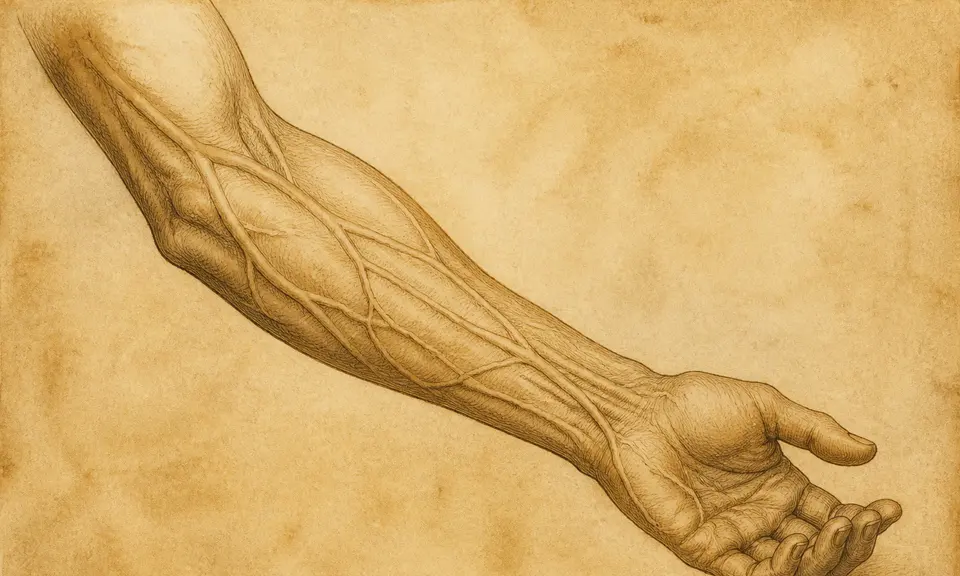
Vein

3 readings from 2 sources.

The image was generated by a model. It is not a period engraving and comes from none of the sources.

Miller reads the vein as a sign about the dreamer's standing: veins seen normal insure him against slander, bleeding veins mean a great sorrow with no escape, swollen veins a hasty rise to distinction and places of trust. an-Nabulsi reads the vein as a person — one of the man's household, of those reckoned to that limb — and then states the rule flatly: the beauty of the vein is his beauty and its corruption his corruption. Both books look under the skin for something about the dreamer's name; in the Arabic one it belongs to a relative. Another Arabic reading narrows it to the jugular and makes it carry both ends at once: a man's death and his life. From there it reads the vein as whoever the dreamer draws help from — two partners, two brothers, the parents, the wife together with the guardian who keeps her protection, or the money she keeps herself upright by.

This paragraph was generated by a model. It sums up the sources above, comes from none of them and is attributed to no one.

Arabic dream book

In a dream it is one of his household, of those who are reckoned to that limb; and the beauty of the vein is his beauty and its corruption his corruption. And whoever saw that he spoiled a vein by chance — then it is the death of one of his relatives of the standing of that vein; and sometimes he himself is the one cut off from his relatives by death, if the vision in its reading points to something hateful or to a calamity. And if the hatefulness of the reading was less than that, then it is a parting between him and them without death. And the veins of the son of Adam are his clan; so when he lost something of them, he parted from some of his relatives by death or by a cutting off. And the veins are of the standing of the water channels, because a man is like the tree, and for the owner of the garden they are his channels; so when something of them was cut, or he ate them, that is of the courses of his garden. And the veins, when they are bare in the dream and nothing covers them, point to the hardness of getting that with which his plants and his saplings and his estates are watered. And the veins known for blood-letting, and the throbbing ones with their accustomed and unceasing movements, point to life and to provisions and to the great ones of the household and of the clan. And whoever saw the veins of his hand running with blood — if he was rich, his money went in the measure of the blood; and if he was poor, he gained money of about that much.

Section letter ayn

The jugular vein points in a dream to a man's death and to his life; and perhaps it points to everyone in whom the dreamer has use and help, such as two partners, or two brothers, or the parents, or the wife and her guardian who keeps her protection, or her money by which she keeps herself upright.

Section letter waw

The Perfuming of Mankind in the Interpretation of Dreams

Abd al-Ghani al-Nabulsi

before 1731; first printed Cairo 1858 · Arab-Islamic

carries the ancient tradition after Artemidorus

About this source

An Arabic dream book by the Damascene scholar al-Nabulsi, an alphabetical dictionary of two and a half thousand headwords. It draws on the ancient tradition directly: Artemidorus was translated into Arabic by Hunayn ibn Ishaq in the ninth century. The readings here almost always address the dreamer’s standing, property and faith rather than their feelings.

Rights: public domain

Where the text is from: https://shamela.ws/book/1217

Miller

To see your veins in a dream, insures you against slander, if they are normal. To see them bleeding, denotes that you will have a great sorrow from which there will be no escape. To see them swollen, you will rise hastily to distinction and places of trust.

Ten Thousand Dreams Interpreted; Or, What's in a Dream

Gustavus Hindman Miller

1901 · American Victorian

carries fragments of the ancient tradition without its system

About this source

An American dream book, the only one here that knows the telephone, the railroad or the elevator. Doctrinally it is the most degraded: it keeps fragments of the ancient tradition without the system that once held them together.

Rights: public domain

Where the text is from: https://www.gutenberg.org/ebooks/926