If a man who has little money dreams that he finds a treasure, it means his hardships will be the less.
Passage Book II, 59
4 readings from 3 sources.
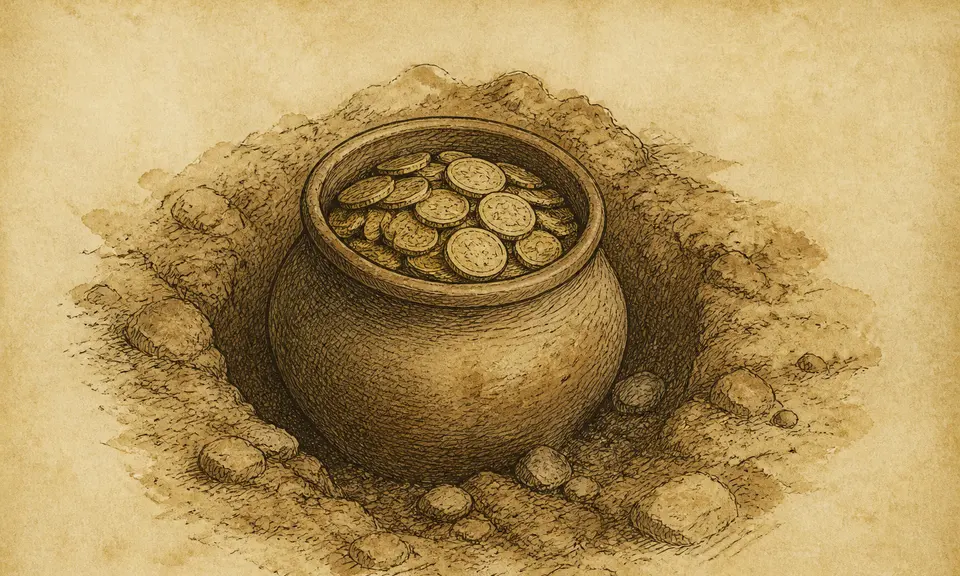
Artemidorus divides the treasure by how much of it there is, and the larger one is the worse. If a man who has little money dreams that he finds a treasure, it means his hardships will be the less; but a treasure of much money means griefs and cares, and often foretells death as well — and the reason is an image rather than a moral, that a treasure is not found without the earth being dug up, just as a corpse is not laid in it either. an-Nabulsi removes the money from the treasure altogether and puts knowledge in its place, since in a dream the treasure is knowledge, so whoever saw that he came upon one attains it, if he was a seeker of knowledge. The rest he sorts by the dreamer's trade — a merchant is granted trade and ready sale and generosity, a man of authority a governorship and justice, and so with every craftsman in his craft — and he ends by saying that treasures are offices a person attains in many lands. Miller stands between them and reads neither the ground nor the man: to dream that one finds treasures denotes being greatly aided in the pursuit of fortune by some unexpected generosity, and to lose them foretells bad luck in business and the inconstancy of friends. His treasure is money again, but it is somebody else's money, and what is really found is a benefactor.
This paragraph was generated by a model. It sums up the sources above, comes from none of them and is attributed to no one.
If a man who has little money dreams that he finds a treasure, it means his hardships will be the less.
Passage Book II, 59
But a treasure of much money means griefs and cares, and often foretells death as well: for a treasure is not found without the earth being dug up, just as a corpse is not laid in it either.
Passage Book II, 59
It in a dream is knowledge. So whoever saw that he came upon a treasure attains knowledge, if he was a seeker of knowledge; and if he was a merchant, he is granted trade and ready sale and generosity; and if he was a man of authority, he attains a governorship and justice; and likewise every craftsman in his craft. And treasures are offices that a person attains in many lands.
Section letter kaf
To dream that you find treasures, denotes that you will be greatly aided in your pursuit of fortune by some unexpected generosity. If you lose treasures, bad luck in business and the inconstancy of friends is foretold.