Trade

5 readings from 2 sources.

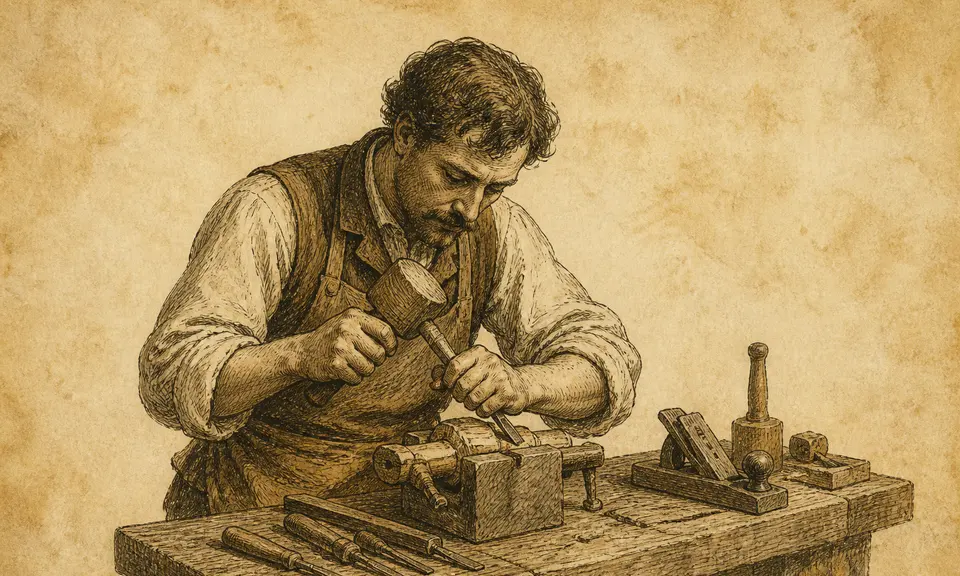
The image was generated by a model. It is not a period engraving and comes from none of the sources.

On this motif both books stand on the same rule and neither makes a secret of it. Artemidorus states it in so many words: whatever a man has learned and been taught and practised, and what works or crafts he carries on — to do and practise these in a dream and to attain what he set out to do is good for everyone, for what he has in mind he will accomplish and will bring about as he chose; but to fail at it is wretched, for it signifies the contrary of what he chose. He adds what to expect in between: it will be hard work and barely brought to completion, and the one who fails at it has, besides the wasted effort, mockery invariably following as well. And he turns it into a rule about the whole page of sources: whatever the crafts signify when a man dreams he is working at them, the craftsmen seen in a dream signify the same, and so do their workshops and their tools — with one small reservation to keep in mind about the tools. Miller has it in two sentences and says the same: to dream of trading denotes fair success in your enterprise, and to fail denotes that trouble and annoyances will overtake you.

This paragraph was generated by a model. It sums up the sources above, comes from none of them and is attributed to no one.

Greek dream book

Whatever a man has learned and been taught and practised, and what works or crafts he carries on — to do and practise these in a dream and to attain what he set out to do is good for everyone, for what he has in mind he will accomplish and will bring about as he chose; but to fail at it is wretched, for it signifies the contrary of what he chose.

Passage Book I, 52

It will be hard work and barely brought to completion; and for the one who fails at it, besides the wasted effort, mockery invariably follows as well.

Passage Book I, 52

And this too: whatever the crafts signify if a man dreams he is working at them, the craftsmen seen in a dream signify the same, and so do their workshops and their tools — with one small reservation kept in mind about the tools.

Passage Book I, 52

All the craftsmen a man meets and sees come out in a way like to their crafts.

Passage Book IV
Ὀνειροκριτικά (Oneirokritika)

Artemidorus of Daldis; edited by Rudolf Hercher

second century; Hercher’s edition 1864 · Greco-Roman

the source of the ancient tradition itself, which the others draw on

About this source

Five books of second-century Greek prose, not an alphabetical dictionary: the readings sit inside argued chapters and the author says of each one why it reads as it does. It is the source the other European and Arabic dream books draw on, including where they do not name it.

Rights: public domain

Where the text is from: https://archive.org/details/bub_gb_CRwTAAAAQAAJ

Miller

To dream of trading, denotes fair success in your enterprise. If you fail, trouble and annoyances will overtake you.

Ten Thousand Dreams Interpreted; Or, What's in a Dream

Gustavus Hindman Miller

1901 · American Victorian

carries fragments of the ancient tradition without its system

About this source

An American dream book, the only one here that knows the telephone, the railroad or the elevator. Doctrinally it is the most degraded: it keeps fragments of the ancient tradition without the system that once held them together.

Rights: public domain

Where the text is from: https://www.gutenberg.org/ebooks/926