Theater

4 readings from 2 sources.

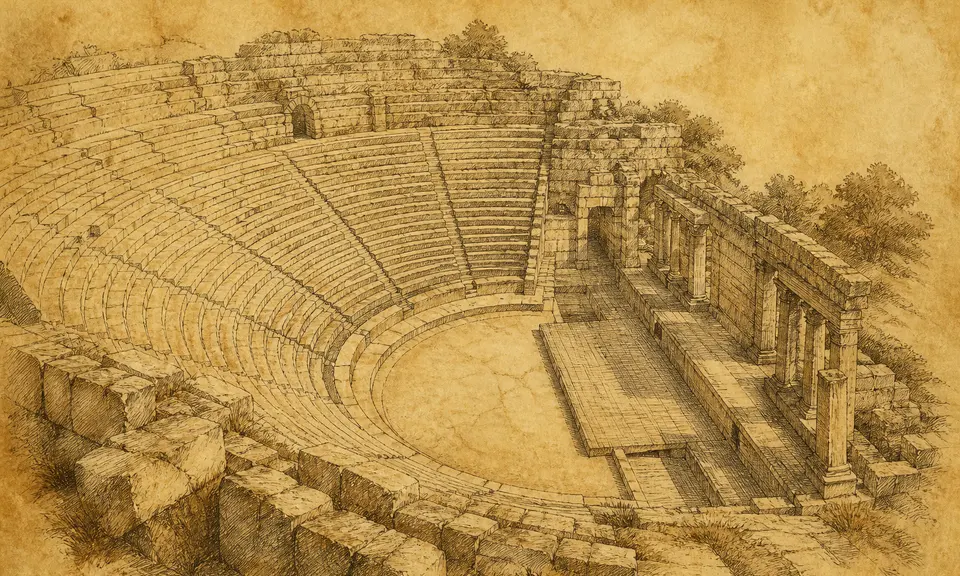
The image was generated by a model. It is not a period engraving and comes from none of the sources.

Artemidorus's three lines are not about sitting in the theatre but about dancing in it — masked and wearing the rest of the costume, and being well thought of and praised. For a poor man it means that he will grow rich, but not into old age, and the reason is a picture of the theatre itself: the dancer plays royal persons and has many attendants, yet after the play he is left alone. To a rich man it foretells some disturbances or lawsuits, because of the manifold entanglements of the plays. For a woman, whether rich or poor, it has not been observed to be good, for it prophesies great disgraces that the whole town talks of. Miller reads the theatre mainly from the seats: being there denotes much pleasure in the company of new friends and satisfactory affairs; a vaudeville theatre puts you in danger of losing property through silly pleasures; a grand opera means you will succeed in your wishes and aspirations; applauding and laughing means you will sacrifice duty to the gratification of fancy; and trying to escape during a fire foretells a hazardous enterprise. On one point the two books agree without saying it the same way: being on the stage is worse than being in the audience — in Artemidorus the dancer is left alone after the play, in Miller the player's pleasures are of short duration.

This paragraph was generated by a model. It sums up the sources above, comes from none of them and is attributed to no one.

Greek dream book

To dream of dancing in the theatre, masked and wearing the rest of the costume, and of being well thought of and praised, means for a poor man that he will grow rich, but not into old age: for the dancer plays royal persons and has many attendants, yet after the play he is left alone.

Passage Book I, 76

To a rich man it foretells some disturbances or lawsuits, because of the manifold entanglements of the plays.

Passage Book I, 76

For a woman, whether rich or poor, this has not been observed to be good: for it prophesies great disgraces that the whole town talks of.

Passage Book I, 76

Ὀνειροκριτικά (Oneirokritika)

Artemidorus of Daldis; edited by Rudolf Hercher

second century; Hercher’s edition 1864 · Greco-Roman

the source of the ancient tradition itself, which the others draw on

About this source

Five books of second-century Greek prose, not an alphabetical dictionary: the readings sit inside argued chapters and the author says of each one why it reads as it does. It is the source the other European and Arabic dream books draw on, including where they do not name it.

Rights: public domain

Where the text is from: https://archive.org/details/bub_gb_CRwTAAAAQAAJ

Miller

To dream of being at a theater, denotes that you will have much pleasure in the company of new friends. Your affairs will be satisfactory after this dream. If you are one of the players, your pleasures will be of short duration. If you attend a vaudeville theater, you are in danger of losing property through silly pleasures. If it is a grand opera, you will succeed in you wishes and aspirations. If you applaud and laugh at a theater, you will sacrifice duty to the gratification of fancy. To dream of trying to escape from one during a fire or other excitement, foretells that you will engage in some enterprise, which will be hazardous.
Ten Thousand Dreams Interpreted; Or, What's in a Dream

Gustavus Hindman Miller

1901 · American Victorian

carries fragments of the ancient tradition without its system

About this source

An American dream book, the only one here that knows the telephone, the railroad or the elevator. Doctrinally it is the most degraded: it keeps fragments of the ancient tradition without the system that once held them together.

Rights: public domain

Where the text is from: https://www.gutenberg.org/ebooks/926