In a dream it points to hypocrisy and to the covering up of foul deeds.
Section letter kha
6 readings from 2 sources.
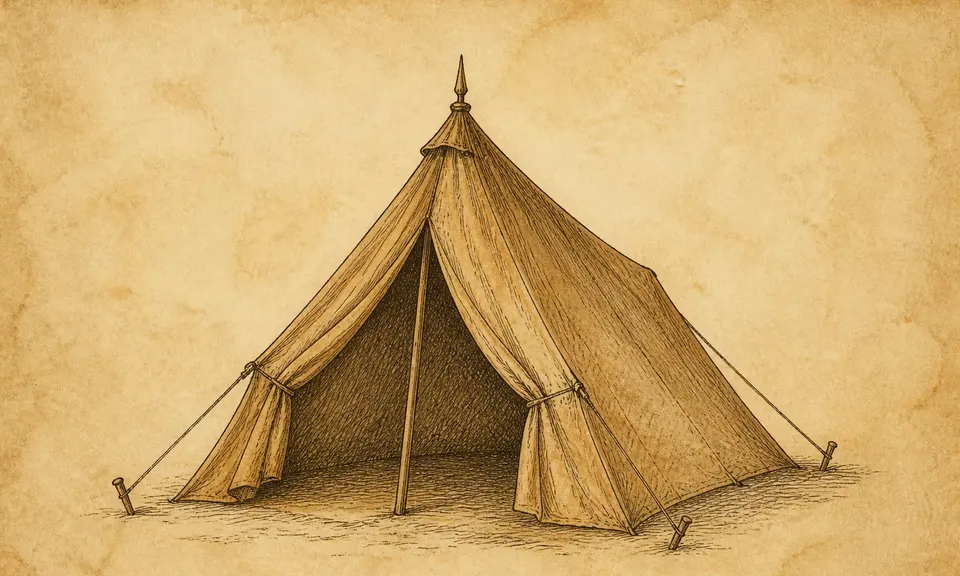
A tent is cloth that can be struck and moved, and each book takes one half of that. Miller reads the moving: a change in the dreamer's affairs, journeys with unpleasant companions, and trouble when the tents are torn or dilapidated. an-Nabulsi reads the cloth, and reads it as a screen, since in a dream it points to hypocrisy and to the covering up of foul deeds. One book watches the tent being carried somewhere; the other watches what is going on inside it. Another Arabic reading takes the pavilion and turns the cloth into a hierarchy: the pavilion is a sultan, the great tents rank below it and the dome below them, and a sultan seen coming out of any of them is losing part of his rule — folded up, his rule has perished or his life has run out. And one reading goes the other way, since a pavilion the dreamer does not know, green or white, means recovery, the rank of a martyr, or a visit to the graves of the righteous. A further Arabic reading takes the great tent and reads it almost entirely as martyrdom, for a man who owns one visits the graves of the martyrs and may leave the world a martyr, and a tent standing in open country means a martyr is there. The last Arabic reading takes the plain tent and reads who is under it: a tent pitched over a ruler is more rule, over a soldier an office, over a merchant a journey and honour — and it adds the one line that reads the weather, that many tents are clouds.
This paragraph was generated by a model. It sums up the sources above, comes from none of them and is attributed to no one.
In a dream it points to hypocrisy and to the covering up of foul deeds.
Section letter kha
It is in a dream a sultan, so that when a man sees a pavilion, he wins over his sultan's opponent. Whoever sees a pavilion pitched — that is a sultan and a king who leads armies, because the pavilions are the kings; and the great tents are likewise, except that they are below him, and the dome below the great tents. Whoever sees the sultan come out of any of these things — it points to his going out of part of his rule; and if they were folded up, his rule perished or his life ran out. And a pavilion or a great tent or a dome that a man does not know, if its colour was green or white, points to recovery and to reaching the rank of a martyr, or to visiting the graves of the martyrs and the righteous, or to a visit to Jerusalem.
Section letter sin
Whoever sees in a dream that a great tent was pitched over him comes by rule and his affair grows strong; so it is said. Whoever sees that he has a great tent visits the graves of the martyrs and prays for them; and perhaps he goes out of the world a martyr. Whoever sees a great tent, or a shelter, or a tent and the like, in open country or in a bare place or in a garden — a martyr is there. And the great tent is the king: if it was folded up, his rule perished and his life ran out. And if a king saw that he went out of a great tent, it points to his going out of some of his rule. And whoever came to own great tents, or took shade in anything of them — that points to a bounty bestowed on him that he is not able to render thanks for. And the unknown of the great tents and the awnings and the domes, if its colour was green or white, points to piety and to martyrdom and to his reaching that by worship; or it points to a visit to Jerusalem.
Section letter fa
In a dream it points to the journey, or the grave, or the wife, or the house; and many tents are clouds. Whoever sees that a tent was pitched over him — if he was a ruler, he came by an increase in his rule; and if he was a soldier, he took an office; and if he was a merchant, he travelled and came by good and honour and a fair slave girl. And if he saw a white tent facing his own, then he is a man who bids what is right and forbids what is wrong and turns back from a great sin. Whoever sees the moon in his tent falls in love with a boy or a girl from the ruler's house. And if he saw a tent of his own and he was on foot, he went on as a horseman or a leader. And the tent in a dream is a kingdom for whoever entered it or had it pitched for him; and if he was not fit for a kingdom, he came by honour from the ruler. And the shelter and the dome are below the tent. And the white tents that were not known in the dream are the graves of the martyrs, and so are the green ones. And whoever went out of a tent as one who parts from it goes out of his rule and is removed from his helpers. Whoever sees his tents folded up — that is his life run out and his rule run out. And the dome is a woman.
Section letter kha
They point in a dream, for the unmarried man, to the wife, and for the unmarried woman to the husband who covers her with his kindness. And perhaps the pitching of them and the entering beneath them points to covering oneself with deeds, and to cunning and trickery and hypocrisy.
Section letter ba
To dream of being in a tent, foretells a change in your affairs. To see a number of tents, denotes journeys with unpleasant companions. If the tents are torn or otherwise dilapidated, there will be trouble for you.