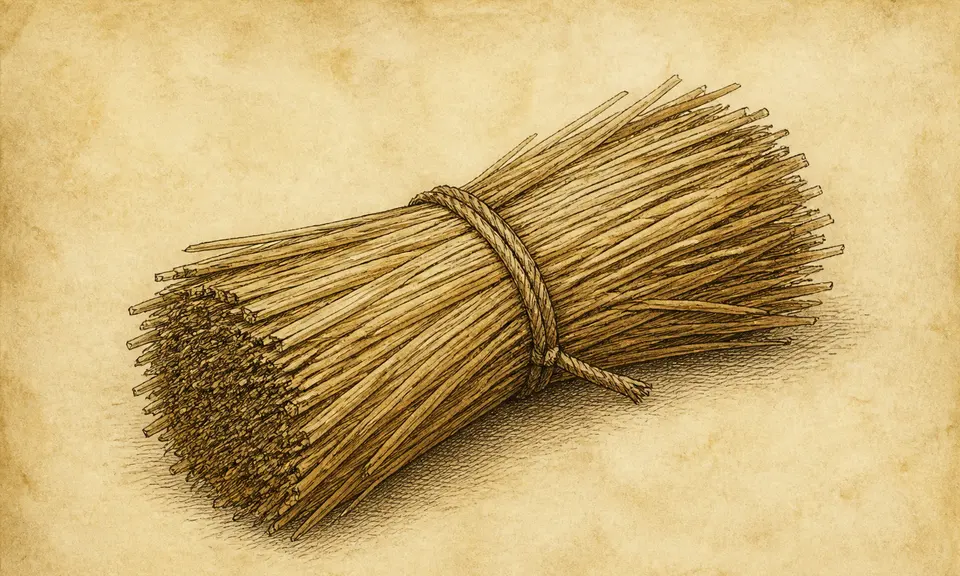
Straw

3 readings from 2 sources.

The image was generated by a model. It is not a period engraving and comes from none of the sources.

Miller splits the field in two and judges the halves differently: straw means a life threatened with emptiness and failure, and feeding it to stock means making poor provision for dependants, while hay — mown, carted, stacked in barns — means abundance, assured fortune and influential strangers. an-Nabulsi has no such division. Straw in a dream is much money and abundance for whoever brought it into his house, and he backs it with a story: Ibn Sirin looked at straw while awake and said, if only this had been in a dream. What is worthless in the yard is wealth in the sleep of both books, and only Miller holds it against the one who feeds it out.

This paragraph was generated by a model. It sums up the sources above, comes from none of them and is attributed to no one.

Arabic dream book

In a dream it is much money and abundance for the one who got it and brought it into his house. And it is told that Ibn Sirin, may God have mercy upon him, looked at straw while awake and said: if only this had been in a dream. And it is said whoever sees straw in his sleep, let him guard the purse — then it is money for the man who came by it, and its mark will show plainly upon him. And it is said the straw is money with weariness, because it is not reached except after threshing. And whoever sees in a dream that he has straw by him came by lawful provision, or by his own keep. And if he ate something of it in the dream, he ate its price, or came by hardship and drought and hunger. And if he put it in a place that does not suit it, such as chests and storerooms, it pointed to dearness and to the death of the beasts he feeds on it. And perhaps the straw pointed to the money of the alms, because it is of the surplus of money. And much straw in a town is a sign of much growing. And the straw is read by what was sown: the straw of wheat points to the wheat, the straw of the bean to the broad bean, and the straw of the chickpea to the chickpea — so whatever he saw in a dream of much or of little goes back on its own origin.

Section letter ta

The Perfuming of Mankind in the Interpretation of Dreams

Abd al-Ghani al-Nabulsi

before 1731; first printed Cairo 1858 · Arab-Islamic

carries the ancient tradition after Artemidorus

About this source

An Arabic dream book by the Damascene scholar al-Nabulsi, an alphabetical dictionary of two and a half thousand headwords. It draws on the ancient tradition directly: Artemidorus was translated into Arabic by Hunayn ibn Ishaq in the ninth century. The readings here almost always address the dreamer’s standing, property and faith rather than their feelings.

Rights: public domain

Where the text is from: https://shamela.ws/book/1217

Miller

If you dream of mowing hay, you will find much good in life, and if a farmer your crops will yield abundantly. To see fields of newly cut hay, is a sign of unusual prosperity. If you are hauling and putting hay into barns, your fortune is assured, and you will realize great profit from some enterprise. To see loads of hay passing through the street, you will meet influential strangers who will add much to your pleasure. To feed hay to stock, indicates that you will offer aid to some one who will return the favor with love and advancement to higher states.

If you dream of straw, your life is threatened with emptiness and failure. To see straw piles burning, is a signal of prosperous times. To feed straw to stock, foretells that you will make poor provisions for those depending upon you.

Ten Thousand Dreams Interpreted; Or, What's in a Dream

Gustavus Hindman Miller

1901 · American Victorian

carries fragments of the ancient tradition without its system

About this source

An American dream book, the only one here that knows the telephone, the railroad or the elevator. Doctrinally it is the most degraded: it keeps fragments of the ancient tradition without the system that once held them together.

Rights: public domain

Where the text is from: https://www.gutenberg.org/ebooks/926