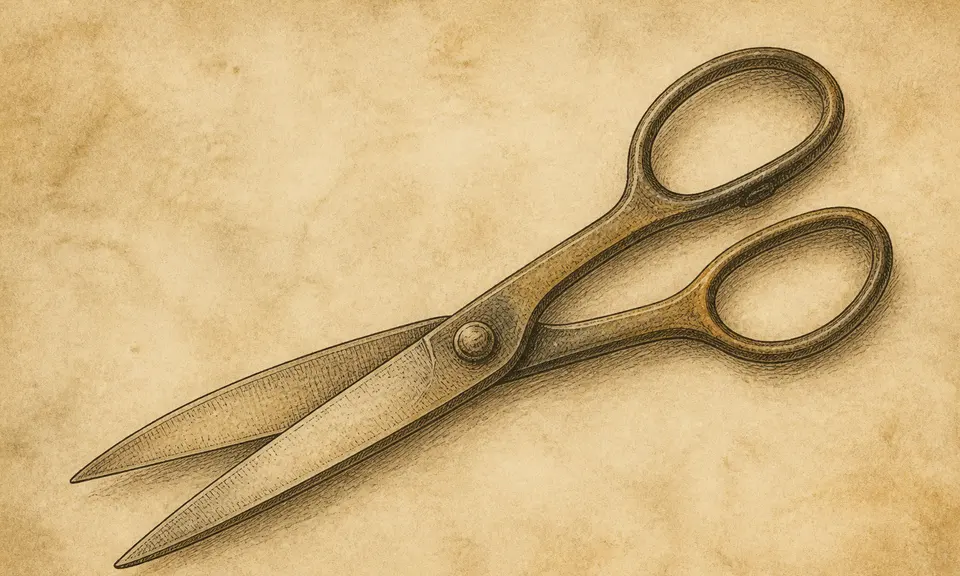
Scissors

2 readings from 2 sources.

The image was generated by a model. It is not a period engraving and comes from none of the sources.

Miller calls the scissors an unlucky omen and keeps them in the house: wives jealous and distrustful, sweethearts quarrelling into crimination, business dull, sharpened scissors work repulsive to one's feelings, broken ones quarrels and probable separations, lost ones a wish to escape unpleasant tasks. an-Nabulsi reads the cutting as slander, because one of the Arabic names for the tool is the shears, and then as the man in authority who divides the true from the false. And then he counts in the other direction: shears in the hand mean an increase — another slave, another child, another brother, another beast; and for an unmarried man, a marriage.

This paragraph was generated by a model. It sums up the sources above, comes from none of them and is attributed to no one.

Arabic dream book

Seeing them in a dream points to the cutting up of people's honour, because one of their names is the shears; and it may point to the man in authority who divides the true from the false. The scissors point to an increase of slaves and of children: whoever saw shears in his hand and had one slave gained another, or had a child and got another — and so with the brother and the sister and the beast: if he had one, he comes by another, unless he is unmarried, and then he marries. And whoever sees that a pair of shears came down upon him from the sky — then his life has run out, and so has the loan. And whoever cut people's beards or their clothes with the shears slanders them and betrays them. And it is said the shears point to two well-schooled partners. And whoever saw them in his hand — a brother was born to him of his mother. And whoever saw them in his hand while he shears hair or wool with them gathers much money. And the shears are a man who divides; so when he cut, he takes hold by knowledge. And whoever sees shears in his hand was driven in a dispute to the judge. And it is said the shears are a man who sets things right between people.

Section letter mim

The Perfuming of Mankind in the Interpretation of Dreams

Abd al-Ghani al-Nabulsi

before 1731; first printed Cairo 1858 · Arab-Islamic

carries the ancient tradition after Artemidorus

About this source

An Arabic dream book by the Damascene scholar al-Nabulsi, an alphabetical dictionary of two and a half thousand headwords. It draws on the ancient tradition directly: Artemidorus was translated into Arabic by Hunayn ibn Ishaq in the ninth century. The readings here almost always address the dreamer’s standing, property and faith rather than their feelings.

Rights: public domain

Where the text is from: https://shamela.ws/book/1217

Miller

To dream of scissors is an unlucky omen; wives will be jealous and distrustful of their husbands, and sweethearts will quarrel and nag each other into crimination and recrimination. Dulness will overcast business horizons. To dream that you have your scissors sharpened, denotes that you will work to do that which will be repulsive to your feelings. To break them, there will be quarrels, and probable separations for you. To lose them, you will seek to escape from unpleasant tasks.

Ten Thousand Dreams Interpreted; Or, What's in a Dream

Gustavus Hindman Miller

1901 · American Victorian

carries fragments of the ancient tradition without its system

About this source

An American dream book, the only one here that knows the telephone, the railroad or the elevator. Doctrinally it is the most degraded: it keeps fragments of the ancient tradition without the system that once held them together.

Rights: public domain

Where the text is from: https://www.gutenberg.org/ebooks/926