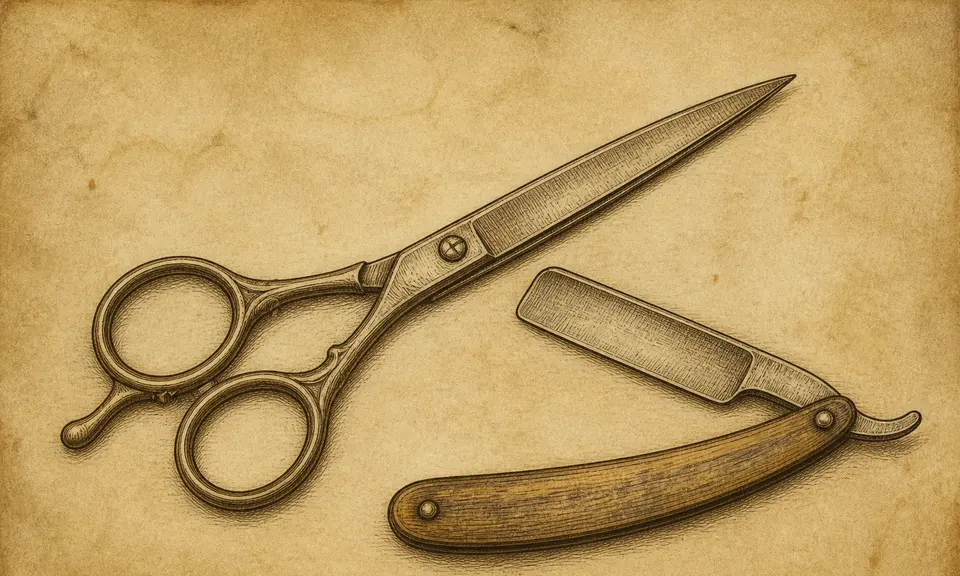
Scissors and razor

8 readings from 6 sources.

The image was generated by a model. It is not a period engraving and comes from none of the sources.

Scissors mean matters of dividing wealth in the Duke of Zhou and cutting something with them means you gain wealth — but a scissor blade snapping means the wife or concubine dies. Miller reads the razor as disagreements and contentions, cutting yourself with one as bad luck in a deal, and a broken or rusty one as worse. Kaluga reads tongs as oppression by enemies and Petersburg reads a mowing scythe as every kind of misfortune. Jagaddeva lists the razor and the scissors with the tongs, the drill and the needle and says all of them bring misfortune. an-Nabulsi is the only one to read the blade as a person: the razor is a male child, because the child is circumcised with it — and flesh sliced with it is the dreamer's own foul tongue, with which he lords it over people.

This paragraph was generated by a model. It sums up the sources above, comes from none of them and is attributed to no one.

Chinese dream book

Scissors: matters of dividing wealth.

Section Knives, swords, banners, bells and drums

Cutting something with scissors: you gain wealth.

Section Knives, swords, banners, bells and drums

A scissor blade snapping: wife or concubine dies.

Section Knives, swords, banners, bells and drums

The Duke of Zhou’s Interpretation of Dreams

attributed to the Duke of Zhou

classical, undated · Chinese

an independent branch, outside the ancient tradition

About this source

A Chinese dream book attributed to the Duke of Zhou. Headword and verdict are fused into one line of five to nine characters. Its readings frequently invert the European ones: poverty, a fallen tree, a death in the dream are auspicious.

Rights: public domain

Where the text is from: https://zh.wikisource.org/wiki/周公解夢

Indian dream book

The tongs, the net, the tube, the razor, the scissors, the drill, the rope and other instruments such as the wheel and the needle bring misfortune in a dream.

The Dream Key (Svapnacintāmaṇi) of Jagaddeva

Jagaddeva; edited and translated by Julius von Negelein

11th century; critical edition 1912 · Indian

an independent branch, outside the ancient tradition

About this source

The Sanskrit Svapnacintamani in Julius von Negelein’s critical edition. Catastrophe in the dream is usually the favourable omen — it is systematically inverted against the other sources.

Rights: public domain

Where the text is from: https://archive.org/details/von-negelein-der-traumschlussel-des-jagaddeva

Arabic dream book

In a dream it is a male child, because the child is circumcised with it. And when something is cut with it, it is the dashing of a matter he is engaged upon. And when flesh is sliced with it, or an animal is wounded with it, that is his foul tongue, by which he lords it over people with hurt. And seeing the razor points to rancour and enmity and to the tongue that gives pain.

Section letter mim

The Perfuming of Mankind in the Interpretation of Dreams

Abd al-Ghani al-Nabulsi

before 1731; first printed Cairo 1858 · Arab-Islamic

carries the ancient tradition after Artemidorus

About this source

An Arabic dream book by the Damascene scholar al-Nabulsi, an alphabetical dictionary of two and a half thousand headwords. It draws on the ancient tradition directly: Artemidorus was translated into Arabic by Hunayn ibn Ishaq in the ninth century. The readings here almost always address the dreamer’s standing, property and faith rather than their feelings.

Rights: public domain

Where the text is from: https://shamela.ws/book/1217

Russian dream book, Kaluga

To see tongs in a dream is a sign of oppression by your enemies.

A Dream Book, or The Interpretation of Dreams

1787 · Russian

carries the ancient tradition after Artemidorus

About this source

A Russian dream book from 1787, printed in pre-reform Cyrillic. The text keeps the doctrine of the ancient tradition almost intact. It comes out of OCR damaged, so the original wording held in the data is a reading of the damaged line rather than a transcription — the line itself is kept beside it.

Rights: public domain

Where the text is from: https://archive.org/details/sonnikiliistolkovaniesnovvybrannoeizna20

Russian dream book, St Petersburg

A mowing scythe, seen in a dream, foretells every kind of misfortune.

A New, Complete and Detailed Dream Book

1811 · Russian

carries the ancient tradition after Artemidorus

About this source

A fuller Russian dream book from 1811. In places it carries Artemidorus’s doctrine verbatim, though it never names him.

Rights: public domain

Where the text is from: https://archive.org/details/novyjpolnyjipodrobnyjsonnikoznachajusc28

Miller

To dream of a razor, portends disagreements and contentions over troubles. To cut yourself with one, denotes that you will be unlucky in some deal which you are about to make. Fighting with a razor, foretells disappointing business, and that some one will keep you harassed almost beyond endurance. A broken or rusty one, brings unavoidable distress.

Ten Thousand Dreams Interpreted; Or, What's in a Dream

Gustavus Hindman Miller

1901 · American Victorian

carries fragments of the ancient tradition without its system

About this source

An American dream book, the only one here that knows the telephone, the railroad or the elevator. Doctrinally it is the most degraded: it keeps fragments of the ancient tradition without the system that once held them together.

Rights: public domain

Where the text is from: https://www.gutenberg.org/ebooks/926