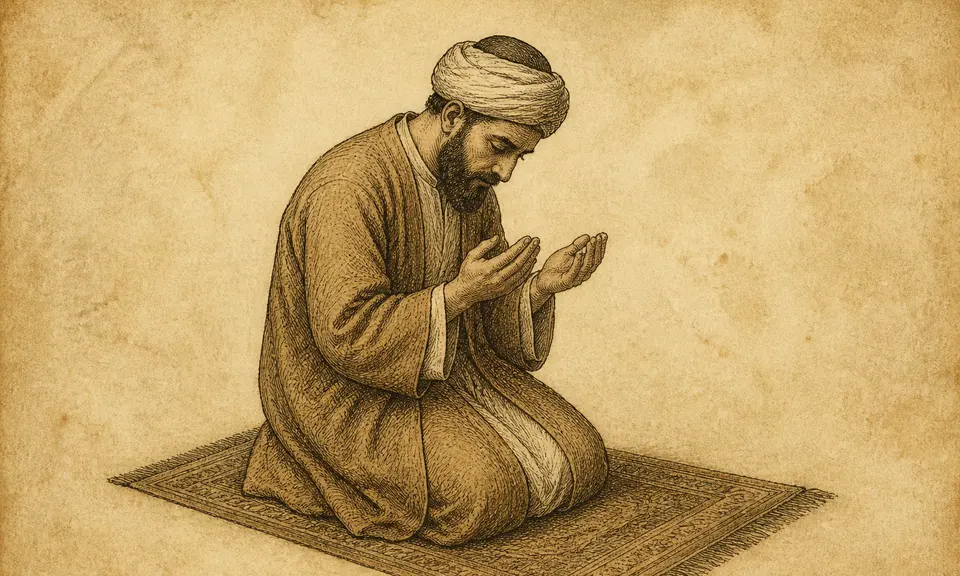
The obligatory prayer in a dream is, for the one praying, office or leadership or a message, and the discharging of a trust, or one of God's obligations, and safety. Whoever saw that he performed the prescribed prayer at its known time, with its ablution and its standing and its bowing and its prostration, turned towards the qibla and upright, discharges what God has made obligatory upon him — the pilgrimage, or a wrong done, or a debt — and keeps away from foul deeds and from what is forbidden. The obligatory prayer points to keeping a promise, to service for the idle man, and to peace with the man who has broken off from him. If he was the one leading the prayer, he gave a guarantee or took on a debt; and if he was one of those following, he was a burden upon somebody else. And the noon prayer is support, or the showing of what was hidden. And whoever sees that he prays the noon prayer gains what he needs and is given support in all that he seeks of the affairs of his world and of his hereafter, after he has seen that he completed the prayer, because the completing of the prayer points to the completing of what a man wants; and if he was imprisoned for a debt, it is paid for him and he is freed from his entanglement and his provision grows wide, when his prayer was completed. And whoever sees that he prays the noon prayer on a clear and bright day and rejoices in it does a work and takes a middle place in it and has splendour by it according to the clearness of that day; and if it was on a cloudy day, then it is a work done in care. And the afternoon prayer is an oath he swears, or that he swears for another, and it points to the sunset prayer. And if he saw that he prays the afternoon prayer, the matter he seeks is completed for him after difficulty and hardship; and if his prayer was not completed, the matter grows hard for him. And whoever sees that he prays the sunset prayer and the sun has set, then the matter he seeks, or that he is in, has ended and come to its last; and if his prayer was completed, the matter he wants was completed for him. And perhaps the night prayer points to the completing of his term and the running out of his life, because it is the last of his business and after it he rises to his sleep, which is likened to his death. And whoever sees that he prays the dawn prayer, and the dawn has broken, then it is a near promise that comes to him, whether it be good or evil. And whoever sees that he prays the night prayer rises to what God has made binding upon him of the affair of his household, such as food and drink and clothing and the rest. And if he saw that he prays the late evening prayer, he rises to the affair of his household and to that in which their souls find rest. And if he saw that he prays the morning prayer, which is the dawn, he begins with what cannot be done without of the living of his world, such as food and clothing, or he strives in the affair of his family and his children. And when he saw that he prays the afternoon prayer, then of that work he is in only the least of it has remained. And if he saw that he prays the noon prayer at the time of the afternoon, he pays a debt that is upon him. And if the noon or the afternoon prayer was cut off for him, he pays half of what is upon him. And the sunset prayer points to the finishing of works and to rest for the weary. And the last night prayer points to the covering of affairs. And perhaps the noon points to repentance or to deposition, for the Kaaba was turned at the noon prayer away from Jerusalem; and perhaps it points to the warring against Satan and against the enemies, for it is the time of the noonday heat and of the midday rest. And the afternoon points to getting the better and to victory when he prays it in the dream; and perhaps it points to guidance and to good and to keeping up what is due. And the sunset prayer points to parting from one of the parents, or from one who used to cover him with his favour or his standing, or to the deposing of the one the sun points to. And whoever sees that he prays the night prayer, perhaps it points to the making ready for journeys, or to marriage, or to moving from place to place; and perhaps the night prayer points to night blindness in the eye and to weakness of sight; and it points to the wideness of the term, for its distance from the dawn. And whoever prayed the dawn, it points to an oath he swears; and whoever prayed the afternoon gains ease after difficulty; and whoever prayed the sunset is in a matter that has ended and he reaches it soon. And whoever sees that he prays the night prayer, then that is cunning and deceit. And whoever sees that he prays the Friday prayer, what he increases is completed for him and he reaches what he hopes for. And whoever sees that he prays in a garden asks forgiveness of God most high; and if he prayed in a piece of sown land, he paid his debt; and if he prayed in the undressing room of the bath, he goes in to a boy. And if he saw that he prays seated for an excuse, his work is not accepted; and if he prayed upon his side, he falls sick; and if he prayed and went out of the mosque, he gains bounty and good. And whoever sees that he prays riding, a hard fear and fighting reach him. And if the prayer leader prayed riding, and with him were people, some of them bowing while riding and some of them prostrating while riding and some of them standing while riding, then if they were in a war or a fight, they are given victory. And if he saw that he prays the obligatory prayer as two bowings, he travels. And whoever sees that he prays and eats honey goes in to his wife while he is fasting. And if a woman saw that she prays the obligatory prayer as two bowings, she menstruates on that day of hers. And if he saw that a prayer had passed him by out of its time and that he finds no place in which to pray that prayer, then what he is in of a matter of religion or of the world grows hard for him. And if he left the prayer on purpose, whether denying it or acknowledging it, and intended to make it up, then he makes light of the law of Islam and hopes to set it right. And the Friday prayer in a dream is a sign of gladness and joy and of attending the feasts and the seasons and the pilgrimage, and of holding to a part of religion only. And the prayer of the feast of the breaking of the fast in a dream points to the paying of a debt and to the healing of the sick man and to deliverance from hardships and to the going of cares and vexations. And the prayer of the feast of the sacrifice points to the taking on of affairs and to the keeping of a will and to the fulfilling of a vow. And perhaps the two prayers point to the meeting of enemies, and their meeting is with the calling of God's greatness. And the forenoon prayer in a dream points to being clear of the setting of partners beside God and to the truthful oath; and perhaps its prayer points to joy, or to vexations and discord. And when the sound man prays the prayer of the sick man in a dream, it was a sign of a lessening of fortune and of wavering in word and in deed. And the joining of prayers, like the shortened prayer, points to travel; and perhaps that points to strife from an enemy. And praying upon the ground with nothing between points to the going in to women from behind and to women in the time of their menstruation, especially if the ground was unclean or was dust; and perhaps the doing of that points to poverty and need and lowness. And if he prayed with his private parts uncovered, it points to foulness in the fast, or to alms from what is unlawful, or he follows innovation and whim while he holds that he is upon the truth. And if he prayed the prayer of fear, it points to the making of a partnership and to bewilderment and scattering, or to the death throes of the sick man. And speaking in the prayer points to the taking back of what he gave, or of what he kept silent about, or of what he gave as alms. And if he was silent in the recitation in the place of speaking aloud in the dream, or spoke aloud in the place of silence, then if he was a judge, he judged unjustly and inclined to innovation and to showing off and to the seeking of a name; and if not, he hid what he has of truth or of money. And whoever outstrips his prayer leader in the dream in the bowing and in the prostration, it points to his going against his parents, or against one whose obedience is due from him; and perhaps he is afflicted with forgetfulness and absence of mind and with no sharpness and no memory. And the night prayers of the fast in a dream point to weariness and toil and to the paying of a debt and to the finding of guidance. And the prayer for rain in a dream points to fear and tightness and to the rising of prices and to the slackness of the living and to vexation by reason of crops and plantings and properties. And the prayer of the eclipse of the sun and of the moon points to striving to bring rest to the one the sun or the moon points to; and perhaps the doing of that in a dream points to the repentance of the wicked man and to the submission of the unbeliever; and perhaps it points to fear and to hardship from the side of the kings and the viziers; and it points to the appearing of a general sign. And the prayer of fear points to fellowship and agreement and the gathering of the word, and to safety from fear. And the prayer over the dead in a dream points to interceding for the one the dead man points to; and if the dead man was not known, it points to service for the idle man and to provision from a partnership; and perhaps the prayer over the dead in a dream points to a lack in the obligatory prayers, such as forgetfulness in the standing and in the sitting. And whoever sees that he prays over the dead man prays much for him and asks forgiveness for him; and if that prayer of his was completed, his supplication was completed. And if he was the leader at the prayer over the dead man, he took an authority from a hypocrite king. And if he saw that he says, may God pray over so and so, then that man is forgiven. And if he saw that he is behind the leader praying over a dead man, he attends a gathering in which they pray for the dead. And whoever sees that he prays over a bier intercedes for a man corrupt in religion. And whoever sees that he is on the day of Friday, or that he prays the Friday prayer, it points to a near relief and to a meeting with a beloved and to the meeting of a need that he seeks. And if he saw that he prays alone, that was given to him and not to another. And whoever has lost something and sees that he is at a feast, what he lost comes back to him; and if it was at the feast of the breaking of the fast, he comes out of straitness into width; and if it was at the feast of the sacrifice, then if he was a slave he was freed, or if imprisoned he was delivered, and if a debt was upon him his debt was paid and his care went and his state was set right. And whoever sees that he prays the prayer of the eclipse, it points to an event that comes down upon the emirs, or upon those whom people take as a model, or to the death of a learned man over whom they all pray. And whoever sees that he prays the prayer for rain, it points to an event that happens in that place, from a judge or a ruler whom they gather to and before whom they humble themselves, that he may lift from them what has come down upon them of that; and if they prayed it in full and turned back to their houses, what had struck them was relieved from them. And whoever sees that he prays the voluntary prayer or the supererogatory prayer, it points to increase and to soundness in his religion and to holding fast to the custom. And if a woman saw that she leads the men in prayer, she dies, because she is not fit for the leading, so that is only at death, when she goes before them and they pray over her; and likewise if a foreign man who is not good at the prayer nor at the recitation saw that he is a prayer leader, he dies. And whoever sees that he prays the custom is one who holds to the custom of the Prophet, God bless him and give him peace, and is clean of filth and has a good quality in him. And whoever sees that he prays a supererogatory prayer rises to the affair of the hereafter and gains by the measure of what he prayed of the supererogatory. And the obligatory prayer is the rising to the affair of his family in what cannot be done without, just as the custom is the rising to the manliness of the world for his family. And whoever sees that he prays the night prayers of the fast with the people, then they rise to the manliness of their families, and their loneliness goes and their breasts are made wide. And whoever sees that he is in a congregational prayer and their row is even, then they are a people who praise God much. And the voluntary prayer in a dream points to the showing of affection and to the drawing near to the hearts of people by service or by money; and if the dreamer was unmarried, he set himself to marry; and if he was married, he is granted two male children, by the word of the Most High: and We granted him Isaac and Jacob as something added. And if he prayed in the dream a supererogatory prayer for God most high, then if he was poor he grew rich and gained good; and if he kept the night vigil in the dream, he gained a high office. And the prayers of desire in a dream point to the seasons, and the attending of them is the carrying out of the promise. And the make up prayer points to the paying of a debt or to the repentance of the wicked man; and perhaps that points to the submission of the unbeliever and to the fulfilling of a vow. And the prayer of the seated man points in a dream to incapacity and failure and to being content with what comes easily of provision; and perhaps the prayer of the seated man points to a warning of the illness of his father or of his master or of one whose dutiful treatment is due from him. And the prayer of the asking of forgiveness points in a dream to the forgiving of sins; and if the people prayed it all together, it points to the coming down of rain; and if he was poor, he grew rich; and if he was barren, he was granted male children; and perhaps he is granted a provision from crops and plantings and properties. And the prayer of the praisings in a dream points to a gift and a present and to the pointing out of good and to the flowing of provision. And the prayer of the seeking of the better choice in a dream is scattering and bewilderment over what he wants in waking, and it points to a good end in what he resolves upon; and if the one seeking the better choice was of the people of the path, that was a lack in his path. And the prayer over the absent one in a dream is the seeking of a profit for which he travels, or for which another travels; and perhaps it points to the work of the bearing of witness and to the taking on of it. And praying at the grave in a dream points to the giving of rare gifts and presents for which no return is made; and perhaps that points to alms for those in want and for the deserving and for the people of the prisons. And the prayer of the greeting of the mosque points to spending upon the near of kin and upon the poor. And the prayer of heedlessness in a dream points to secret alms and to the seeking of favour from the people of injustice. And whoever sees that he prays a voluntary prayer by night or by day does a righteous work by which he draws near to God most high; and perhaps he brings together a people whose desires had been scattered. And whoever sees that he laughs in his prayer is much given to diversion away from the prayer. And whoever sees that he prays while he is drunk bears false witness. And whoever sees that he prays while he is in major impurity is corrupt in religion. And whoever sees that he prays to the east or to the west has swerved from Islam and works against the law. And whoever sees that he prays with his back to the qibla has cast Islam behind his back; and perhaps he sought his wife from behind, or he turns from her to another, or he is granted the pilgrimage. And whoever sees that the people of the mosque pray towards other than the qibla, their governor or their judge is put out of office. And whoever sees that a learned man prays towards other than the qibla, or does a work against the people of the custom, has gone against the law and followed his whim. And praying towards other than the direction of the qibla points to the drawing near to God most high and to the hearts of His servants by what is not permitted, or he turns in his journey to the direction to which he turns in the dream. And whoever sees that he prays towards the east is a man of bad school, full of slander against people, bold in acts of disobedience. And whoever sees that he does not know the qibla, or saw that he seeks it and is not guided to it, is bewildered in his religion. And whoever sees that he prays towards the Kaaba is upright. And whoever sees that he prays towards other than the qibla, and upon him are white clothes and he recites the Qur'an correctly, goes on pilgrimage.
Section letter ṣad