In a dream it points to the houses of fornicators, or to the prayer houses of worshippers who have withdrawn from people.
Section letter waw
4 readings from 3 sources.
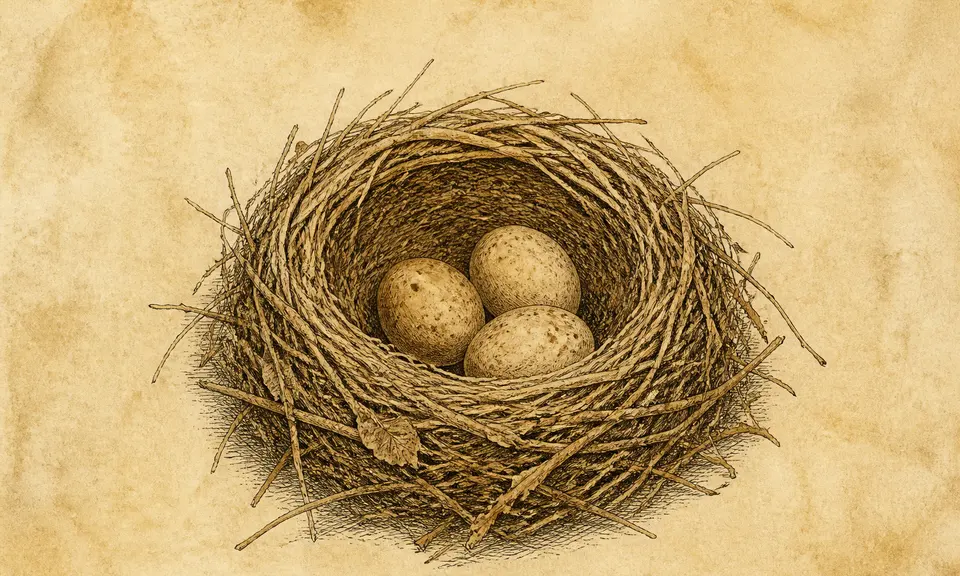
The Petersburg book is plain and kind: to find birds' nests is a sign of wellbeing and joy. Miller is domestic about it — birds' nests mean an interest in a prosperous enterprise, an empty nest sorrow through a friend's absence, hens' nests cheerful and obedient children, and a nest of broken or bad eggs disappointment and failure. an-Nabulsi reads the nest as a house, and names two kinds that could not be further apart: it points to the houses of fornicators, or to the prayer houses of worshippers who have withdrawn from people. Both of them are places somebody has hidden himself away in. Another Arabic reading takes the nest as a house belonging to whoever the bird stood for, and then as the wife, and then as the limit at which the man who knows stops. For a woman with child it is a birth. And it closes on the kind of distinction only this book bothers with: a nest is what is in a tree, and the same thing in a wall or a cave or a mountain has another name.
This paragraph was generated by a model. It sums up the sources above, comes from none of them and is attributed to no one.
In a dream it points to the houses of fornicators, or to the prayer houses of worshippers who have withdrawn from people.
Section letter waw
It is in a dream the house of whoever the bird stood for; and perhaps the nest points to the wife, and to the limit at which the man who knows stops. And seeing a nest, for a woman with child, is a birth. And the nest is what is in a tree: if it is in a wall or a cave or a mountain, it is a wakr.
Section letter ayn
To find birds' nests is a sign of wellbeing and joy.
To dream of seeing birds' nests, denotes that you will be interested in an enterprise which will be prosperous. For a young woman, this dream foretells change of abode. To see an empty nest, indicates sorrow through the absence of a friend. Hens' nests, foretells that you will be interested in domesticities, and children will be cheerful and obedient. To dream of a nest filled with broken or bad eggs, portends disappointments and failure. See Birds' Nest.