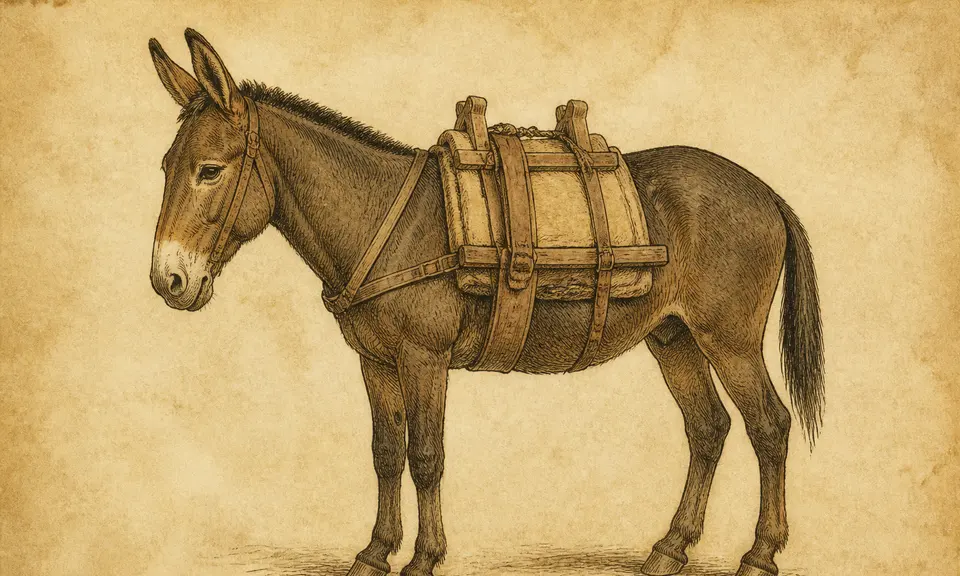
Mule

2 readings from 2 sources.

The image was generated by a model. It is not a period engraving and comes from none of the sources.

Both books tie the mule to marriage and both read it badly, but from different facts about the animal. Miller reads its behaviour: riding one means engaging in pursuits that cause the greatest anxiety, though an uninterrupted arrival brings substantial results; a white mule means a young woman will marry a wealthy foreigner, or one who while wealthy will not be congenial in tastes; mules running loose mean beaux and admirers but no offers of marriage; a kick is disappointment in love and marriage, and a dead mule broken engagements and social decline. an-Nabulsi reads its parentage and says it outright: the mule is travel, and it is a foolish man, a child of fornication, because his father is not of his kind. From its sterility the rest follows — riding it points to length of life and to the marrying of a barren woman who does not bear, and the mule simply is a barren woman. And he reads the direction of the ride, for which Miller has no equivalent: a mule with a blaze upon its brow and whiteness upon its legs ridden toward the qibla means the dreamer makes the pilgrimage, ridden toward any other side a journey with honour; a she-mule that is not his own means he betrays a man in the matter of his wife, and ridden reversed she is a forbidden woman.

This paragraph was generated by a model. It sums up the sources above, comes from none of them and is attributed to no one.

Arabic dream book

In a dream it is travel, and it is a foolish man, a child of fornication, because his father is not of his kind. So whoever saw that he rode a mule with a blaze upon its brow and whiteness upon its legs and turned toward the qibla makes the pilgrimage; if he turned toward another side, then it is a journey with honour. And the riding of the mule points to length of life and to the marrying of a barren woman who does not bear. And the she-mule with her saddle: either she is a fine and well-bred woman, or else it was a journey in which there is benefit. And if he rode a she-mule that is not his, he betrays a man in the matter of his wife. And if he rode her reversed, then she is a forbidden woman. And if it was ascribed to travel, then it is the cutting off of a doubt. And the mule is a barren woman.

Section letter ba

The Perfuming of Mankind in the Interpretation of Dreams

Abd al-Ghani al-Nabulsi

before 1731; first printed Cairo 1858 · Arab-Islamic

carries the ancient tradition after Artemidorus

About this source

An Arabic dream book by the Damascene scholar al-Nabulsi, an alphabetical dictionary of two and a half thousand headwords. It draws on the ancient tradition directly: Artemidorus was translated into Arabic by Hunayn ibn Ishaq in the ninth century. The readings here almost always address the dreamer’s standing, property and faith rather than their feelings.

Rights: public domain

Where the text is from: https://shamela.ws/book/1217

Miller

If you dream that your are riding on a mule, it denotes that you are engaging in pursuits which will cause you the greatest anxiety, but if you reach your destination without interruption, you will be recompensed with substantial results. For a young woman to dream of a white mule, shows she will marry a wealthy foreigner, or one who, while wealthy, will not be congenial in tastes. If she dreams of mules running loose, she will have beaux and admirers, but no offers of marriage. To be kicked by a mule, foretells disappointment in love and marriage. To see one dead, portends broken engagements and social decline.

Ten Thousand Dreams Interpreted; Or, What's in a Dream

Gustavus Hindman Miller

1901 · American Victorian

carries fragments of the ancient tradition without its system

About this source

An American dream book, the only one here that knows the telephone, the railroad or the elevator. Doctrinally it is the most degraded: it keeps fragments of the ancient tradition without the system that once held them together.

Rights: public domain

Where the text is from: https://www.gutenberg.org/ebooks/926