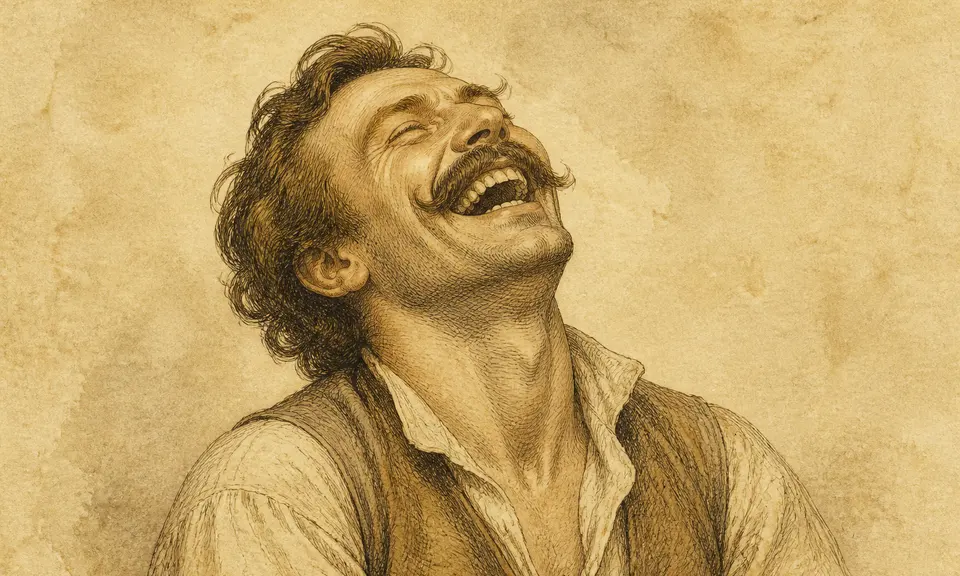
Laughing

2 readings from 2 sources.

The image was generated by a model. It is not a period engraving and comes from none of the sources.

Both readers divide the laughter, but along different cuts. Miller sorts by whose it is and what it is aimed at: your own cheerful laughter is success and good company, children's laughter is joy and health, laughter at another's discomfiture means you will injure your friends for your own ends, and mocking laughter heard means illness. an-Nabulsi sorts by how hard: a smile is sound and is gladness, but a guffaw that lays a man on his back is a sign of weeping, and then the flat sentence — laughter is grief. He also lets it leave the body: the earth laughing means plenty in that place, a dead man laughing is in favour in the hereafter, and in a man of rank laughter is lightness that points to his removal.

This paragraph was generated by a model. It sums up the sources above, comes from none of them and is attributed to no one.

Arabic dream book

It is in a dream a sign of joy and gladness, if it is not a guffaw and the man does not fall on his back; and if it is, it is a sign of weeping. And if the laughter came of a jest made in the dream, it points to the jester having no decency in waking; and so does laughter at mimicry, which points to falling into what is forbidden. And laughter is grief. Whoever sees that he laughs is given good news of a boy. And whoever sees his laughter as a smile is sound, and it is gladness, and perhaps it will be as he saw. And whoever sees the earth laughing — there will be plenty in that place. And if you see a dead man laughing, he is in favour in the hereafter. And laughter is lightness and foolishness, especially in men of rank, where it points to their removal.

Section letter ḍad

The Perfuming of Mankind in the Interpretation of Dreams

Abd al-Ghani al-Nabulsi

before 1731; first printed Cairo 1858 · Arab-Islamic

carries the ancient tradition after Artemidorus

About this source

An Arabic dream book by the Damascene scholar al-Nabulsi, an alphabetical dictionary of two and a half thousand headwords. It draws on the ancient tradition directly: Artemidorus was translated into Arabic by Hunayn ibn Ishaq in the ninth century. The readings here almost always address the dreamer’s standing, property and faith rather than their feelings.

Rights: public domain

Where the text is from: https://shamela.ws/book/1217

Miller

To dream that you laugh and feel cheerful, means success in your undertakings, and bright companions socially. Laughing immoderately at some weird object, denotes disappointment and lack of harmony in your surroundings. To hear the happy laughter of children, means joy and health to the dreamer. To laugh at the discomfiture of others, denotes that you will wilfully injure your friends to gratify your own selfish desires. To hear mocking laughter, denotes illness and disappointing affairs.

Ten Thousand Dreams Interpreted; Or, What's in a Dream

Gustavus Hindman Miller

1901 · American Victorian

carries fragments of the ancient tradition without its system

About this source

An American dream book, the only one here that knows the telephone, the railroad or the elevator. Doctrinally it is the most degraded: it keeps fragments of the ancient tradition without the system that once held them together.

Rights: public domain

Where the text is from: https://www.gutenberg.org/ebooks/926