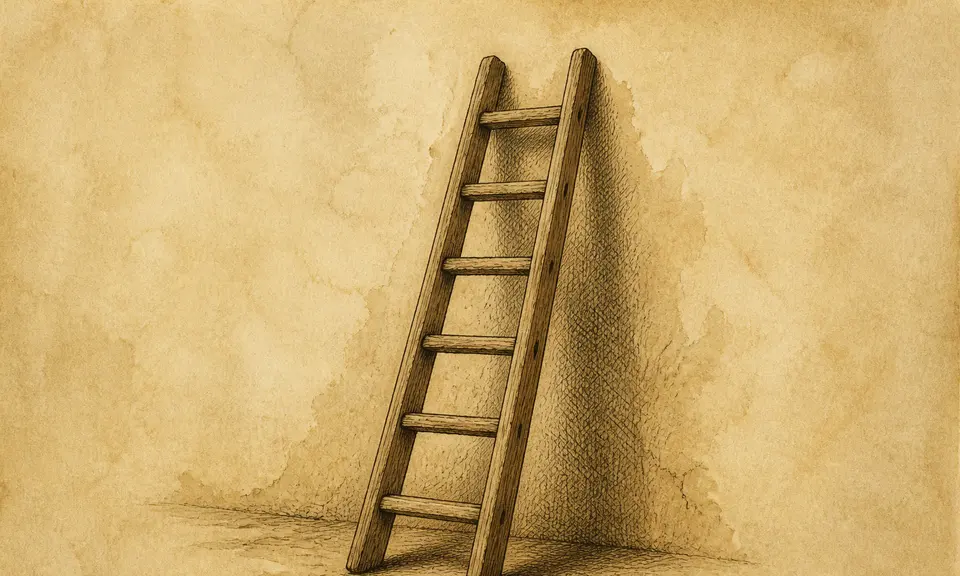
Ladder

2 readings from 2 sources.

The image was generated by a model. It is not a period engraving and comes from none of the sources.

Miller reads the ladder as direction. A ladder raised for the dreamer to ascend means his energetic and nervy qualifications will raise him into prominence; to ascend is prosperity and unstinted happiness, to descend is disappointment in business and unrequited desires, to fall is despondency and unsuccessful transactions for the tradesman and blasted crops for the farmer, and a broken ladder betokens failure in every instance. Even escape by ladder is directional — out of captivity, successful, though many perilous paths may intervene. an-Nabulsi does not read up or down at all. He reads the material and the futility: the ladder of ascent, of wood, is vexation and weariness and a cause of travel, and perhaps the climbing upon it was a commanding of what is right to one who does not obey it, or a forbidding of what is wrong to one who does not accept it and does not desist from it — a climb that changes nothing at the top. Yet the same few lines allow that the ladder perhaps points to safety in affairs, that wooden steps become a building means steadfastness and the covering of what he hopes to have covered over him, and that the ladder is a ruler for whoever saw it. Miller's dizzy climber will become haughty and domineering in his new position; the climber in the Arabic reading is talking to someone who is not listening.

This paragraph was generated by a model. It sums up the sources above, comes from none of them and is attributed to no one.

Arabic dream book

Of wood: the seeing of it in a dream is vexation and weariness and a cause of travel. And perhaps the ladder points to safety in affairs. And perhaps the climbing upon the wooden ladder was a commanding of what is right to one who does not obey it, or a forbidding of what is wrong to one who does not accept it and does not desist from it. And if the wooden steps became a building, perhaps that points to steadfastness in affairs and to the covering of what he hopes to have covered over him. And the ladder is a ruler for whoever saw it.

Section letter sin

The Perfuming of Mankind in the Interpretation of Dreams

Abd al-Ghani al-Nabulsi

before 1731; first printed Cairo 1858 · Arab-Islamic

carries the ancient tradition after Artemidorus

About this source

An Arabic dream book by the Damascene scholar al-Nabulsi, an alphabetical dictionary of two and a half thousand headwords. It draws on the ancient tradition directly: Artemidorus was translated into Arabic by Hunayn ibn Ishaq in the ninth century. The readings here almost always address the dreamer’s standing, property and faith rather than their feelings.

Rights: public domain

Where the text is from: https://shamela.ws/book/1217

Miller

To dream of a ladder being raised for you to ascend to some height, your energetic and nervy qualifications will raise you into prominence in business affairs. To ascend a ladder, means prosperity and unstinted happiness. To fall from one, denotes despondency and unsuccessful transactions to the tradesman, and blasted crops to the farmer. To see a broken ladder, betokens failure in every instance. To descend a ladder, is disappointment in business, and unrequited desires. To escape from captivity, or confinement, by means of a ladder, you will be successful, though many perilous paths may intervene. To grow dizzy as you ascend a ladder, denotes that you will not wear new honors serenely. You are likely to become haughty and domineering in your newly acquired position. See Hill, Ascend, or Fall.

Ten Thousand Dreams Interpreted; Or, What's in a Dream

Gustavus Hindman Miller

1901 · American Victorian

carries fragments of the ancient tradition without its system

About this source

An American dream book, the only one here that knows the telephone, the railroad or the elevator. Doctrinally it is the most degraded: it keeps fragments of the ancient tradition without the system that once held them together.

Rights: public domain

Where the text is from: https://www.gutenberg.org/ebooks/926