Public executioners and jailers are a sign of detention and of grief.
Passage Book III, 60
4 readings from 3 sources.
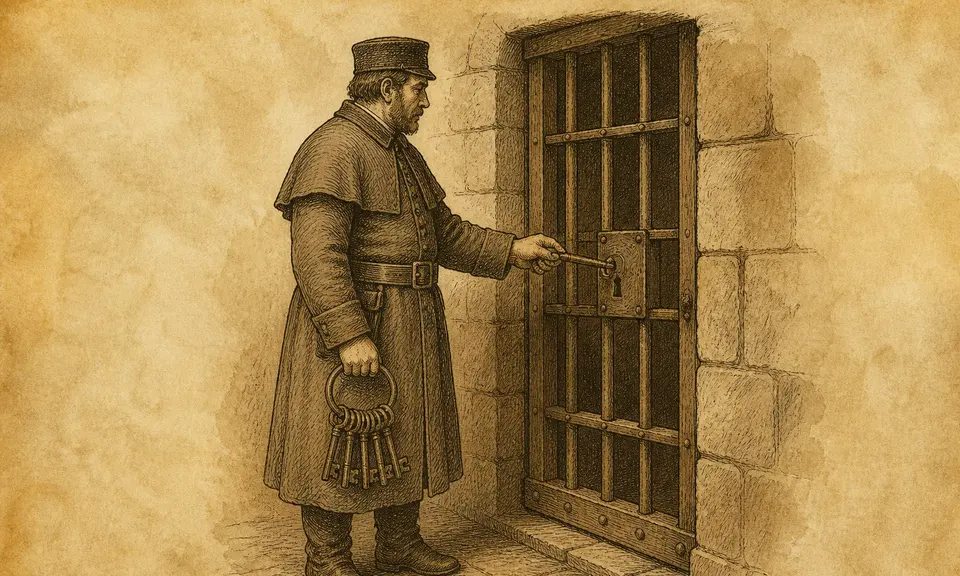
Miller keeps the jailer inside a plot and an-Nabulsi makes him a different trade altogether. For Miller, seeing a jailer denotes that treachery will embarrass the dreamer's interests and that evil women will enthral him; and to see a mob attempting to break open a jail is a forerunner of evil, with desperate measures used to extort money and bounties. The jail is a scene, and the people around it are doing things to the dreamer. Artemidorus reads the jailer together with the executioner and takes him for a condition rather than a scene: public executioners and jailers are a sign of detention and of grief, and they bind evildoers and expose what is hidden, for they come to those who have been convicted and caught in the act. an-Nabulsi gives one sentence and no scene: the jailer is, in a dream, the digger of graves. He is read by what he does, not by whom he does it to — he is the man who shuts people into a place they do not leave, and the Arabic simply names the other man who does that.
This paragraph was generated by a model. It sums up the sources above, comes from none of them and is attributed to no one.
Public executioners and jailers are a sign of detention and of grief.
Passage Book III, 60
They bind evildoers and expose what is hidden, for they come to those who have been convicted and caught in the act.
Passage Book III, 60
He is in a dream the digger of graves.
Section letter sin
To see a jailer, denotes that treachery will embarrass your interests and evil women will enthrall you. To see a mob attempting to break open a jail, is a forerunner of evil, and desperate measures will be used to extort money and bounties from you.