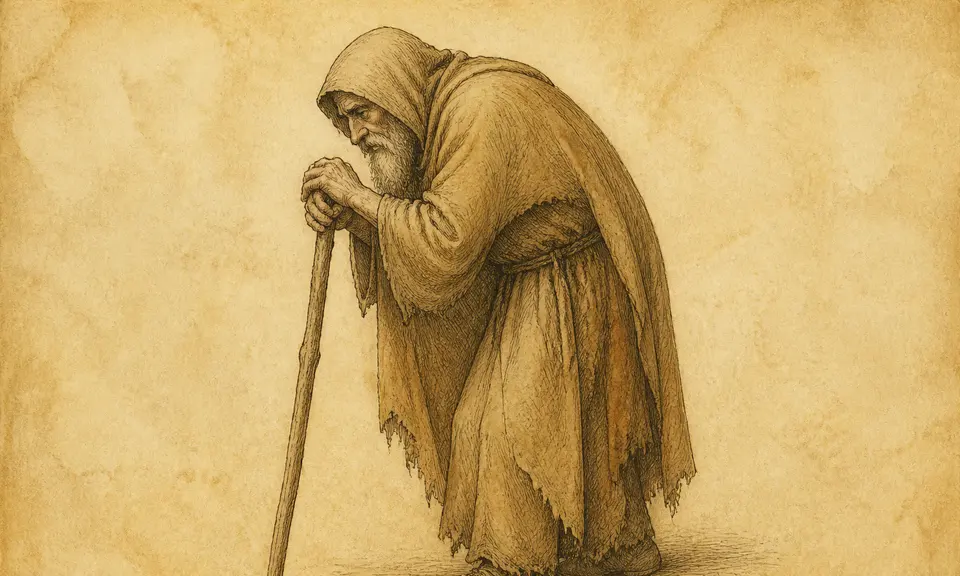
Hunchback

4 readings from 4 sources.

The image was generated by a model. It is not a period engraving and comes from none of the sources.

Miller needs one sentence: a hunchback means unexpected reverses in the dreamer's prospects. The Petersburg book reads the dreamer's own back and takes it as work — to see yourself hunchbacked means taking a heavy business upon yourself. Artemidorus has a case in which the hump was not on the person it seemed to be on: a man dreamed that he saw his own daughter with a hunched back, and the dreamer’s sister died — rightly and with reason, he says, for the family was not sound. an-Nabulsi starts from the same idea and then will not stop: a strong back among the dreamer's kin or children brings much money and property, and shrewdness with it; the hump carries fame, and also a debt heaped on a man that he cannot discharge, because the back is the place where the load sits; and it may be a burden of sin, or a long life, or children. The Russian and the Arabic reading meet exactly on the load, and the English one does not know about it.

This paragraph was generated by a model. It sums up the sources above, comes from none of them and is attributed to no one.

Greek dream book

For example, a man dreamed that he saw his own daughter with a hunched back. The dreamer’s sister died, rightly and with reason; for his family was not sound.

Passage Book IV, 29

Ὀνειροκριτικά (Oneirokritika)

Artemidorus of Daldis; edited by Rudolf Hercher

second century; Hercher’s edition 1864 · Greco-Roman

the source of the ancient tradition itself, which the others draw on

About this source

Five books of second-century Greek prose, not an alphabetical dictionary: the readings sit inside argued chapters and the author says of each one why it reads as it does. It is the source the other European and Arabic dream books draw on, including where they do not name it.

Rights: public domain

Where the text is from: https://archive.org/details/bub_gb_CRwTAAAAQAAJ

Arabic dream book

Whoever saw in a dream that he is hunchbacked will get much money and property from a strong back among his kin or his children, and with it he is granted shrewdness. The hump is a matter that carries fame, and a debt heaped upon him which he cannot discharge, because the back is the place of the load; and it may be a burden of sin. It is said the hump is a long life, and it is said it is children.

Section letter ḥa

The Perfuming of Mankind in the Interpretation of Dreams

Abd al-Ghani al-Nabulsi

before 1731; first printed Cairo 1858 · Arab-Islamic

carries the ancient tradition after Artemidorus

About this source

An Arabic dream book by the Damascene scholar al-Nabulsi, an alphabetical dictionary of two and a half thousand headwords. It draws on the ancient tradition directly: Artemidorus was translated into Arabic by Hunayn ibn Ishaq in the ninth century. The readings here almost always address the dreamer’s standing, property and faith rather than their feelings.

Rights: public domain

Where the text is from: https://shamela.ws/book/1217

Russian dream book, St Petersburg

To see yourself hunchbacked in a dream means taking a heavy business upon yourself.

A New, Complete and Detailed Dream Book

1811 · Russian

carries the ancient tradition after Artemidorus

About this source

A fuller Russian dream book from 1811. In places it carries Artemidorus’s doctrine verbatim, though it never names him.

Rights: public domain

Where the text is from: https://archive.org/details/novyjpolnyjipodrobnyjsonnikoznachajusc28

Miller

To dream of a hunchback, denotes unexpected reverses in your prospects.

Ten Thousand Dreams Interpreted; Or, What's in a Dream

Gustavus Hindman Miller

1901 · American Victorian

carries fragments of the ancient tradition without its system

About this source

An American dream book, the only one here that knows the telephone, the railroad or the elevator. Doctrinally it is the most degraded: it keeps fragments of the ancient tradition without the system that once held them together.

Rights: public domain

Where the text is from: https://www.gutenberg.org/ebooks/926