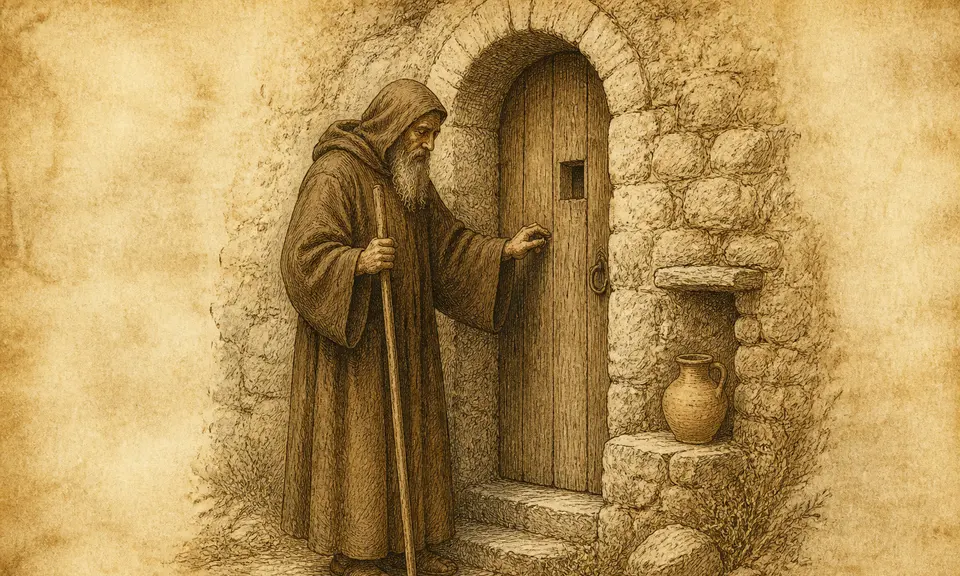
Hermit

2 readings from 2 sources.

The image was generated by a model. It is not a period engraving and comes from none of the sources.

Both books read the solitary man, and they disagree about whether he chose it. For Miller the hermit is sadness and loneliness, and the cause is outside the dreamer — the unfaithfulness of friends; being a hermit yourself turns into research into intricate subjects, and standing in a hermit's abode means being unselfish to enemies and friends alike. an-Nabulsi reads the cell rather than the man, and the withdrawal is deliberate and well thought of: solitude and a good way of life, pleasures cut off, wives divorced, brothers left behind. Then he turns it: for a sick man it is death, for the builder a rank and a raised standing, and because the cell stands for the chief himself, whatever collapses on it collapses on the man it stood for.

This paragraph was generated by a model. It sums up the sources above, comes from none of them and is attributed to no one.

Arabic dream book

It is in a dream a sign of solitude and of a good way of life, of withdrawal and of cutting off, of cutting off pleasures, of divorcing wives and leaving brothers behind; and perhaps seeing it points to illnesses and to giving up the appetites of food and drink. And if the seer is ill, he dies and his pleasures are cut off. And whoever has his cell at his command, or builds it in his dream, attains a rank and his standing is raised. And the cell, to whoever sees it fair and high and new in a dream, is a wife, or else beauty — especially if a king sees it so in his dream while he was aiming at an enemy, and perhaps that points to his overpowering and subduing him. And the cell points to being a stranger, and to desolation, and to breaking with companions, and seeing it points to concealment. And the cell points to the ruler and the chief and the man of name; so whatever reaches it or comes down upon it — demolition, collapse or anything else — its reading goes back upon the one it stood for.

Section letter ṣad

The Perfuming of Mankind in the Interpretation of Dreams

Abd al-Ghani al-Nabulsi

before 1731; first printed Cairo 1858 · Arab-Islamic

carries the ancient tradition after Artemidorus

About this source

An Arabic dream book by the Damascene scholar al-Nabulsi, an alphabetical dictionary of two and a half thousand headwords. It draws on the ancient tradition directly: Artemidorus was translated into Arabic by Hunayn ibn Ishaq in the ninth century. The readings here almost always address the dreamer’s standing, property and faith rather than their feelings.

Rights: public domain

Where the text is from: https://shamela.ws/book/1217

Miller

To dream of a hermit, denotes sadness and loneliness caused by the unfaithfulness of friends. If you are a hermit yourself, you will pursue researches into intricate subjects, and will take great interest in the discussions of the hour. To find yourself in the abode of a hermit, denotes unselfishness toward enemies and friends alike.

Ten Thousand Dreams Interpreted; Or, What's in a Dream

Gustavus Hindman Miller

1901 · American Victorian

carries fragments of the ancient tradition without its system

About this source

An American dream book, the only one here that knows the telephone, the railroad or the elevator. Doctrinally it is the most degraded: it keeps fragments of the ancient tradition without the system that once held them together.

Rights: public domain

Where the text is from: https://www.gutenberg.org/ebooks/926