Hedges

2 readings from 2 sources.

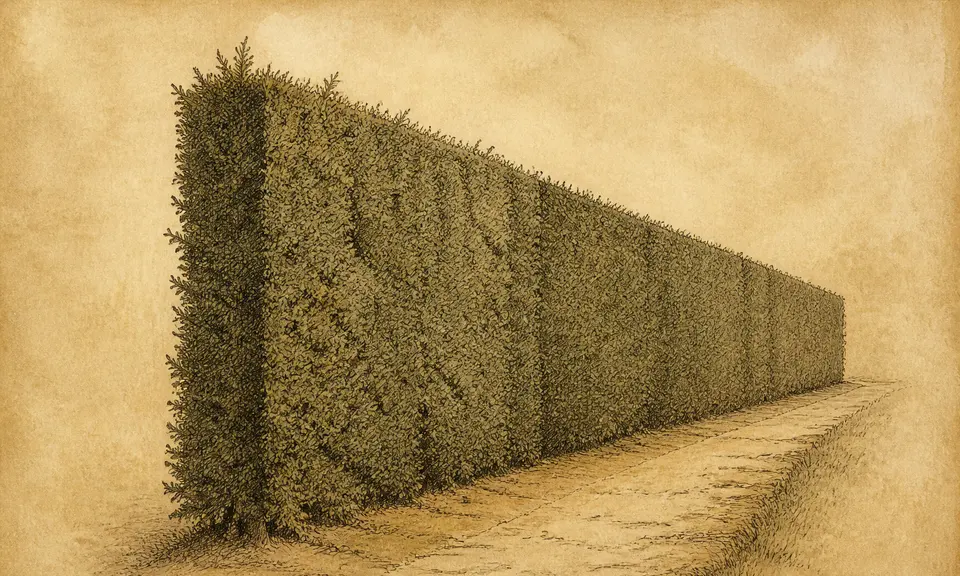
The image was generated by a model. It is not a period engraving and comes from none of the sources.

Miller reads the hedge as the lover's path and the businessman's tangle: evergreen hedges are joy and profit, bare ones distress and unwise dealings, a walk beside a green hedge means a marriage soon consummated, and being caught in a thorny one means being hampered by unruly partners — with quarrels and jealousy for anyone in love. an-Nabulsi reads the same green boundary as religion itself. The fence is the faith and the trees inside it are the duties of the faith; replace it with a stout wall or a moat and its owner stands higher and better defended. If the fence moves inward and fruit takes its place, religion is ruined and the world lost, the ignorant are put first and the learned last. And what the fence stands for depends on what the garden stands for: the owner's household and trade if the garden is the man, and the sons of the world, high and low, if the garden is the world.

This paragraph was generated by a model. It sums up the sources above, comes from none of them and is attributed to no one.

Arabic dream book

If in a dream it moves inward and the fruit takes its place, it points to the ruin of religion and the loss of the world, to the plotting of the army and the breaking of repentance, to the ignorant put first and the people of knowledge put last, to turning from the faith or going back on one's school, or to the common people rising and the people of standing coming down. And if what stood where the trees were became a strong wall, or a stout rampart, or a moat, that is stronger and better defended and of higher rank for its owner. The fence points to religion, and the rest of the trees are the duties of religion; and perhaps the fence points to the stronghold of the king and the other trees to the masters of his state. And if the garden stands for its owner, the fence spoken of is his household and his kin and his trade; and if the garden stands for the world, the fence is its sons, among whom are the high and the low, the generous and the mean. And perhaps the fence points to the religion of its owner and to his deeds, and to what shields him from the punishment of this world and the next.

Section letter sin

The Perfuming of Mankind in the Interpretation of Dreams

Abd al-Ghani al-Nabulsi

before 1731; first printed Cairo 1858 · Arab-Islamic

carries the ancient tradition after Artemidorus

About this source

An Arabic dream book by the Damascene scholar al-Nabulsi, an alphabetical dictionary of two and a half thousand headwords. It draws on the ancient tradition directly: Artemidorus was translated into Arabic by Hunayn ibn Ishaq in the ninth century. The readings here almost always address the dreamer’s standing, property and faith rather than their feelings.

Rights: public domain

Where the text is from: https://shamela.ws/book/1217

Miller

To dream of hedges of evergreens, denotes joy and profit. Bare hedges, foretells distress and unwise dealings. If a young woman dreams of walking beside a green hedge with her lover, it foretells that her marriage will soon be consummated. If you dream of being entangled in a thorny hedge, you will be hampered in your business by unruly partners or persons working under you. To lovers, this dream is significant of quarrels and jealousies.

Ten Thousand Dreams Interpreted; Or, What's in a Dream

Gustavus Hindman Miller

1901 · American Victorian

carries fragments of the ancient tradition without its system

About this source

An American dream book, the only one here that knows the telephone, the railroad or the elevator. Doctrinally it is the most degraded: it keeps fragments of the ancient tradition without the system that once held them together.

Rights: public domain

Where the text is from: https://www.gutenberg.org/ebooks/926