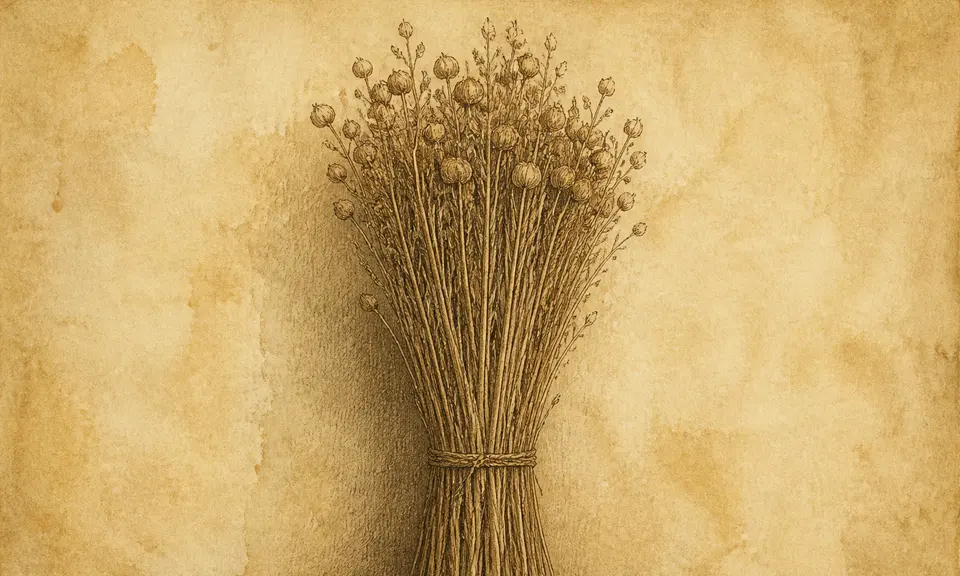
Flax

3 readings from 2 sources.

The image was generated by a model. It is not a period engraving and comes from none of the sources.

This is a page where the books do not contradict each other and the second one barely speaks. Artemidorus gives flax two readings and a reason for each: it is good for marriage and for partnership, because of its plaiting, and good for the things one hopes for, because of the setting of nets that is made from it, and the fine meshes and the like, with which men hunt what is far off and distant. The second Greek line is a closing remark on the whole group of plants that flax belongs to in his chapter rather than on flax alone: one must know that each of these foretells nothing ill-omened for merchants, for sellers, and for those who work with them or by means of them. Miller has one short line — to see flax in a dream, prosperous enterprises are denoted — and no reason at all. The two end in the same place, trade and good fortune, but only one of them says why: in the Greek book the plant means a marriage because it is plaited and a hope because it is made into nets, and the omen is in what is done with the fibre.

This paragraph was generated by a model. It sums up the sources above, comes from none of them and is attributed to no one.

Greek dream book

Flax is good for marriage and for partnership, because of its plaiting, and good for the things one hopes for, because of the setting of nets that is made from it, and the fine meshes and the like, with which men hunt what is far off and distant.

Passage Book III, 59

One must know that each of these foretells nothing ill-omened for merchants, for sellers, and for those who work with them or by means of them.

Passage Book III, 59

Ὀνειροκριτικά (Oneirokritika)

Artemidorus of Daldis; edited by Rudolf Hercher

second century; Hercher’s edition 1864 · Greco-Roman

the source of the ancient tradition itself, which the others draw on

About this source

Five books of second-century Greek prose, not an alphabetical dictionary: the readings sit inside argued chapters and the author says of each one why it reads as it does. It is the source the other European and Arabic dream books draw on, including where they do not name it.

Rights: public domain

Where the text is from: https://archive.org/details/bub_gb_CRwTAAAAQAAJ

Miller

To see flax in a dream, prosperous enterprises are denoted.

Ten Thousand Dreams Interpreted; Or, What's in a Dream

Gustavus Hindman Miller

1901 · American Victorian

carries fragments of the ancient tradition without its system

About this source

An American dream book, the only one here that knows the telephone, the railroad or the elevator. Doctrinally it is the most degraded: it keeps fragments of the ancient tradition without the system that once held them together.

Rights: public domain

Where the text is from: https://www.gutenberg.org/ebooks/926