To have more feet is good for a merchant.
Passage Book I, 48
11 readings from 3 sources.
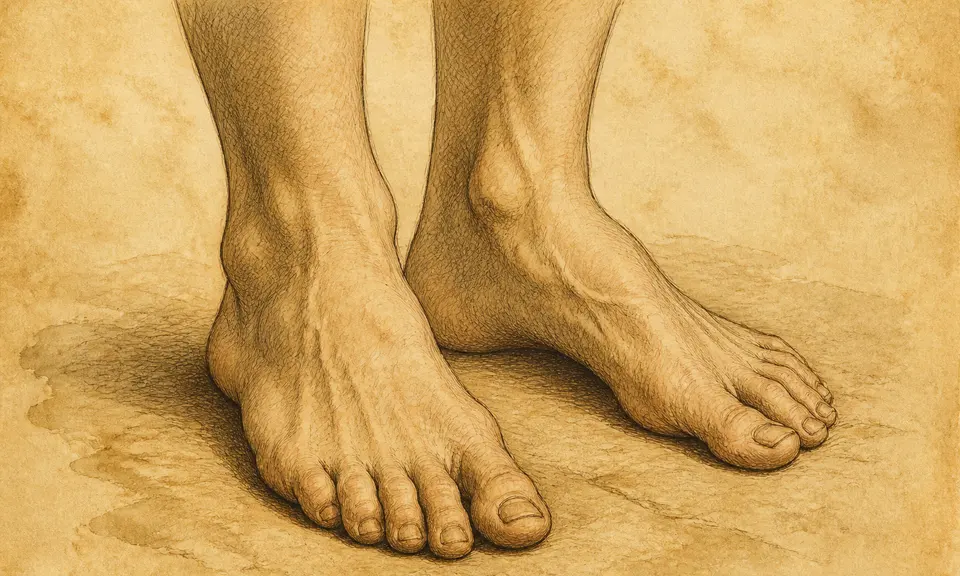
Miller reads the feet as standing in the world, and he is almost all bad news: seeing your own feet is despair and being overcome by another's will, hurting feet are humiliating family quarrels, swollen red feet mean a sudden break with your family and a dream he calls evil. Only other people's feet come out well — you will hold your rights pleasantly and win a place above the common walks of life. an-Nabulsi reads them as what a man stands on: the ornament of his money and his steadiness, the works of his righteousness, the toes his daughters and servants, the bones the money he leans on. Feet cut off mean the beast dead and the money gone; an extra foot means a wider living. And his measure for the foot is beauty — a fair foot is a man fair in his faith, and on a dead man it says he is in the garden.
This paragraph was generated by a model. It sums up the sources above, comes from none of them and is attributed to no one.
To have more feet is good for a merchant.
Passage Book I, 48
And for a shipowner, and for everyone who keeps hired men, for they will command more bodies than before.
Passage Book I, 48
To a helmsman who has seen the dream it means calm weather, for he will use more feet as the ship is rowed.
Passage Book I, 48
It is good for a poor man too, for he will get servants of his own.
Passage Book I, 48
To a rich man it means illness, so that, using not only his own feet but those of the men who carry him, he may seem to have more.
Passage Book I, 48
This dream has made many men blind as well, so that they should use someone to lead them by the hand; and it has bound criminals, so that they should go out with guards and not alone.
Passage Book I, 48
I know a man who dreamed that, while his whole body stayed still, his feet alone were walking, and that they went forward not even a little, and yet were moving. It happened that he was condemned to the bilge pump.
Passage Book I, 48
The ankles and the ends of the feet mean the same as the knees in other respects, but they differ in meaning not freedmen but slaves.
Passage Book I, 47
Like these is also what is written below. Syrus, the slave of Antipater, dreamed that the undersides of his feet were parched dry. He was burned alive.
Passage Book IV
They are in a dream the ornament of a man's money and his steadiness, the works of his righteousness and the support of his affairs. Their toes are the ornament of his daughters and his slave girls and his boys, and their bones are the money he leans on and his living. If he sees anything of them go up to heaven, he dies. Hair on the feet is a debt that has the upper hand over him. The two feet point to his beast and his money: if he sees his feet cut off, his beast perishes and his money goes; and if he sees that he has an extra foot, his living increases. A fair foot is a sign that the seer is fair in his faith and in his world, and if a dead man's feet are fair, it is a sign that he is in the garden. If a transgressor sees that his foot has become fair, it points to his repentance, and for an unbeliever it points to his taking Islam; and perhaps it points to boldness in affairs and to a good end in what he aims at, and a fair foot may point to the completing of the prayer. And the foot points to whatever holds him up: a master, a child, a mother, a beast, a vessel, a craft or money.
Section letter qaf
To dream of seeing your own feet, is omnious{sic} of despair. You will be overcome by the will and temper of another. To see others' feet, denotes that you will maintain your rights in a pleasant, but determined way, and win for yourself a place above the common walks of life. To dream that you wash your feet, denotes that you will let others take advantage of you. To dream that your feet are hurting you, portends troubles of a humiliating character, as they usually are family quarrels. To see your feet swollen and red, you will make a sudden change in your business by separating from your family. This is an evil dream, as it usually foretells scandal and sensation.