Chair

5 readings from 3 sources.

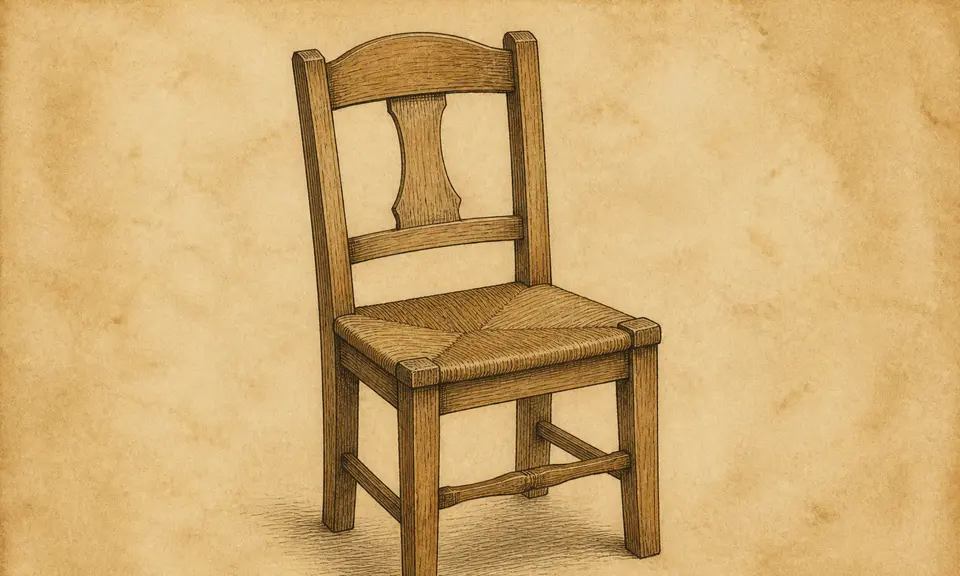
The image was generated by a model. It is not a period engraving and comes from none of the sources.

Miller reads the chair as a position one can lose: a chair means failure to meet an obligation and vacated profitable places, somebody taking your seat means being pestered for help, giving a woman your seat means yielding to her artfulness, a friend sitting motionless means news of his death or illness — and only the rocking-chair is kind, bringing friendly intercourse and, when the mother or wife is in it, the sweetest joys the earth affords. an-Nabulsi reads the chair as a position one is given, and sorts it by material: it is a rise that comes from the ruler or from a woman, iron means strength and victory, and wood means less than that, with hypocrisy in it. Artemidorus has one case and it is the birth-stool the Arabic reading ends on: a woman who longed for children dreamed that she saw seven birth-stools floating on the sea, and it came about that she conceived, but did not become a mother — the seven children she bore died before their time, still in swaddling bands.

This paragraph was generated by a model. It sums up the sources above, comes from none of them and is attributed to no one.

Greek dream book

A woman who longed for children dreamed that she saw seven birth-stools floating on the sea. It came about that she conceived, but she did not become a mother: the seven children she bore died before their time, still in swaddling bands.

Passage Book V

Ὀνειροκριτικά (Oneirokritika)

Artemidorus of Daldis; edited by Rudolf Hercher

second century; Hercher’s edition 1864 · Greco-Roman

the source of the ancient tradition itself, which the others draw on

About this source

Five books of second-century Greek prose, not an alphabetical dictionary: the readings sit inside argued chapters and the author says of each one why it reads as it does. It is the source the other European and Arabic dream books draw on, including where they do not name it.

Rights: public domain

Where the text is from: https://archive.org/details/bub_gb_CRwTAAAAQAAJ

Arabic dream book

In a dream it is a rise that comes from the ruler or from a woman; if it is of iron it is strength and victory, and if it is of wood it is less than that, and there is hypocrisy with it. And whoever sees that he is sitting on a chair — then he becomes an agent or a guardian; and if he is fit for authority, he is invested with rule and office and attained elevation; and if he was away, he came back to his household and attained what he wanted. And whoever sees that he is sitting on a chair with clothes upon it, or on his couch — then he attains lofty knowledge and good that comes quickly and swift kindness and might and elevation. And the chair points, for the holders of offices, to height and elevation and to wives and children and lofty dwellings and beasts and garments. And whoever sees that he got a chair and sat upon it got authority, or he marries a woman according to the measure of the chair and its form; and it is said, if he had a woman with child, she brought forth a son; and it is said he dies a martyr. And whoever sees that his chair broke — then it is a sign of his death, or of the death of his wife, or of his parting from her, or of the fall of his standing and his authority. And the chair is gladness and a rank that comes quickly for whoever sat upon it; and the chair, for whoever sat upon it, points to winning through in the hereafter, according to its measure and its beauty and its height and its newness; and there is no good in it for the sick man. And the sitting of the woman with child upon it gives notice of the stool of the midwife, which she mounts at the birth: and if upon it there was a crown on her head, she bore a boy; and if it was a net, or the sheath of a sword, or a spear butt without a spear, she bore a girl. And the sight of the Seat of God Most High, which is above the heavens, is a sign for whoever is of the people of knowledge of the loftiness of degrees and of high offices, and above all if he saw it in a perfect condition; and it may be for the woman with child a deliverance from her hardship, and for the unmarried a spouse, and for the married a child; and it points to travel for the people of journeys; and for the sick man, to his being carried upon the bier of death, or a beast he rides, or a house he dwells in, or a practice he sets up by which he becomes known and by which those after him come to know him.

Section letter kaf
The Perfuming of Mankind in the Interpretation of Dreams

Abd al-Ghani al-Nabulsi

before 1731; first printed Cairo 1858 · Arab-Islamic

carries the ancient tradition after Artemidorus

About this source

An Arabic dream book by the Damascene scholar al-Nabulsi, an alphabetical dictionary of two and a half thousand headwords. It draws on the ancient tradition directly: Artemidorus was translated into Arabic by Hunayn ibn Ishaq in the ninth century. The readings here almost always address the dreamer’s standing, property and faith rather than their feelings.

Rights: public domain

Where the text is from: https://shamela.ws/book/1217

Miller

To see a chair in your dream, denotes failure to meet some obligation. If you are not careful you will also vacate your most profitable places. To see a friend sitting on a chair and remaining motionless, signifies news of his death or illness.

Rocking-chairs seen in dreams, bring friendly intercourse and contentment with any environment. To see a mother, wife, or sweetheart in a rocking chair, is ominous of the sweetest joys that earth affords. To see vacant rocking-chairs, forebodes bereavement or estrangement. The dreamer will surely merit misfortune in some form.

To think, in a dream, that some one has taken your seat, denotes you will be tormented by people calling on you for aid. To give a woman your seat, implies your yielding to some fair one's artfulness.

Ten Thousand Dreams Interpreted; Or, What's in a Dream

Gustavus Hindman Miller

1901 · American Victorian

carries fragments of the ancient tradition without its system

About this source

An American dream book, the only one here that knows the telephone, the railroad or the elevator. Doctrinally it is the most degraded: it keeps fragments of the ancient tradition without the system that once held them together.

Rights: public domain

Where the text is from: https://www.gutenberg.org/ebooks/926