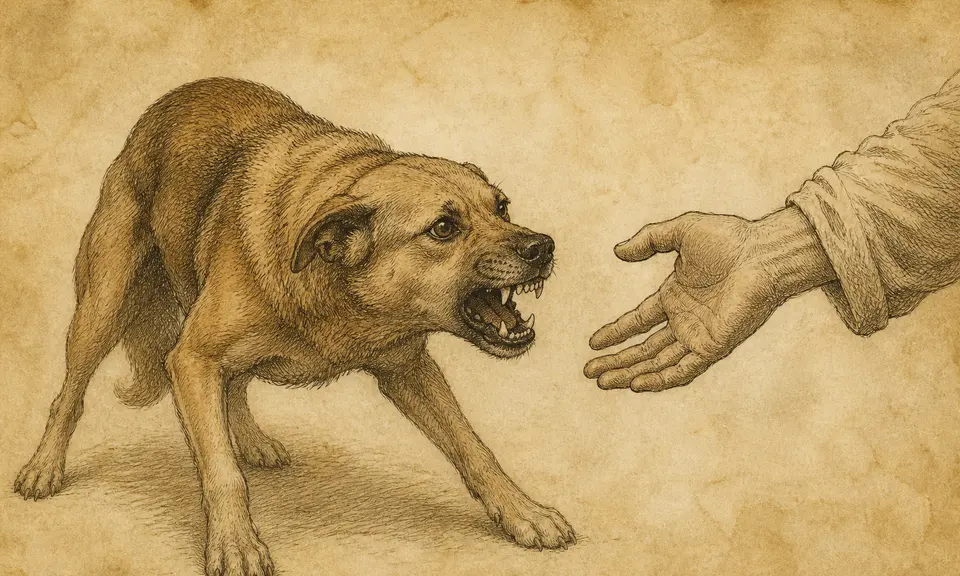
Bite

2 readings from 2 sources.

The image was generated by a model. It is not a period engraving and comes from none of the sources.

Miller reads the bite as regret: the dream omens ill, implies a wish to undo work that is past undoing, and threatens losses through an enemy. an-Nabulsi reads it as rage and reads it in the Qur'an twice: biting the fingertips is rancour, by the verse about biting fingertips in rage, and biting one's own fingers is the wrongdoer's gesture, by the verse about the day the wrongdoer bites his hands. He allows one opposite reading, that biting may be an excess of love — and one plain one, that a man who bites his own flesh and spits it out is a slanderer.

This paragraph was generated by a model. It sums up the sources above, comes from none of them and is attributed to no one.

Arabic dream book

It is in a dream a scheme; and it is said rancour; and it is said biting points to excess of love, because what is bitten was from a man or from something else, and it points to a trial. And whoever bites his own flesh and throws it to the ground is a slanderer. And whoever sees a man biting his fingertips is full of rancour, by His word, exalted be He: “they bite their fingertips at you in rage”. And whoever sees that he bit his fingers, regret reaches him; and it is said he is a wrongdoer, by His word: “and on the day the wrongdoer bites his hands”. And a bite that draws blood is a trial in sin; and biting is an excess of rage. And whoever sees that a man bit him attains gladness and joy in the first part of his life, but inflamed eyes or a pain in the heart reach him.

Section letter ayn

The Perfuming of Mankind in the Interpretation of Dreams

Abd al-Ghani al-Nabulsi

before 1731; first printed Cairo 1858 · Arab-Islamic

carries the ancient tradition after Artemidorus

About this source

An Arabic dream book by the Damascene scholar al-Nabulsi, an alphabetical dictionary of two and a half thousand headwords. It draws on the ancient tradition directly: Artemidorus was translated into Arabic by Hunayn ibn Ishaq in the ninth century. The readings here almost always address the dreamer’s standing, property and faith rather than their feelings.

Rights: public domain

Where the text is from: https://shamela.ws/book/1217

Miller

This dream omens ill. It implies a wish to undo work that is past undoing. You are also likely to suffer losses through some enemy.

Ten Thousand Dreams Interpreted; Or, What's in a Dream

Gustavus Hindman Miller

1901 · American Victorian

carries fragments of the ancient tradition without its system

About this source

An American dream book, the only one here that knows the telephone, the railroad or the elevator. Doctrinally it is the most degraded: it keeps fragments of the ancient tradition without the system that once held them together.

Rights: public domain

Where the text is from: https://www.gutenberg.org/ebooks/926