We hold the back and all the hinder parts to be significant of old age. Hence some rightly call them Pluto's own. And so, in whatever state a man dreams he has them, such an old age will he have.
Passage Book I, 49
4 readings from 3 sources.
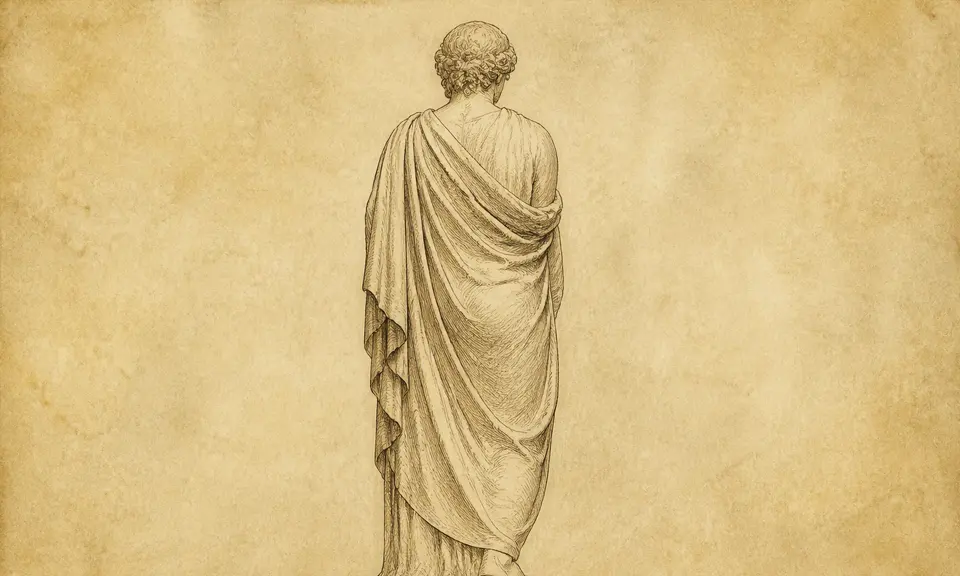
Miller reads the back as the side of a person that is turned away: a nude back means loss of power and makes lending advice or money dangerous, somebody turning and walking away means envy and jealousy at work, and dreaming of one's own back bodes no good. an-Nabulsi reads it as what a man has behind him in both senses — what shows on him, such as his clothing, and what he backs himself with, money laid away or an advantage kept up — and because the Arabic word for the back is also the word for noon, the reading ends on one of the five prayers. Another Arabic reading goes under the skin to the backbone and makes it the seat of steadiness, so that a strong backbone is steadiness and understanding, weakness or strength in it is to be laid to the dreamer's child, and because the same word means the hard part of anything, its hardness is a virgin wife for the unmarried man and a child for the married one. That word also means crucifixion, so that a tree grown in a man's backbone is the cross he was crucified on, while a backbone turned to iron cures the man who was sick in his. Artemidorus reads the back as time rather than as support, and the Arabic reading has the same claim buried in the middle of its list: we hold the back and all the hinder parts to be significant of old age, which is why some rightly call them Pluto's own, so that in whatever state a man dreams he has them, such an old age will he have.
This paragraph was generated by a model. It sums up the sources above, comes from none of them and is attributed to no one.
We hold the back and all the hinder parts to be significant of old age. Hence some rightly call them Pluto's own. And so, in whatever state a man dreams he has them, such an old age will he have.
Passage Book I, 49
A man's back in a dream points to what shows on him or to what he supports himself with; and the back may point to what shows on him, such as clothing, and to what he backs himself with, of money laid away or of an advantage he keeps up. The back points to the outside of the house or of the town or of a school of law; and a broken back is fear or sorrow. And the back may point to the noon, which is one of the five prayers. And whoever sees that his back is black or red, it is feared for him that he will be beaten upon it. And if he saw it fat and white and shining, it points to the renewing of fine clothes; and perhaps that points to his backing himself with knowledge, or with a child, or with an authority that strengthens his back, or with a dwelling or a house; and perhaps he put his wife away by the back-oath. And if his back was branded with fire, it points to his miserliness and to his withholding of what is God's due. And the man's back is that by which he backs himself and the place of his strength, and for the slave it is his master. And if he saw that his back is bent, a misfortune struck him. And if he saw his friend's back, his friend turns his face from him. And if he saw his enemy's back, he is safe from his evil. And if he saw a woman's back, and she was ascribed to the world and was an old woman, then the world turns away from him; and if she was middle-aged, then he is seeking a matter that has grown hard for him and has turned from him; and if she was young, then he waits for a good that is a little slow in reaching him. And the back points to old age, and so do all the hinder limbs. And whoever sees a bending in his back from pain becomes poor and grows old. And the pain of the back points to the death of a brother. And the back is a man to whom he resorts in his affairs, and he is a man of rank and money; and whatever happens in it of pain or of lack, it is the man's refuge and his chief on whom he leans. And it is said the back is purity or a coverlet, so whatever happens in the back, it is the coverlet or the cleanness of the garment, and likewise the reverse. And whoever sees that his back pains him, his chief on whom he leans is imprisoned. And whoever sees that he carries on his back a heavy load, that is a great debt; and it is said the heavy load is a bad neighbour. And whoever sees his back broken, it is the going of his strength and his power, or his perishing, or the perishing of his keeper or his master. And the heavy load upon the back is care or sins or burdens. And whoever sees that he carries coffins or wares upon his back, they are debts that come up upon him. And when he sees that he carries sins, he carries backbiting and talebearing and he passes on lies. And whoever sees his back broken and he was sick, the one who was a back to him died, or it pointed to his poverty and to the scantness of what is in his hand. And it is said the heavy load upon the back is many dependents and little money. And whoever sees a person hunchbacked, it points to an increase of his money or to the length of his life, and it may point to the multitude of his dependents and his offspring.
Section letter ẓa
A man who is leaned upon, a strong one. Whoever sees his backbone strong is granted steadiness, because the backbone is the seat of steadiness. Whoever sees weakness or strength in his backbone, let him lay that to his child. Whoever sees his backbone strong is granted understanding — and it is said, a strong child. And perhaps the backbone points to crucifixion; and the hard of every thing is called by the same word, so that its strength and its hardness are a sign of a virgin wife for the unmarried man, and of a child for the married one. And whoever had a tree grow in his backbone was crucified upon it. And if he was sick in his backbone and saw that his backbone had turned to iron, he recovered from his illness.
Section letter ṣad
To dream of seeing a nude back, denotes loss of power. Lending advice or money is dangerous. Sickness often attends this dream. To see a person turn and walk away from you, you may be sure envy and jealousy are working to your hurt. To dream of your own back, bodes no good to the dreamer.