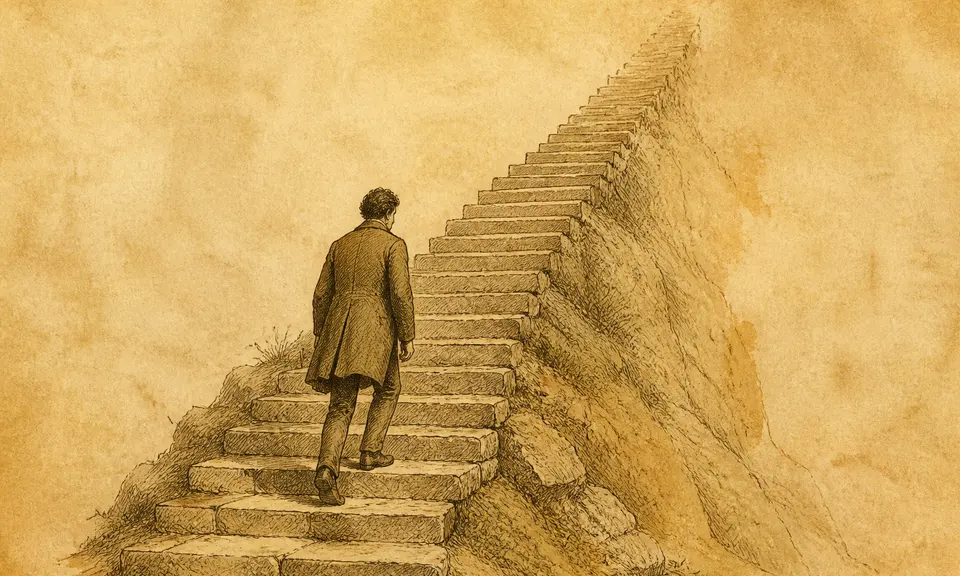
Ascend

2 readings from 2 sources.

The image was generated by a model. It is not a period engraving and comes from none of the sources.

Miller reads the ascent as a test of footing: reach the top of the steps without stumbling and it is good, stumble and there are obstacles to clear before the day yields anything. an-Nabulsi reads it as a measure, and the measure cuts both ways — whoever comes to a height will fall in the measure of that height. Climb to the stars and become one of the stars men steer by, and you get a great office; climb a mountain and it is grief and a journey; climb a pass and it is rule bought with weariness. The mountain is the end of what you seek and you reach it in the measure of how far you were seen to climb. And an ascent on level ground, which costs effort and gains no height, is hardship with no good in it at all.

This paragraph was generated by a model. It sums up the sources above, comes from none of them and is attributed to no one.

Arabic dream book

Ascending is the opposite of descending: whoever comes to a height, his fall will be in the measure of his height; and perhaps it points to his wronging himself. And whoever sees that he ascended to heaven until he reached its stars and turned into one of the stars men steer by attains an office and a noble, great headship. And if he climbed a mountain, it is grief and a journey. Ascending is raising and descending is lowering. And if he climbed a pass, it is elevation and rule with weariness. And if he sees that he climbed the mountain, the mountain is the end of what he seeks, and he reaches it in the measure of how far he saw himself climb, until he stands level on top. And every ascent a man sees — a mountain, a pass, a hill, a roof or anything else — means he gets what he is seeking. And an ascent on the level is hardship, and there is no good in it.

Section letter ṣad

The Perfuming of Mankind in the Interpretation of Dreams

Abd al-Ghani al-Nabulsi

before 1731; first printed Cairo 1858 · Arab-Islamic

carries the ancient tradition after Artemidorus

About this source

An Arabic dream book by the Damascene scholar al-Nabulsi, an alphabetical dictionary of two and a half thousand headwords. It draws on the ancient tradition directly: Artemidorus was translated into Arabic by Hunayn ibn Ishaq in the ninth century. The readings here almost always address the dreamer’s standing, property and faith rather than their feelings.

Rights: public domain

Where the text is from: https://shamela.ws/book/1217

Miller

If you reach the extreme point of ascent, or top of steps, without stumbling, it is good; otherwise, you will have obstacles to overcome before the good of the day is found.

Ten Thousand Dreams Interpreted; Or, What's in a Dream

Gustavus Hindman Miller

1901 · American Victorian

carries fragments of the ancient tradition without its system

About this source

An American dream book, the only one here that knows the telephone, the railroad or the elevator. Doctrinally it is the most degraded: it keeps fragments of the ancient tradition without the system that once held them together.

Rights: public domain

Where the text is from: https://www.gutenberg.org/ebooks/926