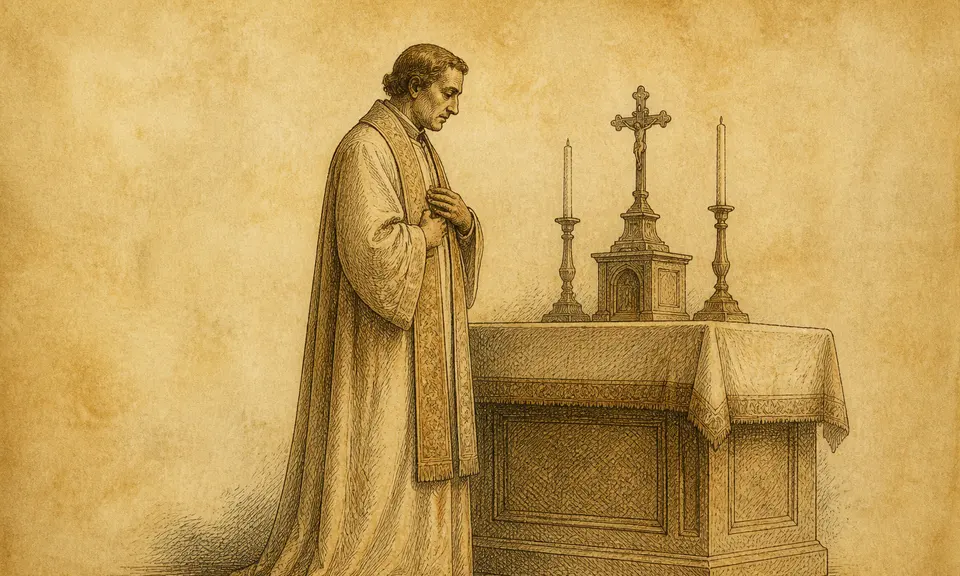
To be a priest and to receive a priesthood from the people is good for everyone except those who are in hiding: for priests are conspicuous.
Passage Book II, 30
4 readings from 2 sources.
Two books and opposite starting points. Artemidorus holds a priesthood to be good: to receive one from the people is good for everyone except those in hiding, because priests are conspicuous. He then sorts by the god — whatever god a man supposes himself priest of, such will be the good that comes about for him, or it will come from men or women of that kind. And one restriction is hard and runs both ways: every priesthood and every office in which a woman has no part foretells death for a woman who dreams she holds it, and the same foretells death for a man who dreams he holds a priesthood or an office in which a man has no part. Miller begins by calling the priest an augury of ill and stays there: in the pulpit he denotes sickness and trouble; a woman who dreams she is in love with a priest is warned of deceptions and an unscrupulous lover; his making love to her brings reproach for her love of gaiety and practical joking; confessing to him denotes humiliation and sorrow. He then turns the reading on the dreamer: the priest is his spiritual adviser, and any dream of his professional presence is a warning against the dreamer's own imperfections — only in social circles do the same rules apply as to other friends, unless he rises before you as a spectre. One book reads the priesthood as a standing that can be got; the other reads the priest as a visitor who never brings good.
This paragraph was generated by a model. It sums up the sources above, comes from none of them and is attributed to no one.
To be a priest and to receive a priesthood from the people is good for everyone except those who are in hiding: for priests are conspicuous.
Passage Book II, 30
Whatever god a man supposes himself to be priest of, such will be the good that comes about for him, or it will come from men or women of that kind.
Passage Book II, 30
Every priesthood and every office in which a woman has no part, if a woman supposes that she holds the priesthood or the office, foretells death for her; and again, every priesthood and every office in which a man has no part, if a man supposes that he holds the priesthood or the office, likewise foretells death for him.
Passage Book II, 30
A priest is an augury of ill, if seen in dreams. If he is in the pulpit, it denotes sickness and trouble for the dreamer. If a woman dreams that she is in love with a priest, it warns her of deceptions and an unscrupulous lover. If the priest makes love to her, she will be reproached for her love of gaiety and practical joking. To confess to a priest, denotes that you will be subjected to humiliation and sorrow. These dreams imply that you have done, or will do, something which will bring discomfort to yourself or relatives. The priest or preacher is your spiritual adviser, and any dream of his professional presence is a warning against your own imperfections. Seen in social circles, unless they rise before you as spectres, the same rules will apply as to other friends. See Preacher.