Labor

2 readings from 2 sources.

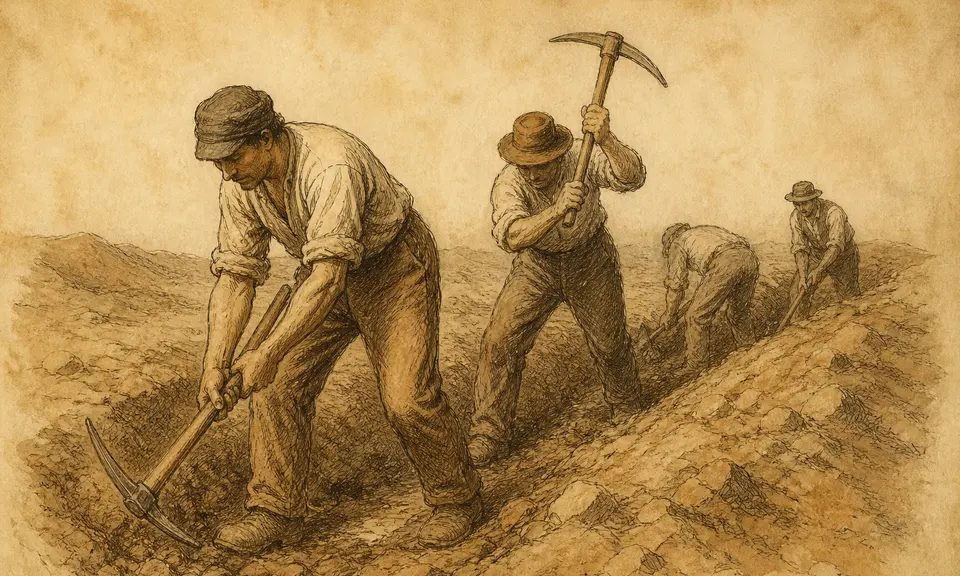
The image was generated by a model. It is not a period engraving and comes from none of the sources.

Miller reads the labour by who is doing it. Domestic animals under heavy burdens mean the dreamer will prosper and be unjust to the people who work for him; men toiling mean profitable work and robust health; labouring yourself is a favourable outlook for a new enterprise and, for a farmer, bountiful crops. an-Nabulsi reads the labourer as a man who can be two things at once: poverty and riches, the patient carrier of another's burden, and the man who pieces speech together and prettifies it, or mixes the lawful with the forbidden. Idle, he sets people against one another for what he can take out of it; at work, his doing is God's doing. And then the exact image: the dust that falls on him is the measure of what he gains, and if no dust fell, he gained nothing.

This paragraph was generated by a model. It sums up the sources above, comes from none of them and is attributed to no one.

Arabic dream book

He is in a dream a sign of poverty and of riches; and perhaps he points to travel and to going to and fro in search of a living, and to the man who carries another's burden with patience for the state he is in. And perhaps seeing him points to the piecing together of speech and the prettying of it, or to the man who mixes the lawful with the forbidden. And the labourer is a man who stirs people up one against another for a benefit he takes out of it — that is, when he does nothing himself. And when he does do something, his doing is the doing of God. If the dust falls on him, he gains in the measure of the dust that fell; and if no dust fell on him, he gained nothing by it. And if he sees the labourer pulling down houses and walls and mixing the one into the other, desolation falls between the men of that place, or they die. And if he sees that he does something with his own hand, such as digging with a pick, his doing is the doing of God, whatever it is, good or evil. And the pick is a man who draws people to himself and gets into the root of everything.

Section letter fa

The Perfuming of Mankind in the Interpretation of Dreams

Abd al-Ghani al-Nabulsi

before 1731; first printed Cairo 1858 · Arab-Islamic

carries the ancient tradition after Artemidorus

About this source

An Arabic dream book by the Damascene scholar al-Nabulsi, an alphabetical dictionary of two and a half thousand headwords. It draws on the ancient tradition directly: Artemidorus was translated into Arabic by Hunayn ibn Ishaq in the ninth century. The readings here almost always address the dreamer’s standing, property and faith rather than their feelings.

Rights: public domain

Where the text is from: https://shamela.ws/book/1217

Miller

To dream that you watch domestic animals laboring under heavy burdens, denotes that you will be prosperous, but unjust to your servants, or those employed by you. To see men toiling, signifies profitable work, and robust health. To labor yourself, denotes favorable outlook for any new enterprise, and bountiful crops if the dreamer is interested in farming.

Ten Thousand Dreams Interpreted; Or, What's in a Dream

Gustavus Hindman Miller

1901 · American Victorian

carries fragments of the ancient tradition without its system

About this source

An American dream book, the only one here that knows the telephone, the railroad or the elevator. Doctrinally it is the most degraded: it keeps fragments of the ancient tradition without the system that once held them together.

Rights: public domain

Where the text is from: https://www.gutenberg.org/ebooks/926